
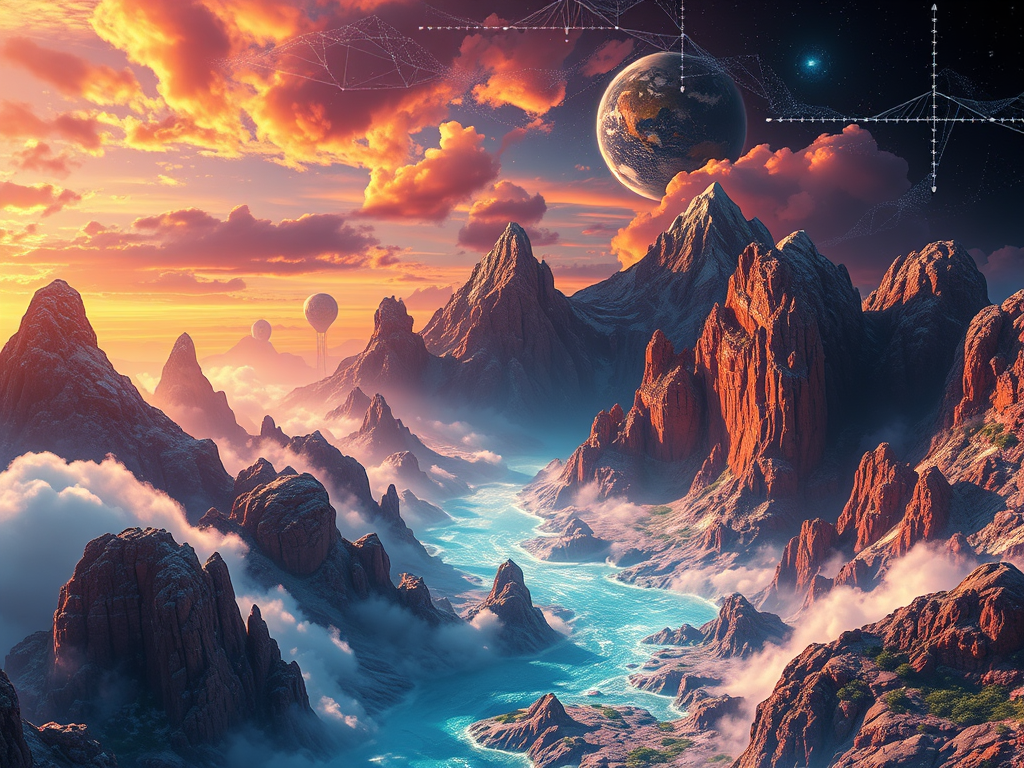
The world of digital art has been revolutionized by Artificial Intelligence (AI) image generators, tools that can conjure stunning visuals from mere text descriptions. What once required hours of meticulous manual effort by skilled artists can now be achieved in seconds, opening up a new frontier for creativity and design. But how do these seemingly magical tools function? Beneath their user-friendly interfaces lies a complex interplay of sophisticated algorithms, vast datasets, and iterative refinement processes. Understanding these underlying “secrets” is key to not only appreciating their capabilities but also to mastering the art of prompt engineering and truly harnessing their power.
From generating photorealistic landscapes to abstract dreamscapes, AI image generators are fundamentally changing our perception of what’s possible in visual creation. They are not merely copying existing images; rather, they are learning the intricate relationships between concepts, styles, and visual elements from colossal datasets, enabling them to synthesize entirely novel compositions. This article will demystify the mechanics of AI image generation by revealing ten crucial insights, empowering you to unlock your artistic potential and create breathtaking digital art.
1. The Foundation: Massive Datasets and Pattern Recognition
At the heart of every AI image generator lies an enormous dataset, often comprising billions of images paired with descriptive text captions. Think of it as an immense digital library where every picture has a detailed label describing its contents, style, and context. These datasets are meticulously curated, though often scraped from the internet, meaning the AI learns from a vast array of human-created imagery. The “secret” here is that the AI doesn’t “see” images as humans do; it interprets them as complex arrangements of numerical data—pixels, colors, textures, and shapes. Through countless hours of training, sophisticated neural networks analyze these numerical representations, identifying intricate patterns and correlations between the textual descriptions and the visual features. This pattern recognition is the bedrock upon which all AI image generation is built, allowing the AI to understand that the word “sunset” relates to warm hues, orange skies, and silhouettes, or that “Baroque painting” implies specific brushstrokes and dramatic lighting.
2. Generative Models: From GANs to Diffusion Magic
The primary “engine” behind AI image generation is a type of machine learning model known as a “generative model.” Historically, Generative Adversarial Networks (GANs) were dominant. GANs involve two competing neural networks: a “generator” that creates images from random noise and a “discriminator” that tries to distinguish between real images and those created by the generator. Through this adversarial training, both improve, leading to increasingly realistic outputs. However, the latest breakthrough comes from Diffusion Models. These models work by taking an image and progressively adding noise to it until it becomes pure static. During training, the model learns to reverse this process, step-by-step, effectively learning how to “denoise” images. When generating a new image, the process is inverted: the model starts with random noise and iteratively refines it, removing noise and adding details based on the input prompt, until a coherent image emerges. This “denoising” process is a key secret to the remarkably high quality and creative control seen in modern AI art.
3. Text Embeddings: Translating Words into Visual Concepts
For an AI to turn your textual prompt (“A majestic dragon flying over a futuristic city at sunset, in the style of a cyberpunk anime”) into an image, it first needs to understand what those words mean visually. This is where “text embeddings” come in. Large Language Models (LLMs) are used to convert words and phrases into numerical vectors in a high-dimensional space. Think of this space as a giant map where words with similar meanings or visual associations are clustered close together. So, “dragon” and “wyvern” might be close, and “sunset” and “dusk” would also be neighbours. This numerical representation, known as an embedding, captures the semantic meaning of your prompt and allows the image generation model to “interpret” your textual instructions as specific visual attributes, guiding the generation process to align the output with your desired concept. The quality of these text embeddings is a vital “secret” for accurate and creative interpretation of user prompts.
4. Latent Space: The AI’s Canvas of Imagination
Imagine a vast, abstract multi-dimensional space where every possible image, concept, and style exists as a unique point. This is the “latent space” (or latent manifold) that AI image generators operate within. It’s not a literal space you can see, but a mathematical representation where the AI learns and stores its understanding of the visual world. When you provide a prompt, the AI translates it into a specific location or region within this latent space. The image generation process then involves navigating or sampling from this space. Diffusion models, for example, might start with random noise (a random point in latent space) and gradually move towards the region corresponding to your prompt, iteratively refining the image until it “looks like” the desired output. Understanding latent space is crucial because it’s where the AI’s “creativity” manifests, as it interpolates between learned concepts to generate novel visuals that weren’t explicitly in its training data.
5. Iterative Refinement: The Journey from Noise to Art
Creating a stunning image isn’t a one-shot process for AI generators; it’s an iterative journey of refinement. Especially with Diffusion Models, the process begins with what looks like pure visual noise (like static on an old TV screen). Over hundreds or even thousands of small, sequential steps, the AI gradually transforms this noise into a coherent image. In each step, the model predicts and removes a tiny bit of noise, guided by the textual prompt and its learned understanding of visual patterns. This is akin to a sculptor slowly chipping away at a block of marble, or a painter adding layers of detail to a canvas. The iterative nature allows for progressive improvement and the emergence of intricate details, making the “secret” of this step-by-step transformation critical to the high fidelity and artistic quality of the final output. The longer and more refined the process, generally, the better the image.
6. Prompt Engineering: The Art of Speaking to AI
The magic of AI image generation often lies not just in the algorithms themselves, but in the human ability to communicate effectively with them. This is known as “prompt engineering,” and it’s perhaps the biggest “secret” to achieving precise and stunning results. A prompt is your instruction to the AI, and crafting a good one is an art form. It’s about being specific yet imaginative, using descriptive language, and sometimes including stylistic cues. Instead of “a dog,” try “a fluffy golden retriever puppy playing in a sun-drenched field, photorealistic, 8K, highly detailed, golden hour lighting, cinematic.” Good prompts leverage keywords for style (e.g., “Impressionist,” “cyberpunk,” “oil painting”), technical details (e.g., “8K,” “cinematic lighting”), and emotional tones (e.g., “serene,” “dramatic”). Experimentation and iterative refinement of prompts are essential to unlock the full potential of these generative AI art tools.
7. Negative Prompts: Telling the AI What Not to Do
While positive prompts tell the AI what you want to see, “negative prompts” are an equally powerful, often overlooked, “secret” for controlling the output. A negative prompt tells the AI what elements or qualities to avoid in the generated image. This is incredibly useful for refining results and eliminating undesirable artifacts or styles. For example, if your image of a person keeps showing distorted hands, you can add “ugly, deformed, disfigured, extra fingers, malformed hands” to your negative prompt. If you’re aiming for realism but get something too artistic, you might use “drawing, painting, illustration, cartoon” as negative prompts. This ability to guide the AI by exclusion allows for much finer control over the final image, helping to remove common AI “hallucinations” or undesirable traits that the model might otherwise introduce, leading to cleaner and more accurate artistic generation.
8. Seed Values: Reproducibility and Variation
When you generate an image, many AI tools allow you to specify a “seed” value, usually a number. This seed is a crucial “secret” for reproducibility and for exploring variations. Think of the seed as the initial random state from which the image generation process begins. If you use the same prompt and the same seed, you should get an identical (or nearly identical) image every time. This is invaluable for refining a specific piece without losing your progress. However, changing just the seed value while keeping the prompt the same will generate a completely different image, yet one that still adheres to the prompt’s instructions. This allows artists to quickly explore numerous creative variations of a single concept, discovering unexpected and appealing results simply by iterating through different seed numbers, making it a powerful tool for artistic exploration and image control.
9. ControlNet and Image-to-Image: Directing the AI’s Hand
Beyond just text prompts, advanced AI image generators offer more direct control mechanisms, such as ControlNet and Image-to-Image capabilities. ControlNet allows users to impose structural or stylistic constraints on the generated image using an input image. For example, you can provide a rough sketch or a silhouette, and ControlNet will ensure the generated image adheres to that underlying structure, while still generating new details based on your text prompt. Image-to-Image (Img2Img) takes an existing image and transforms it based on a new prompt or style. You could take a photograph of your cat and ask the AI to “turn this into a cyberpunk warrior cat,” and it would use the original image’s composition while applying the new style. These features are key “secrets” for artists who want to blend their traditional artistic input with the power of AI, allowing for far more precise control over composition, pose, and overall aesthetics.
10. Ethical Considerations and the Human Element: The Unspoken Secret
While technically not a “secret” of how they work, the ethical considerations surrounding AI image generators are an undeniable part of their existence and a crucial aspect for any digital artist to understand. These tools are trained on vast datasets, often without explicit consent from the original artists whose work is included. This raises questions of copyright, ownership, and fair use. Furthermore, AI models can perpetuate biases present in their training data, leading to stereotypical or problematic outputs. The “secret” here is that despite their power, AI image generators are tools, and the ultimate creative responsibility and ethical stewardship lie with the human operator. Understanding the limitations, biases, and legal implications is as important as mastering the technical aspects. The best digital art created with AI is still a collaboration between human vision and algorithmic capability, where human judgment and ethical awareness remain paramount.
The journey into understanding AI image generators reveals a fascinating blend of art and science. From the foundational datasets and generative models to the nuances of prompt engineering and ethical considerations, each element plays a vital role in bringing digital art to life. As these technologies continue to evolve, mastering these “secrets” will empower you to push the boundaries of your creativity and shape the future of visual expression.
Further Reading:
- “Generative Deep Learning: Teaching Machines to Paint, Write, Compose, and Play” by David Foster
- “The Artist in the Machine: The World of AI-Powered Creativity” by Arthur I. Miller
- “AI Narratives: A History of Imagining Artificial Intelligence” by Stephen Cave and Kanta Dihal
- “Applied Deep Learning: A Case-Based Approach to Understanding Deep Neural Networks” by Umberto Michelucci
- “Artificial Intelligence: A Guide for Thinking Humans” by Melanie Mitchell
Here at Zentara.blog, our mission is to take those tricky subjects and unlock them, making knowledge exciting and easy to grasp for everyone. But the adventure doesn’t stop on this page! We’re constantly exploring new frontiers and sharing discoveries across the digital universe. Want to dive deeper into more mind-bending Top 10s and keep expanding your world? Come join us on our other platforms – we’ve got unique experiences waiting for you on each one!
Get inspired by visual wonders and bite-sized facts: See the world through Zentara’s eyes on Pinterest!
Pin our fascinating facts and stunning visuals to your own boards. Explore Pins on Pinterest: https://uk.pinterest.com/zentarablog/
Discover quick insights and behind-the-scenes peeks: Hop over to Tumblr for snippets, quotes, and unique content you won’t find anywhere else. It’s a different flavour of discovery! Follow the Fun on Tumblr: https://www.tumblr.com/zentarablog
Ready for deep dives you can listen to or watch? We’re bringing our accessible approach to video and potentially audio! Subscribe to our YouTube channel and tune into future projects that make learning pop! Subscribe on YouTube: https://www.youtube.com/@ZentaraUK
Seeking even more knowledge in one place? We’ve compiled some of our most popular topic deep dives into fantastic ebooks! Find them on Amazon and keep the learning journey going anytime, anywhere. Find Our Ebooks on Amazon: https://www.amazon.co.uk/s?k=Zentara+UK&ref=nb_sb_noss
Connect with us and fellow knowledge seekers: Join the conversation on BlueSky! We’re sharing updates, thoughts, and maybe even asking you what wonders we should explore next. Chat with Us on BlueSky: https://bsky.app/profile/zentarablog.bsky.social
Perfect for learning on the move! We post multiple 10-minute podcasts per day on Spotify. Pop on your headphones and fill your day with fascinating facts while you’re out and about! Listen on Spotify: https://open.spotify.com/show/3dmHbKeDufRx95xPYIqKhJ
Follow us on Instagram for bytesize knowledge! We post multiple posts per day on our official Instagram account. https://www.instagram.com/zentarablog/ Every click helps us keep bringing honest, accessible knowledge to everyone. Thanks for exploring with us today – see you out there in the world of discovery!

Leave a Reply