
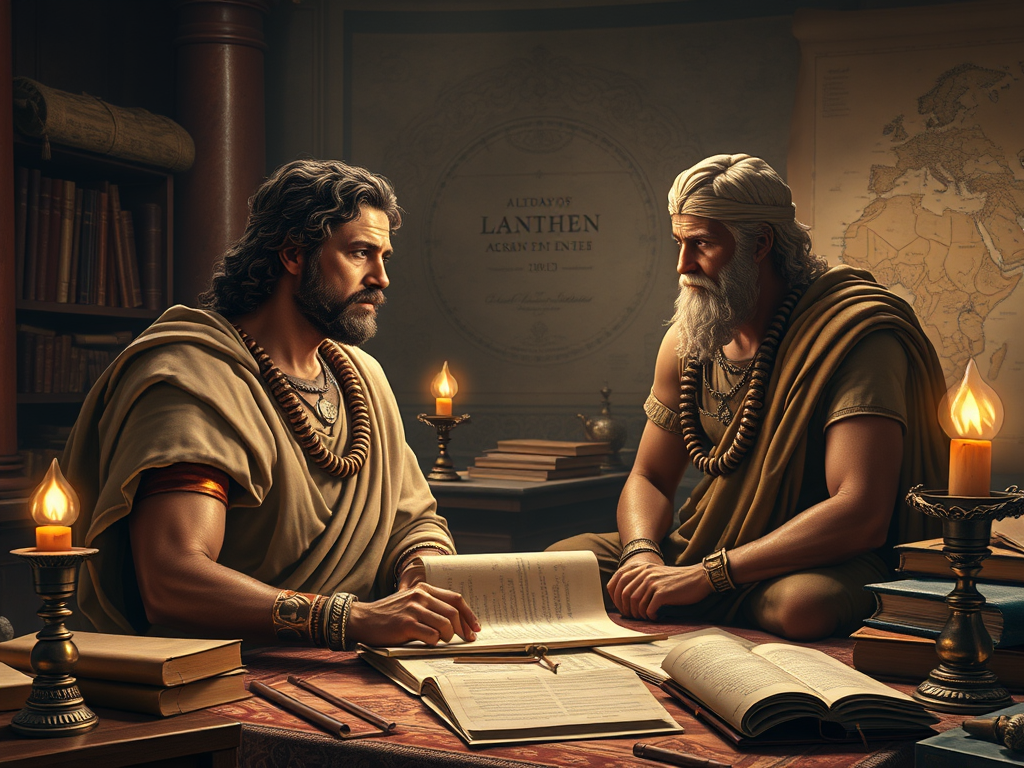
In the grand theatre of human history, few names echo with the same force and fascination as Alexander the Great. In just over a decade, this Macedonian king, a formidable military commander, redrew the map of the known world, creating one of the largest empires in history. His story is more than a simple tale of conquest; it is a saga of ambition, strategic brilliance, cultural fusion, and a legacy that has captivated historians, leaders, and artists for over two millennia. To understand Alexander is to explore the very essence of monumental achievement and the enduring impact one individual can have on the course of civilisation. This article delves into the ten pivotal aspects of his life and reign that cemented his status as a legendary figure. We willjourney from his royal tutelage to his final, mysterious days, uncovering the key moments that forged the man and the myth.
1. The Royal Tutelage: Forged by the Mind of Aristotle
Before he was a conqueror of nations, Alexander was a student of the brilliant philosopher Aristotle. At the secluded Lyceum of Mieza, the young prince and his companions were immersed in a world of intellectual rigour. Aristotle, a towering figure in Western philosophy, did not merely lecture on abstract concepts; he instilled in Alexander a deep appreciation for science, medicine, literature, and political theory. This was not a simple education; it was a sharpening of the mind that would later inform his leadership and his vision for a new world. The seeds of the Hellenistic period, a time of unprecedented cultural exchange, were sown in these early years. It was Aristotle who introduced Alexander to the epic tales of Homer, with the hero Achilles becoming a lifelong inspiration for the young prince. This education gave him a unique perspective; he was not just a warrior king but a leader who understood the power of ideas and the importance of knowledge. This foundation would be crucial in his administration of a vast and diverse empire, allowing him to see beyond the battlefield and envision a future where Greek culture could blend with the traditions of the East.
2. Taming Bucephalus: A Legendary Bond is Forged
One of the most enduring stories of Alexander’s youth is the taming of Bucephalus, a wild and magnificent stallion that no one else could ride. While others saw an untameable beast, a young Alexander observed that the horse was afraid of its own shadow. With this simple insight, he turned Bucephalus towards the sun, calming the animal and riding him to the astonishment of all, including his father, King Philip II. This event was more than just a display of bravery; it was a demonstration of Alexander’s keen powers of observation and his ability to find a solution where others saw only an insurmountable problem. Bucephalus became his faithful companion throughout his campaigns, a living symbol of his master’s indomitable spirit. Their bond was legendary, and when the horse died of old age and battle wounds in India, a grieving Alexander founded the city of Bucephala in his honour. This story, passed down through the ages, encapsulates the charisma and insight that would later allow him to lead armies and win the loyalty of his men. It’s a powerful metaphor for his entire career: seeing what others miss and achieving the seemingly impossible through intellect and courage.
3. The Gordian Knot: A Decisive Stroke of Genius
In the Phrygian city of Gordium, an ancient ox-cart was bound to a post by a complex and intricate knot. According to prophecy, whoever could untie this “Gordian Knot” would be destined to rule all of Asia. Many had tried and failed, their fingers fumbling with the tangled ropes. When presented with the challenge, Alexander did not waste time with conventional methods. After a brief and fruitless attempt to find the end of the rope, he declared, “It makes no difference how it is loosed,” and with a single, decisive stroke of his sword, he severed the knot. This act, whether a display of inspired problem-solving or a moment of frustration, has become a timeless metaphor for a bold and direct solution to a seemingly intractable problem. It was a clear statement of his leadership style: where tradition and complexity created obstacles, Alexander would forge his own path. This event, occurring early in his Persian campaign, sent a powerful message to both his followers and his enemies. It was a demonstration of a mind that was not bound by convention, a leader who could think outside the box to achieve his ambitious goals.
4. The Battle of Gaugamela: Masterclass in Military Strategy
The Battle of Gaugamela in 331 BC was the decisive confrontation between Alexander’s Macedonian forces and the vast army of the Persian King Darius III. Outnumbered but not outmanoeuvred, Alexander showcased his unparalleled military genius. Understanding the terrain and the composition of the Persian army, he employed a brilliant and audacious strategy. He advanced with his army in an oblique formation, drawing the Persian cavalry on the left flank out to the side. This created a gap in the centre of the Persian line, the very opportunity Alexander had been waiting for. Seizing the moment, he led his elite Companion Cavalry in a daring charge directly at Darius. The Persian king, witnessing the ferocity of the Macedonian advance, fled the battlefield, and with his departure, the Persian army’s morale shattered, leading to a comprehensive victory for Alexander. The military tactics of Alexander the Great at Gaugamela are still studied in military academies today. This battle was not just a victory; it was the moment the Achaemenid Empire effectively fell, and Alexander became the undisputed ruler of Asia. It was a testament to his ability to remain calm under immense pressure and to execute complex strategies with precision and courage.
5. The Siege of Tyre: Unwavering Determination
The island city of Tyre, a powerful Phoenician port, presented Alexander with one of his greatest military challenges. Confident in their formidable naval power and impenetrable walls, the Tyrians refused to surrender. Where others might have bypassed the city, Alexander was determined to conquer it. His solution was as audacious as it was laborious: he would build a causeway, a land bridge, across the sea to the island. For seven months, his engineers and soldiers toiled, facing constant attacks from the Tyrian navy. When the causeway was finally complete, Alexander’s forces, with the help of a newly assembled fleet, launched a relentless assault. The fall of Tyre was a brutal affair, but it demonstrated Alexander’s unwavering resolve and his innovative approach to siege warfare. It also secured his control over the entire eastern Mediterranean coast, neutralizing the Persian fleet and paving the way for his invasion of Egypt. The Siege of Tyre stands as a powerful example of Alexander’s refusal to accept defeat and his ability to overcome any obstacle, no matter how daunting.
6. Founding Alexandria: A Beacon of Culture and Learning
Of the many cities Alexander founded, none is more famous or enduring than Alexandria in Egypt. Established in 331 BC, it was strategically placed at the mouth of the Nile, destined to become a major centre of trade and culture. Alexander envisioned a city that would be a crossroads of civilizations, a place where Greek knowledge and traditions would mingle with the ancient wisdom of Egypt and the East. His vision became a reality. Under the Ptolemaic Kingdom, one of the successor states to his empire, Alexandria flourished, becoming home to the legendary Library of Alexandria, a repository of knowledge from across the ancient world. The city also housed the Musaeum, a research institution that attracted scholars, scientists, and philosophers for centuries. The founding of Alexandria was a pivotal moment in the creation of the Hellenistic world, a testament to Alexander’s understanding that true power lay not just in military conquest but in the cultivation and dissemination of knowledge. The city remains a vibrant metropolis to this day, a lasting monument to its founder’s extraordinary vision.
7. The Spread of Hellenism: A Cultural Revolution
Alexander’s conquests were not merely about acquiring territory; they were about a conscious and deliberate effort to spread Greek culture, language, and ideas throughout his vast empire. This process, known as Hellenization, was a transformative force that shaped the development of civilizations from the Mediterranean to India. As his armies marched eastward, they were followed by Greek architects, administrators, artists, and philosophers. Greek became the lingua franca of the elite, facilitating trade and communication across diverse regions. While Alexander’s successors would continue this policy, it was his initial vision and actions that set this cultural revolution in motion. This was not a one-way street; Greek culture was also influenced by the traditions of the East, leading to a rich and dynamic cultural fusion. The emergence of Greco-Buddhism in the East is a striking example of this synthesis. The legacy of Alexander the Great is in many ways the story of Hellenism, a period of unprecedented cultural exchange that laid the groundwork for the Roman Empire and continues to influence the world today.
8. The March to India and the Mutiny at the Hyphasis
After a decade of relentless campaigning, Alexander’s army reached the Hyphasis River in India. Having conquered the Persian Empire and fought his way through fierce resistance in what is now modern-day Pakistan, Alexander was eager to press on and explore the lands beyond. However, his loyal but exhausted troops had reached their limit. They had been away from their homes for years, had endured incredible hardships, and were now faced with the prospect of fighting yet another powerful kingdom. In a rare act of defiance, they refused to go any further. For three days, a frustrated and angry Alexander secluded himself in his tent, but his men would not be swayed. Finally, he relented, agreeing to turn back. This moment is significant because it shows a rare instance where Alexander’s ambition was checked by the will of his soldiers. It is a reminder that even the most powerful leaders are ultimately reliant on the support of their followers. The return journey was arduous, with Alexander himself being severely wounded, but it marked a turning point in his campaigns and in his relationship with his army.
9. The Mystery of His Death: An Untimely End to a Grand Vision
In 323 BC, at the age of just 32, Alexander the Great died in the palace of Nebuchadnezzar II in Babylon. The exact cause of his death remains one of history’s great mysteries. Was it malaria, typhoid fever, or the effects of his numerous battle wounds and a lifetime of heavy drinking? Or was he poisoned by his rivals, who feared his growing power and autocratic tendencies? Ancient sources are contradictory, and modern historians continue to debate the possibilities. His death was as dramatic and consequential as his life. He left behind a vast empire with no clear heir, famously declaring on his deathbed that his kingdom was “to the strongest.” This set the stage for the Wars of the Diadochi, a series of conflicts between his generals that would ultimately lead to the fragmentation of his empire into several Hellenistic kingdoms, including the Ptolemaic Kingdom in Egypt and the Seleucid Empire in the East. The question of “how did Alexander the Great die?” has fascinated people for centuries, not just because of the mystery, but because his untimely death left the world to wonder what more he might have achieved.
10. The Enduring Legacy: Shaping the Course of History
The legacy of Alexander the Great is immense and multifaceted. Militarily, he is considered one of the greatest commanders in history, his strategies and tactics studied for millennia. Politically, his conquests shattered the old world order, ushering in the Hellenistic period and paving the way for the rise of Rome. Culturally, he was the architect of a new era of interaction between East and West, a process that had a profound and lasting impact on art, religion, philosophy, and science. The question of “was Alexander the Great a good leader?” is complex. He was a brilliant strategist and a charismatic leader, but also a ruthless conqueror responsible for the deaths of countless people. Yet, his vision of a connected world, a world where ideas and cultures could intermingle, was revolutionary. He remains a figure of immense fascination, a symbol of ambition, achievement, and the enduring power of a single individual to shape the destiny of the world. His story is a powerful reminder that history is not just a series of inevitable events, but is often forged by the will and vision of extraordinary individuals.
Further Reading
For those wishing to delve deeper into the life and times of this remarkable historical figure, the following books offer accessible yet scholarly accounts:
- Alexander the Great by Robin Lane Fox
- The Campaigns of Alexander by Arrian
- Alexander the Great: A New History by a collective of scholars, edited by Waldemar Heckel and Lawrence A. Tritle
- Alexander of Macedon, 356-323 B.C.: A Historical Biography by Peter Green
- The Life of Alexander the Great by Plutarch
Here at Zentara.blog, our mission is to take those tricky subjects and unlock them, making knowledge exciting and easy to grasp for everyone. But the adventure doesn’t stop on this page! We’re constantly exploring new frontiers and sharing discoveries across the digital universe. Want to dive deeper into more mind-bending Top 10s and keep expanding your world? Come join us on our other platforms – we’ve got unique experiences waiting for you on each one!
Get inspired by visual wonders and bite-sized facts: See the world through Zentara’s eyes on Pinterest!
Pin our fascinating facts and stunning visuals to your own boards. Explore Pins on Pinterest: https://uk.pinterest.com/zentarablog/
Discover quick insights and behind-the-scenes peeks: Hop over to Tumblr for snippets, quotes, and unique content you won’t find anywhere else. It’s a different flavour of discovery! Follow the Fun on Tumblr: https://www.tumblr.com/zentarablog
Ready for deep dives you can listen to or watch? We’re bringing our accessible approach to video and potentially audio! Subscribe to our YouTube channel and tune into future projects that make learning pop! Subscribe on YouTube: https://www.youtube.com/@ZentaraUK
Seeking even more knowledge in one place? We’ve compiled some of our most popular topic deep dives into fantastic ebooks! Find them on Amazon and keep the learning journey going anytime, anywhere. Find Our Ebooks on Amazon: https://www.amazon.co.uk/s?k=Zentara+UK&ref=nb_sb_noss
Connect with us and fellow knowledge seekers: Join the conversation on BlueSky! We’re sharing updates, thoughts, and maybe even asking you what wonders we should explore next. Chat with Us on BlueSky: https://bsky.app/profile/zentarablog.bsky.social
Perfect for learning on the move! We post multiple 10-minute podcasts per day on Spotify. Pop on your headphones and fill your day with fascinating facts while you’re out and about! Listen on Spotify: https://open.spotify.com/show/3dmHbKeDufRx95xPYIqKhJFollow us on Instagram for bytesize knowledge! We post multiple posts per day on our official Instagram account. https://www.instagram.com/zentarablog/ Every click helps us keep bringing honest, accessible knowledge to everyone. Thanks for exploring with us today – see you out there in the world of discovery!




Leave a Reply