
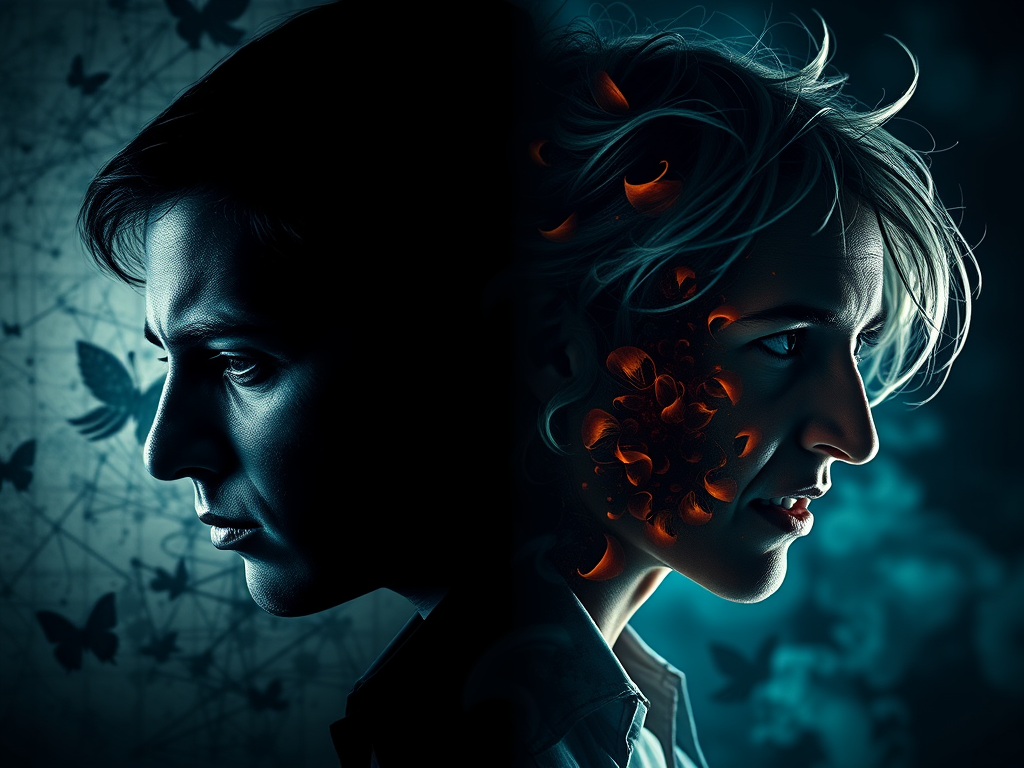
In the chilling corridors of psychological thrillers and the stark reality of criminal justice, the terms “psychopath” and “sociopath” are often used interchangeably, painting a broad-stroked picture of a cold, calculating, and remorseless individual. While both fall under the umbrella of Antisocial Personality Disorder (ASPD) in the Diagnostic and Statistical Manual of Mental Disorders (DSM-5), they are not one and the same. Understanding the nuanced differences is key to demystifying these complex personality structures. Think of it like this: all squares are rectangles, but not all rectangles are squares. Similarly, most psychopaths and sociopaths meet the criteria for ASPD, but they represent distinct variations of the disorder. This exploration will delve into the top 10 traits that distinguish a psychopath from a sociopath, offering a clearer understanding of their inner worlds, motivations, and behaviours.
1. The Origins of the Disorder: Born vs. Made
One of the most fundamental distinctions between psychopathy and sociopathy lies in their perceived origins. Psychopathy is largely considered to be a product of genetics and biology. Brain imaging studies have suggested that psychopaths may have underdeveloped components of the brain responsible for emotional regulation and impulse control. It’s as if the wiring for empathy and emotional connection was never properly installed. This “nature” argument suggests that a psychopath is essentially born, not made. Their condition is often viewed as a neurodevelopmental disorder, with a biological predisposition that makes them incapable of experiencing emotions in the same way most people do.
Conversely, sociopathy is more commonly linked to environmental factors. While a genetic predisposition might exist, it’s often a traumatic or abusive childhood, a chaotic home life, or a lack of positive socialisation that is believed to trigger the development of sociopathic traits. This is the “nurture” side of the coin. Imagine a young plant with the potential for healthy growth being starved of sunlight and water; it will inevitably grow stunted and misshapen. In a similar vein, the emotional and moral development of a sociopath is thought to be derailed by their early life experiences, leading to their antisocial behaviours.
2. The Nature of Their Conscience: Absent vs. Weakened
A defining characteristic that sets psychopaths and sociopaths apart is the state of their conscience. A psychopath is often described as having no conscience whatsoever. The internal voice that guides most people to distinguish between right and wrong, to feel guilt or remorse, is entirely absent. They are morally blind. This isn’t a choice; it’s a fundamental aspect of their psychological makeup. They can understand societal rules and expectations intellectually, but they feel no internal obligation to abide by them. This lack of a moral compass allows them to commit harmful acts without a flicker of guilt, making them particularly dangerous.
A sociopath, on the other hand, is generally considered to have a weakened or underdeveloped conscience. They may have a sense of morality, but it’s flexible and easily overridden by their desires and impulses. A sociopath might know that what they are doing is wrong and may even feel a pang of guilt or remorse afterward, but this is often not enough to deter their behaviour. Their moral compass is faulty and unreliable, pointing them in the direction of self-interest more often than not. This internal conflict, however minimal, is a key differentiator from the moral void of a psychopath.
3. Emotional Capacity: The Icelander and the Volcano
The emotional landscapes of psychopaths and sociopaths are starkly different. A psychopath is often likened to an emotional Icelander – cold, detached, and unable to experience the full spectrum of human emotions. They can mimic emotions, often with startling accuracy, learning to display the appropriate facial expressions and verbal responses in social situations. This is a calculated performance, a mask of sanity they wear to blend in and manipulate others. Underneath this facade, however, there is a profound emotional emptiness. They are incapable of forming genuine emotional attachments and view others as mere objects to be used for their own gratification.
In contrast, a sociopath can be seen as an emotional volcano – volatile, eruptive, and prone to outbursts of anger and rage. While they also struggle with empathy and forming deep connections, they are more capable of experiencing emotions, albeit in a chaotic and often destructive manner. They can form attachments to individuals or groups, but these relationships are often unstable and fraught with conflict. Their emotional instability can make them appear more “human” than a psychopath, but it also makes them unpredictable and potentially violent when their frustrations boil over.
4. The Art of Deception: The Meticulous Planner vs. The Impulsive Liar
Both psychopaths and sociopaths are masters of deceit, but their methods differ significantly. The psychopath is the meticulous planner, a grandmaster of manipulation. Their lies are carefully constructed, their schemes elaborate and long-term. They are patient predators, willing to invest significant time and effort in gaining the trust of their victims before exploiting them. Their charm is often described as superficial and glib, a polished veneer that conceals their true intentions. They are the con artists who can sell you a bridge, the seemingly perfect partners who systematically dismantle your life.
The sociopath, in contrast, is more of an impulsive liar. Their deceptions are often born out of immediate need or a desire to avoid consequences. They are less calculating and more prone to spontaneous acts of dishonesty. Their lies may be less convincing and their schemes more transparent, often unravelling due to their impulsivity and lack of foresight. While they can also be charming and manipulative, their efforts are typically less refined and more easily detected than those of their psychopathic counterparts.
5. Behavioural Patterns: Cold and Calculating vs. Hot-Headed and Erratic
The outward behaviour of psychopaths and sociopaths often reflects their internal emotional states. The psychopath’s actions are typically cold, calculating, and premeditated. They are capable of committing heinous crimes with a chilling level of detachment. Their violence, when it occurs, is often instrumental – a means to an end, rather than an emotional outburst. They can maintain a facade of normality for extended periods, holding down jobs, having families, and appearing to be upstanding members of the community, all while leading a secret life of manipulation and harm.
The sociopath’s behaviour, on the other hand, is more hot-headed, erratic, and impulsive. They are more likely to act on a whim, to engage in reckless behaviour without considering the consequences. Their violence is often reactive, a product of frustration, anger, or a perceived slight. This impulsivity makes it more difficult for them to maintain the same level of social camouflage as a psychopath. They are more likely to have a history of unstable employment, volatile relationships, and frequent run-ins with the law.
6. Social Integration: The Hidden Predator vs. The Obvious Outcast
Due to their ability to mimic emotions and maintain a convincing facade, psychopaths are often highly successful at integrating into society. They can be the charming CEO, the respected surgeon, or the friendly neighbour. Their true nature remains hidden, allowing them to operate in plain sight, manipulating and exploiting those around them without arousing suspicion. They are the wolves in sheep’s clothing, the hidden predators who prey on the trust and goodwill of others.
Sociopaths, with their impulsivity and emotional volatility, find it much more difficult to blend in. They are often the obvious outcasts, the individuals who struggle to hold down a job, maintain stable relationships, or stay on the right side of the law. Their antisocial behaviour is more overt and less easily concealed. While they may still be able to manipulate and charm people in the short term, their erratic nature and inability to control their impulses often lead to their social exclusion.
7. The Capacity for Love and Attachment: Non-Existent vs. Distorted
When it comes to the fundamental human experiences of love and attachment, the distinction between psychopaths and sociopaths is particularly poignant. For a psychopath, the capacity for genuine love and emotional attachment is non-existent. They may feign love and affection to manipulate a partner, but these are merely calculated performances. They see relationships as transactional, a means of acquiring resources, status, or gratification. The concept of a deep, emotional bond is entirely foreign to them.
A sociopath, while also severely impaired in this area, may have a distorted capacity for attachment. They can form bonds with certain individuals, such as a family member or a close friend, but these attachments are often selfish and possessive. Their love, if it can be called that, is conditional and easily withdrawn if their needs are not being met. These relationships are typically turbulent and unhealthy, marked by manipulation and emotional instability.
8. Criminality: The White-Collar Criminal vs. The Street-Level Offender
Both psychopathy and sociopathy are associated with an increased likelihood of criminal behaviour, but the nature of their crimes often differs. Psychopaths, with their cunning and meticulous planning, are more likely to be the white-collar criminals, the masterminds behind complex financial frauds, elaborate scams, and other non-violent but highly destructive crimes. When they do engage in violence, it is often calculated and instrumental, designed to achieve a specific goal.
Sociopaths, with their impulsivity and lack of self-control, are more likely to be the street-level offenders, engaging in crimes of opportunity such as theft, assault, and vandalism. Their criminal acts are often unplanned and driven by immediate gratification or emotional outbursts. This is not to say that sociopaths cannot commit serious, violent crimes, but their criminal careers are often less sophisticated and more chaotic than those of psychopaths.
9. Response to Punishment: Indifferent vs. Potentially Responsive
The way psychopaths and sociopaths respond to punishment is another key area of differentiation. A psychopath is largely indifferent to the threat of punishment. Their lack of fear and their inability to learn from experience mean that traditional forms of discipline, such as imprisonment, have little to no deterrent effect. They may be able to intellectually grasp the consequences of their actions, but this understanding does not translate into a change in their behaviour. They are, in many ways, incorrigible.
A sociopath, on the other hand, may be potentially responsive to punishment, particularly if it is swift, certain, and severe. Their capacity to feel anxiety and fear, albeit in a limited way, means that the prospect of negative consequences can sometimes influence their decision-making. However, their impulsivity and poor judgment often override any deterrent effect. While they may be more amenable to some forms of therapeutic intervention than psychopaths, the prognosis for meaningful change remains guarded.
10. The Mask of Sanity: The Master Actor vs. The Flawed Performer
The concept of the “mask of sanity,” first introduced by psychiatrist Hervey Cleckley, is central to understanding both psychopathy and sociopathy. However, the quality of this mask differs significantly. The psychopath is the master actor, wearing a flawless mask of normality that can deceive even the most astute observers. Their charm, intelligence, and feigned empathy create a convincing illusion of a well-adjusted and likeable individual. This mask is their primary tool of manipulation, allowing them to move through the world undetected.
The sociopath is the flawed performer, their mask of sanity often slipping to reveal the turmoil and anger simmering beneath the surface. Their attempts at charm and manipulation may be less polished and more transparent. Their emotional outbursts and impulsive behaviours frequently crack the facade, exposing their true nature to those around them. While they may be able to deceive some people some of the time, their inability to consistently maintain the illusion of normality makes them more easily identifiable.
In conclusion, while the terms psychopath and sociopath are often used as synonyms for a person who lacks empathy and engages in antisocial behaviour, they represent two distinct psychological constructs with different origins, emotional capacities, and behavioural patterns. Understanding these differences is not merely an academic exercise; it has profound implications for our justice system, our mental health services, and our personal safety. By moving beyond the sensationalised stereotypes and embracing a more nuanced understanding, we can better identify, manage, and perhaps even prevent the harm caused by these complex and challenging individuals.
Further Reading
- “Without Conscience: The Disturbing World of the Psychopaths Among Us” by Dr. Robert D. Hare
- “The Sociopath Next Door” by Dr. Martha Stout
- “Snakes in Suits: When Psychopaths Go to Work” by Dr. Paul Babiak and Dr. Robert D. Hare
- “The Psychopath Test: A Journey Through the Madness Industry” by Jon Ronson
- “The Mask of Sanity” by Dr. Hervey M. Cleckley
Here at Zentara.blog, our mission is to take those tricky subjects and unlock them, making knowledge exciting and easy to grasp for everyone. But the adventure doesn’t stop on this page! We’re constantly exploring new frontiers and sharing discoveries across the digital universe. Want to dive deeper into more mind-bending Top 10s and keep expanding your world? Come join us on our other platforms – we’ve got unique experiences waiting for you on each one!
Get inspired by visual wonders and bite-sized facts: See the world through Zentara’s eyes on Pinterest!
Pin our fascinating facts and stunning visuals to your own boards. Explore Pins on Pinterest: https://uk.pinterest.com/zentarablog/
Discover quick insights and behind-the-scenes peeks: Hop over to Tumblr for snippets, quotes, and unique content you won’t find anywhere else. It’s a different flavour of discovery! Follow the Fun on Tumblr: https://www.tumblr.com/zentarablog
Ready for deep dives you can listen to or watch? We’re bringing our accessible approach to video and potentially audio! Subscribe to our YouTube channel and tune into future projects that make learning pop! Subscribe on YouTube: https://www.youtube.com/@ZentaraUK
Seeking even more knowledge in one place? We’ve compiled some of our most popular topic deep dives into fantastic ebooks! Find them on Amazon and keep the learning journey going anytime, anywhere. Find Our Ebooks on Amazon: https://www.amazon.co.uk/s?k=Zentara+UK&ref=nb_sb_noss
Connect with us and fellow knowledge seekers: Join the conversation on BlueSky! We’re sharing updates, thoughts, and maybe even asking you what wonders we should explore next. Chat with Us on BlueSky: https://bsky.app/profile/zentarablog.bsky.social
Perfect for learning on the move! We post multiple 10-minute podcasts per day on Spotify. Pop on your headphones and fill your day with fascinating facts while you’re out and about! Listen on Spotify: https://open.spotify.com/show/3dmHbKeDufRx95xPYIqKhJFollow us on Instagram for bytesize knowledge! We post multiple posts per day on our official Instagram account. https://www.instagram.com/zentarablog/ Every click helps us keep bringing honest, accessible knowledge to everyone. Thanks for exploring with us today – see you out there in the world of discovery!




Leave a Reply