
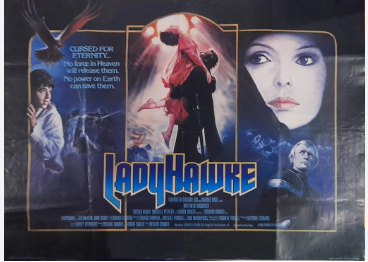
Step into a world of myth, magic, and eternal love. For many of us, the 1985 classic Ladyhawke holds a special place in our hearts. It’s a film that dared to be different, weaving together a breathtaking medieval romance, thrilling adventure, and a surprising rock-and-roll sensibility. The story of the cursed lovers—Captain Etienne of Navarre, who becomes a wolf by night, and the beautiful Isabeau of Anjou, who turns into a hawk by day—is one of cinema’s most unforgettable tales. They are “always together, eternally apart,” a heartbreaking curse that has captivated audiences for decades.
But behind the soaring hawk and the lonesome wolf, beyond the castle walls and moonlit forests, lies a treasure trove of incredible stories. The making of Ladyhawke was an adventure in itself, filled with unexpected challenges, bold creative choices, and moments of pure movie magic. Here at Zentara.blog, we’re peeling back the curtain to reveal the secrets behind this beloved fantasy epic. Prepare to see the film in a whole new light as we uncover 10 things you probably didn’t know about Ladyhawke.

1. A Very Different Navarre and Mouse
It’s almost impossible to imagine anyone other than the stoic Rutger Hauer as Captain Navarre and the charming Matthew Broderick as the thief Phillipe “the Mouse” Gaston. Yet, the film could have looked dramatically different. Initially, director Richard Donner had his sights set on Kurt Russell for the role of Navarre. Russell was a huge star at the time, but scheduling conflicts with another film, The Mean Season, forced him to drop out. Imagine a more swaggering, less melancholic Navarre! After Russell’s departure, Rutger Hauer, fresh from his iconic role in Blade Runner, was brought in, and he perfectly captured the haunted, noble soul of the cursed knight.
Even more surprising was the casting for Phillipe. The studio’s top choice was Dustin Hoffman, a massive star who would have brought a completely different energy to the role. Sean Penn was also considered. However, Richard Donner had just seen an early screening of a little movie called WarGames and was blown away by its young star, Matthew Broderick. Donner fought hard for Broderick, seeing in him the perfect blend of wit, vulnerability, and charm that the character needed. The studio eventually agreed, and Broderick’s performance as the fast-talking thief who serves as the audience’s guide became one of the film’s most beloved elements.
2. The Divisive and Daring Rock Soundtrack
Let’s talk about the elephant in the room—or rather, the synthesizer in the castle. Ladyhawke’s soundtrack is arguably its most debated feature. While the film is a sweeping medieval fantasy, the score is a pulse-pounding mix of 80s progressive rock and synth-pop, composed by Andrew Powell of The Alan Parsons Project. For many viewers at the time, and even today, the modern music felt jarringly out of place against the backdrop of knights and castles. So, why did it happen?
Director Richard Donner made this bold choice intentionally. He felt that a traditional, orchestral score would make the film feel like a dusty old fairy tale. He wanted something modern, energetic, and epic to give the fantasy a contemporary heartbeat and a timeless quality. He believed the rock score would connect the ancient story to a younger, modern audience. The film’s producer, Alan Parsons, suggested his bandmate Andrew Powell, and the rest is history. While 20th Century Fox executives were reportedly horrified by the decision, Donner stood his ground. Love it or hate it, the soundtrack makes Ladyhawke utterly unique and is a perfect time capsule of the bold, experimental filmmaking of the 1980s.
3. The Real Stars: Working with Hawks and Wolves
The animal actors in Ladyhawke are just as crucial to the story as their human counterparts. Bringing the cursed forms of Isabeau and Navarre to life was a monumental task that required immense patience and expertise. The majestic hawk that played Isabeau’s daytime form was, in fact, portrayed by four different trained hawks, though the “star” was a female Harris’s hawk named Spike. Rutger Hauer spent weeks with the animal trainers, learning how to handle the birds so that the bond between Navarre and the hawk felt authentic. The scenes where he holds and speaks to the bird are incredibly powerful precisely because Hauer formed a real connection with his avian co-star.
The wolf that represented Navarre’s nighttime form was equally challenging. The production used several timber wolves, led by a primary animal actor named “Shasta.” Wolves are notoriously difficult to train and direct, as they are not domesticated like dogs. The crew had to build special enclosures and follow strict safety protocols. Many of the scenes involving the wolf required clever camera tricks, hidden trainers just off-screen, and countless takes to get the right shot. The dedication to using real animals, rather than puppets or effects, gives the film a tangible sense of magic and danger that CGI often struggles to replicate.
4. The Magical Kingdom Was Real-World Italy
The breathtaking landscapes and ancient castles of Ladyhawke aren’t a Hollywood backlot; they are real, historic locations in Italy. Richard Donner wanted the fantasy to feel grounded and epic, so he took the entire production to the stunning Abruzzo region of Italy. The film’s primary castle, the fortress of the evil Bishop of Aquila, is a combination of several locations. The magnificent, ruined fortress that Navarre and Phillipe first see from a distance is Rocca Calascio, a mountaintop fortress dating back to the 10th century. At the time of filming, it was incredibly remote and difficult to access, requiring equipment to be hauled up the mountain by mules.
Other locations included the Castello di Torrechiara near Parma, which was used for many of the courtyard scenes, and the beautiful village of Castell’Arquato. Filming in these ancient, often protected, locations presented huge logistical nightmares. The crew had to be incredibly careful not to damage the historic structures and often had to work with limited electricity and resources. However, this commitment to authenticity is what gives Ladyhawke its incredible sense of scale and history. The magic you see on screen is enhanced by the real-world magic of Italy’s timeless beauty.
5. Rutger Hauer’s Knightly Dedication
Rutger Hauer was not an actor who simply showed up and said his lines. He was known for his intense dedication to his roles, and his work on Ladyhawke was no exception. Beyond learning to handle the hawk, he poured himself into becoming Captain Navarre. He contributed heavily to his character’s backstory and motivations, often discussing details with Donner to make Navarre more than just a brooding hero. One of Hauer’s most significant contributions was a line he improvised. When Phillipe asks him if he talks to God, Navarre solemnly replies, “No, not for some time now. He and I are on a first-name basis. I call him ‘The Pig’, he calls me ‘The Kike’… I think he’s trying to get my goat.” This was Hauer’s idea, but the studio found it too controversial, so it was changed in post-production to a simpler, less specific line about his relationship with God.
Furthermore, Hauer performed many of his own stunts, including the demanding sword-fighting sequences. The film’s climactic duel between Navarre and his rival Marquet was meticulously choreographed, and Hauer’s physicality makes the fight feel raw and desperate. His most impressive physical feat, however, involved horseback riding. In the stunning opening sequence, Hauer rides his massive black Friesian horse, named Goliath, at a full gallop across the landscape. He did this himself, demonstrating a level of horsemanship that added another layer of authenticity to his portrayal of the battle-hardened knight.
6. The Mouse That Roared: Expanding Phillipe’s Role
While the central story of Ladyhawke is the tragic romance between Navarre and Isabeau, the audience experiences most of it through the eyes of Phillipe Gaston. He is the glue that holds the narrative together, providing not just comic relief but also the human heart of the story. However, in the original script by Edward Khmara, the character of Phillipe was much smaller. The initial drafts focused almost exclusively on the two lovers, telling a much darker, more somber tale.
When Richard Donner and the studio came on board, they felt the story needed a relatable character that the audience could follow from beginning to end. They decided to significantly expand the role of “the Mouse,” transforming him from a minor supporting character into a main protagonist. This structural change was crucial. It allowed the film to balance its dark, romantic elements with moments of humor and adventure. Phillipe’s constant chatter, his unique relationship with God, and his journey from a self-serving thief to a loyal friend gave the film its warmth and accessibility. Matthew Broderick’s brilliant performance turned what could have been a simple sidekick into the film’s indispensable soul.
7. A Pre-CGI Marvel of Special Effects
In today’s world of digital effects, creating a person-to-animal transformation is a matter of complex computer-generated imagery (CGI). But in 1985, the filmmakers had to rely on practical, in-camera ingenuity. The iconic transformation scenes in Ladyhawke are masterpieces of clever editing, lighting, and old-school movie magic. For example, the beautiful moment where Isabeau transforms from a hawk back into a woman at dawn was achieved through a masterful series of dissolves.
The visual effects team, led by Bran Ferren, filmed Michelle Pfeiffer on a special platform that could be raised and lowered. They would film her wrapped in a cloak, then slowly replace her with the hawk, using careful, overlapping fades—known as dissolves—to blend the two images together seamlessly. They used similar techniques for Navarre’s wolf transformation, combining shots of Rutger Hauer with shots of the wolf, using dramatic lighting and quick cuts to create the illusion of a physical change. The most famous effect—the “solar eclipse” that finally allows the lovers to face the Bishop as humans—was also a practical effect, created using specialized lighting and camera filters. This hands-on approach gives the film’s magic a weight and texture that feels wonderfully real.
8. The Script’s Own Cursed Journey
Like many great films, Ladyhawke’s journey to the screen was long and fraught with challenges. The original screenplay, penned by Edward Khmara in the late 1970s, was inspired by a real medieval legend. Khmara’s script was a much more serious and atmospheric piece, attracting the attention of 20th Century Fox. However, the project languished in “development hell”—a term for projects that are stuck in the pre-production phase—for years.
Different directors and actors circled the project, but it never quite came together. When Richard Donner finally took the helm, he brought in new writers, including Tom Mankiewicz and David Webb Peoples (Blade Runner, Unforgiven), to reshape the story. They were the ones who expanded Phillipe’s role and injected more humor and action into the narrative to broaden its appeal. While Khmara received sole screenwriting credit due to Writers Guild rules, the final film was a collaboration of several creative minds. This evolution from a dark fable into the adventure-romance we know today was essential to getting the film made and is a classic example of how Hollywood scripts often transform on their way to the silver screen.
9. Michelle Pfeiffer’s Ethereal Breakthrough
When Michelle Pfeiffer was cast as Lady Isabeau, she was still a relative newcomer. She had gained some notice for her role in Scarface, but Ladyhawke was her first major leading role in a big-budget production. She was chosen for her ethereal beauty and her ability to convey deep emotion with very few words. After all, for half of the film, her character is a hawk, so her human scenes had to be incredibly impactful. Pfeiffer perfectly captured Isabeau’s grace, strength, and profound sadness.
However, filming was not easy for her. She was terrified of the hawks, and wearing the heavy, authentic period costumes was physically demanding. In one interview, she recalled how uncomfortable the corsets were and how the heavy wool dresses were almost unbearable during the Italian summer. Despite these challenges, her performance is luminous. Her on-screen chemistry with Rutger Hauer is palpable, even though they only share a few precious moments of screen time as humans together until the very end. The role of Isabeau turned Michelle Pfeiffer into a major Hollywood star, showcasing the talent and screen presence that would define her incredible career.
10. The Director’s Unwavering Passion
Ladyhawke was a true passion project for director Richard Donner. Known for blockbuster hits like Superman and The Goonies, Donner was drawn to Ladyhawke for its unique blend of genres and its powerful, timeless love story. He saw it as more than just a fantasy film; he viewed it as a story about faith, hope, and the enduring power of love against impossible odds. It was this vision that guided him through the film’s many challenges, from studio arguments over the soundtrack to the logistical difficulties of filming in remote Italian castles.
Donner’s enthusiasm was infectious on set. He created a collaborative and energetic atmosphere, encouraging his actors to experiment and bring their own ideas to their characters. Matthew Broderick has often spoken about how Donner’s guidance helped him find the right comedic and emotional tone for Phillipe. Donner fought for his vision at every turn, particularly for casting Broderick and for the controversial musical score. His belief in the story’s emotional core is the reason the film works so well. It’s not just a collection of cool fantasy elements; it’s a story with a massive heart, and that heart was put there by its dedicated director.
Conclusion
From casting choices that could have changed everything to a rock-and-roll score that still sparks debate, the story behind Ladyhawke is as epic as the film itself. It’s a testament to a time when movie magic was made with real animals, authentic locations, and the sheer force of a director’s passion. Learning about Rutger Hauer’s dedication, the ingenuity of the pre-CGI effects, and the script’s long journey to the screen gives us an even deeper appreciation for this 80s classic. Ladyhawke endures not just because of its unforgettable story, but because of the incredible heart and artistry that were poured into every frame. It’s a film that reminds us that even in the darkest night, dawn will eventually break, and true love, like a great story, is eternal.
Now we want to hear from you! What is your favorite moment from Ladyhawke, and what are your thoughts on its one-of-a-kind soundtrack? Let us know in the comments below!
Dive Deeper
Want to immerse yourself further in the world of Ladyhawke and epic fantasy? Check out these amazing reads:
- Ladyhawke by Joan D. Vinge: The official novelization of the film, which beautifully expands on the characters’ inner thoughts and the world’s rich lore.
- The Making of a Blockbuster: Richard Donner by GeoffREY DErbY: A look into the career of the legendary director, with insights into his creative process on films like Superman, The Goonies, and Ladyhawke.
The World of Fantasy Filmsby Richard Meyers: Explore the golden age of 80s fantasy cinema and see how Ladyhawke fits into the larger tapestry of films like The Dark Crystal and Labyrinth.




Leave a Reply