
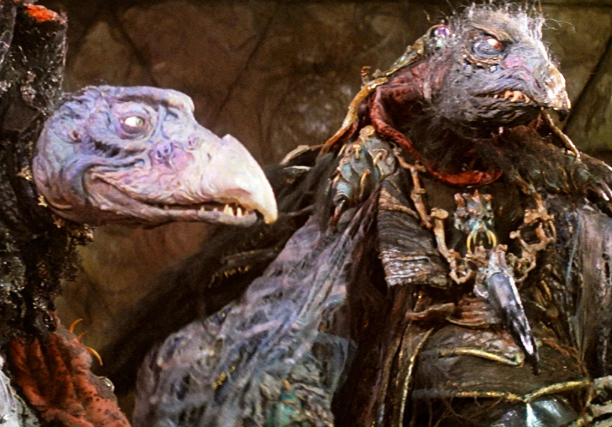
In the early 1980s, a cinematic earthquake occurred that forever altered the landscape of fantasy filmmaking. Jim Henson, the visionary mastermind behind the whimsical world of the Muppets, decided to pivot toward a realm of shadows, strange biology, and ancient prophecy. The result was The Dark Crystal, a film that remains an unparalleled masterpiece of world-building and practical effects. While many remember it as a “dark” puppet movie, it is actually a deeply spiritual, high-concept epic that pushed the boundaries of what was technologically possible at the time.
Stepping into the world of Thra is like entering a fever dream designed by a master biologist and a medieval philosopher. There are no humans in this story—no familiar faces to ground the audience. Instead, we are treated to a landscape where rocks are alive, plants have sentience, and the very light of the heavens dictates the fate of a dying civilization. To truly appreciate The Dark Crystal, one must look beneath the latex and foam to understand the Herculean effort required to bring Jim Henson’s “creature feature” to life. Whether you are a lifelong fan or a newcomer curious about this cult classic, these ten essential facts will reveal the hidden depth of this crystalline masterpiece.
1. The Philosophical Duality of the Skeksis and the Mystics
One of the most profound elements of The Dark Crystal lore is the metaphysical connection between the antagonistic Skeksis and the peaceful Mystics (UrRu). While they appear as separate species—one a group of decaying, vulture-like aristocrats and the other a tribe of slow-moving, four-armed sages—they are actually two halves of the same being. Originally, they were a single race known as the UrSkeks, who arrived on Thra from another dimension. During a botched attempt to use the Great Conjunction to return home, their souls and bodies were splintered into two distinct manifestations of their inner nature.
This duality is the philosophical backbone of the film. The Skeksis represent the uncontrolled id—greed, cruelty, and the desperate fear of death. The Mystics represent the superego—patience, wisdom, and the acceptance of the natural cycle of life. Every time a Skeksis is harmed, its Mystic counterpart suffers the exact same injury. This creates a fascinating narrative tension where the heroes cannot simply “kill” the villains without destroying the very source of wisdom on the planet. Jim Henson intended this to reflect the Taoist concept of Yin and Yang, suggesting that true balance requires the integration of both light and shadow.
2. Brian Froud’s Visual Revolution and Concept Art
The unique, organic aesthetic of Thra did not come from a Hollywood storyboard artist; it came from the mind of British illustrator Brian Froud. Before a single puppet was built, Henson spent years collaborating with Froud to define the “visual language” of the world. Froud’s work is characterized by a “found-object” quality—everything looks like it grew out of the earth or was weathered by centuries of wind and rain. He avoided the clean, plastic lines of traditional sci-fi, opting instead for a gritty, moss-covered reality that felt thousands of years old.
Froud’s influence extended to the very movements of the characters. He didn’t just draw monsters; he designed ecosystems. He considered how a creature would breathe, how its weight would shift on uneven terrain, and how its clothing would fray over time. This obsession with detail is why The Dark Crystal feels like a documentary of a real place rather than a set in a studio. The “Froudian” style became so synonymous with the film that it is impossible to imagine Thra without his signature blend of folklore, biology, and whimsy. His designs forced the puppet builders to innovate, as they had to figure out how to translate his complex, asymmetrical sketches into functional, three-dimensional performers.
3. The Incredible Physical Toll of Performance Puppetry
While the characters on screen are made of foam, latex, and cable-controlled animatronics, the human effort required to move them was nothing short of athletic. The Skeksis, in particular, were massive, heavy suits that required the performer to stand in a crouched position with one arm extended high above their head to operate the jaw. Performers often had to wear weight-bearing harnesses and look at small video monitors strapped to their chests just to see where they were going. The heat inside the suits was so intense that actors could only stay inside for short bursts before needing oxygen.
For the Mystics, the challenge was different but equally grueling. Performers had to move on all fours, often with their legs tucked into uncomfortable positions to mimic the creatures’ four-armed, lumbering gait. The Gelfling puppets, Jen and Kira, required a “team” approach, with one primary puppeteer handling the head and one hand, while a second puppeteer handled the other hand. This level of synchronization meant that every blink of an eye or tilt of a head was a choreographed dance between multiple artists. This physical sacrifice is what gives the film its “soul”—you aren’t watching a digital puppet; you are watching a human being straining to give life to a dream.
4. The Invention and Subsequent Removal of a Fictional Language
In its original conception, Jim Henson wanted The Dark Crystal to be an even more immersive experience by having the characters speak a completely invented language. Working with linguists, the production developed a tongue for the Skeksis and Mystics that sounded ancient and guttural, intended to be supported by subtitles for the audience. Henson’s goal was to make the world feel truly alien, removing the “human-centric” feel of English dialogue. Scenes were actually filmed and recorded with this fictional language, emphasizing the ritualistic nature of the Skeksis’ court.
However, during early test screenings, the audience found the subtitles distracting and the alien dialogue difficult to connect with emotionally. Concerned that the film would become too “high-concept” for a general audience, the decision was made to re-dub the entire movie into English. While this made the story more accessible, fragments of the original intent remain in the character’s vocalizations and the chanting of the Mystics. This hidden layer of linguistic depth shows how far Henson was willing to go to achieve total world immersion, treating the film more like an anthropological study than a standard fantasy flick.
5. Groundbreaking Animatronics and the “No Humans” Rule
One of the most daring creative choices made during production was the strict “no humans” rule. Every single character on screen—from the smallest crawling bug to the towering Landstriders—is a puppet or an animatronic. This was a massive gamble. At the time, audiences were used to seeing human protagonists in fantasy settings (like Star Wars or The NeverEnding Story). By removing humans entirely, Henson forced the audience to empathize with characters that looked radically different from themselves.
To achieve this, the team at Jim Henson’s Creature Shop had to invent new technologies. They used advanced cable-control systems that allowed for subtle facial movements, such as a sneer or a quivering lip, which had never been seen in puppetry before. The Landstriders, the spindly-legged mounts used by the Gelflings, were operated by brave performers on high stilts who had to navigate uneven sets. This commitment to a purely non-human world is what gives The Dark Crystal its timeless quality. Because there are no 1980s hairstyles or human actors to date the film, Thra remains a world that exists outside of our own timeline.
6. The Darker Side of Jim Henson’s Creative Vision
Many viewers who grew up with The Dark Crystal remember it as a terrifying experience, and that was entirely intentional. Jim Henson was a firm believer that it was “healthy for children to be scared.” He felt that modern fairy tales had become too sanitized and that children needed to see darkness to understand the importance of light. The Skeksis’ “Essence Draining” machine, where they literally suck the life force out of Podlings to maintain their youth, remains one of the most chilling concepts in family cinema.
Henson looked back to the original Brothers Grimm fairy tales for inspiration, where danger was real and the villains were genuinely grotesque. The Skeksis aren’t just mean; they are decaying, desperate, and morally bankrupt. This darkness serves a narrative purpose: it makes the journey of the Gelflings feel truly perilous. When Jen and Kira succeed, it isn’t just a happy ending; it is a hard-won victory over a terrifying evil. This willingness to embrace the macabre is why the film has such a strong cult following among adults today; it respects the intelligence and emotional range of its audience.
7. The Mathematical and Astronomical Lore of the Three Suns
The world-building of Thra is rooted in a complex system of astronomy. The planet is at the center of a “Triple Sun” system, and the entire plot revolves around the movement of these celestial bodies. The Great Conjunction—the moment when the three suns align—is the only time the Dark Crystal can be healed. This creates a “ticking clock” element for the story that is based on cosmic laws rather than a simple villain’s whim.
Henson and his team went so far as to build a massive, functional model of the solar system (an orrery) in Aughra’s laboratory. This set piece is a marvel of mechanical engineering, featuring rotating globes and spinning rings that track the movement of the heavens. It symbolizes the theme of “Harmony of the Spheres,” suggesting that the health of the planet is intrinsically tied to the movement of the universe. This attention to detail implies a history that stretches back millennia, giving the audience the sense that they are only seeing a small snapshot of a much larger, older cosmic story.
8. Frank Oz: The Unsung Co-Director
While Jim Henson is the name most associated with the film, the contribution of Frank Oz cannot be overstated. Known primarily as the voice and hand behind Yoda and Miss Piggy, Oz served as the co-director of The Dark Crystal. His expertise in performance was vital in guiding the puppeteers to find the “humanity” in their non-human characters. While Henson focused on the grand vision and the technical aspects of the Creature Shop, Oz often focused on the character beats and the emotional resonance of the performances.
The collaboration between Henson and Oz was a perfect “duality” in itself. Henson provided the wonder and the world, while Oz provided the discipline and the dramatic tension. Oz was instrumental in the pacing of the Skeksis scenes, ensuring that their bickering felt like a dysfunctional royal court rather than just monsters shouting at each other. Their partnership allowed the film to balance its massive technical ambitions with a focused, character-driven story. It remains one of the most successful directorial collaborations in the history of fantasy cinema.
9. The Evolution and Design Challenges of the Gelflings
The Gelflings, Jen and Kira, were actually the hardest characters to design and build. While the Skeksis could be ugly and grotesque, the Gelflings had to be “beautiful” and relatable to the audience. In the world of puppetry, creating a “realistic” humanoid face is much more difficult than creating a monster. If the proportions are slightly off, the character falls into the “Uncanny Valley,” appearing creepy rather than endearing.
Early designs for the Gelflings were much more alien, with larger ears and more feline features. However, Henson eventually moved toward a more “human-adjacent” look to ensure the audience could bond with them. The puppets were made of a specialized soft foam-latex that mimicked skin, and their eyes were hand-painted glass to give them a lifelike depth. Despite their simple appearance, the Gelflings were the pinnacle of the Creature Shop’s technological achievements, requiring the most delicate touch to operate. They represent the “innocence” of Thra, acting as the emotional bridge for the viewer to enter this strange, beautiful world.
10. Aughra: The Embodiment of the Planet Thra
Perhaps the most iconic character in the film is Aughra, the one-eyed, horns-wearing astronomer who serves as the guardian of the secrets of Thra. Aughra was not just a character; she was a technological marvel. Operated by Frank Oz, the puppet featured an incredibly complex array of facial movements, allowing her to appear ancient, cranky, and wise all at once. She is described as being “born of the rocks,” a literal manifestation of the planet’s consciousness.
Aughra’s role in the lore is that of the “Crone” archetype—the wise woman who provides the hero with the tools they need to succeed. However, she is also a tragic figure; she was present when the UrSkeks arrived and witnessed the cracking of the crystal. Her laboratory, filled with thousands of years of observations, represents the lost knowledge of Thra. She is the only character who truly understands the scope of the disaster facing her world, and her grumpy, no-nonsense attitude provides much-needed levity in an otherwise dark story. Aughra remains a fan favorite because she is unapologetically herself, a powerful female figure in a world of ancient cosmic forces.
Further Reading
- The World of the Dark Crystal by Brian Froud and J.J. Llewellyn
- Jim Henson: The Biography by Brian Jay Jones
- The Dark Crystal: The Ultimate Visual History by Caseen Gaines
- The Making of the Dark Crystal by Christopher Finch
- Podcast Episode: Classic Films And Horror Icons
- 10 The Exorcist III (1990) Movie Facts You Didn’t Know
- 10 Scream (1996) Movie Facts That Changed Horror
- 10 The Lion King (1994) Facts That Made It Iconic – Classic Movie
- 10 Forrest Gump (1994) Facts That Make It Timeless – Classic Movie
- 10 Fight Club (1999) Facts That Still Surprise Fans – Classic Movie
- 10 Hostel (2005) Movie Facts That Shocked Viewers
- 10 Avatar (2009) Facts That Changed Cinema – Classic Movie
- 10 Hellraiser (1987) Movie Facts That Built Its Legacy
- 10 Jurassic Park (1993) Facts That Changed Movies Forever – Classic Movie



