
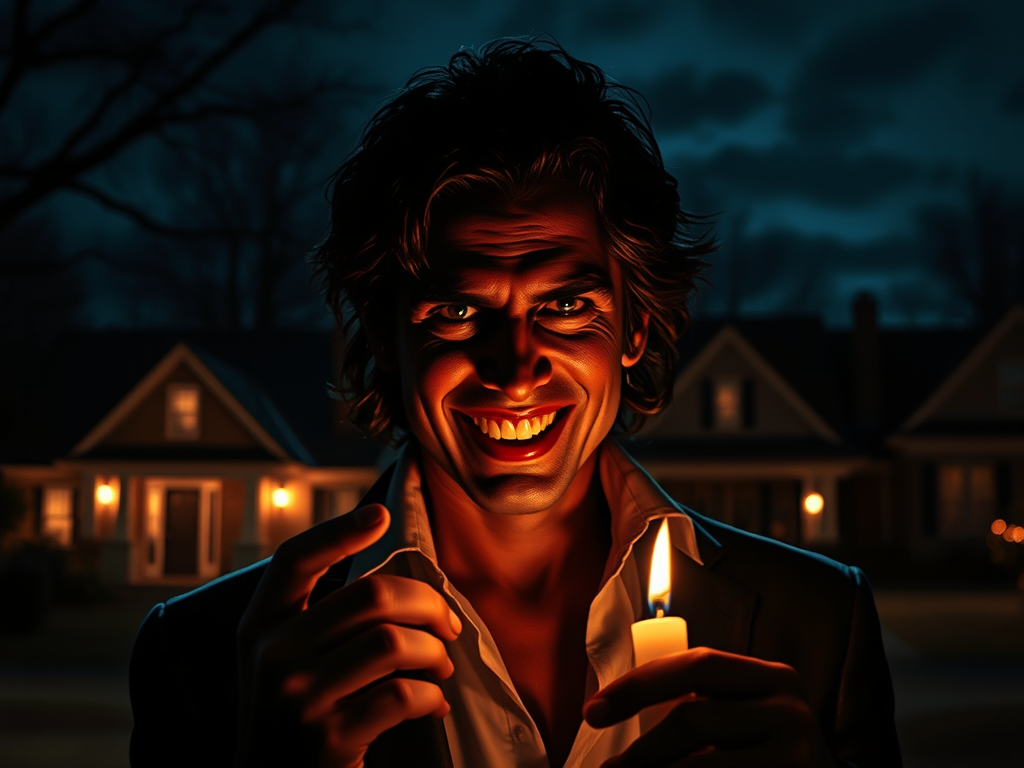
Welcome, fellow horror hounds and creatures of the night, to a special celebration of one of the most beloved vampire films of all time. Pull the curtains, light a candle, and get ready to delve into the shadows of 1985’s masterpiece, Fright Night. In an era dominated by slasher villains, writer-director Tom Holland dared to be different, sinking his teeth into classic vampire lore and injecting it with a fresh, funny, and genuinely frightening dose of suburban paranoia. The story of teenager Charley Brewster, who discovers his charming new neighbour is a bloodsucking monster, struck a perfect chord with audiences. It was a brilliant mix of knowing winks to horror history and state-of-the-art 80s special effects. Fright Night wasn’t just a great horror movie; it was a love letter to the entire genre, creating unforgettable characters like the suave and menacing Jerry Dandrige and the washed-up, cowardly vampire hunter, Peter Vincent. But even if you’ve watched it a hundred times, there are secrets buried in Jerry’s cellar you’ve never unearthed. Today, we’re staking our claim as we reveal 10 fascinating, little-known facts about the making of this iconic film that will make you see it in a whole new light. For real.
1. The Idea Came From a Real-Life Love of Horror
The brilliant concept for Fright Night didn’t come from a studio executive; it sprang directly from the heart of a true fan. Writer-director Tom Holland, who had previously penned the script for the horror hit Psycho II, was a lifelong devotee of classic horror films. The idea for Fright Night sparked when he imagined a horror fan whose love for the genre suddenly becomes his worst nightmare. Holland wondered, “What if a teenage horror fan, who lives and breathes monster movies, discovered a real vampire was living next door? And what if no one believed him?” This simple, yet ingenious, premise became the foundation of the film. He then added the inspired character of Peter Vincent, a washed-up actor who hosted a late-night horror movie show, as Charley’s only hope. This character allowed Holland to directly pay homage to the classic horror hosts he grew up watching, like the legendary Vampira and Zacherley, and to explore the theme of what happens when a lifetime of fantasy collides with a terrifying reality.
2. Chris Sarandon Was Cast for His Seductive Charm, Not Menace
Jerry Dandrige is one of the most charismatic and memorable vampires in cinema history, and that’s largely thanks to the suave performance of Chris Sarandon. When casting the role, Tom Holland specifically wanted to avoid the monstrous, Bela Lugosi-style vampire. He envisioned Jerry as a seductive, alluring predator who could believably charm his way into the neighbourhood and into Amy’s heart before revealing his true nature. Sarandon, known for his Oscar-nominated role in Dog Day Afternoon, had the perfect blend of sophistication and underlying danger. Holland instructed Sarandon to play the character as if he were the romantic lead, a man deeply and genuinely in love with Amy, whom he believes is the reincarnation of his long-lost love. This approach made Jerry a much more complex and compelling villain. He wasn’t just a monster; he was a tragic figure whose monstrous acts were driven by a twisted sense of love and longing, making him all the more terrifying when his charming facade finally dropped.
3. Peter Vincent Was Written Specifically for a Horror Legend
The character of Peter Vincent, the “Great Vampire Killer,” was a tribute to the horror icons of a bygone era. The name itself is a portmanteau of two legendary actors: Peter Cushing and Vincent Price. Tom Holland’s dream was to cast a genuine horror legend in the role, and his first and only choice was Vincent Price himself. Holland had idolised Price for years and wrote the part as a direct homage to the actor’s famous on-screen personas. Unfortunately, by the mid-1980s, Price’s health was failing, and he had largely stepped away from the horror genre, feeling he had been typecast. He politely turned down the role. The part then went to another screen veteran, Roddy McDowall, who was perfect in his own right. McDowall beautifully captured the character’s initial cowardice and eventual bravery, creating a deeply human and lovable hero. As a touching nod to the man who inspired the role, the horror host show seen in the film is called Peter Vincent’s Fright Night, giving the character the same name as the film itself.
4. The Groundbreaking Special Effects Were Done by a Ghostbusters Genius
Fright Night is packed with incredible practical special effects that still hold up remarkably well today, and that’s because they were created by a team of true masters. The film’s effects were supervised by Richard Edlund, who was fresh off his Oscar-winning work on a little film called Ghostbusters. Edlund and his team at Boss Film Studios were responsible for bringing all of the film’s terrifying transformations and monstrous creations to life. One of the most complex and impressive sequences was the death of “Evil” Ed, where he transforms from a wolf back into his human form as he dies. This required a stunningly detailed, full-body wolf puppet and a series of complex bladder effects and makeup appliances. Another showstopper was the final transformation of Jerry Dandrige from his human form into a monstrous bat-like creature. This involved multiple stages of prosthetic makeup, animatronic heads, and a massive, fully-articulated bat puppet that took a team of 15 puppeteers to operate. The effects were a huge part of the film’s success, delivering the kind of visceral, state-of-the-art horror that 80s audiences craved.
5. “Evil Ed” Was One of the First Openly Gay Characters in Mainstream Horror
Stephen Geoffreys’ electrifying performance as Charley’s eccentric best friend, “Evil” Ed Thompson, is a major fan favourite. With his bizarre laugh and memorable catchphrases (“You’re so cool, Brewster!”), Ed is a unique and unforgettable character. He is also widely considered to be one of the first implicitly, if not explicitly, gay characters in a mainstream 1980s horror film. While the script never spells it out, the subtext is strong. Tom Holland and Stephen Geoffreys have both acknowledged that they played the character with this understanding. Ed’s outsider status, his theatrical personality, and the intense, almost romantic devotion he shows to Charley all contribute to this reading. His transformation into a vampire and his seductive tempting of Charley (“I know you want me, Brewster”) further solidifies this interpretation. In an era when gay characters were largely invisible or stereotyped in Hollywood, Evil Ed was a refreshingly complex and groundbreaking figure in the horror genre.
6. The Iconic Poster Was a Last-Minute Stroke of Genius
The poster for Fright Night is one of the most iconic images in all of 80s horror. The haunting image of a vampire’s face looming in the clouds above a suburban house perfectly captures the film’s premise of supernatural terror invading everyday life. But this memorable poster was actually a last-minute creation. The original poster design was a much more conventional and less interesting concept. Dissatisfied, the marketing team at Columbia Pictures scrambled to come up with something better just before the promotional campaign was set to launch. They hired an artist who created the moody, atmospheric painting that would become the final poster. The image was so effective and chilling that it immediately grabbed the public’s attention and created a huge amount of buzz for the film. It’s a perfect example of how brilliant marketing can elevate a film, promising a unique and terrifying experience that the movie itself more than delivered on.
7. It Was a Surprise Hit That Dominated the Summer of 1985
In the summer of 1985, the box office was crowded with big-name sequels and high-concept comedies. Horror was still dominated by the slasher subgenre, and a classic-style vampire movie was seen as a significant risk. Nobody expected Fright Night to be a major hit. However, thanks to its clever script, positive word-of-mouth, and that brilliant marketing campaign, the film became a bona fide blockbuster. It was the second highest-grossing horror film of 1985 (behind A Nightmare on Elm Street 2) and was a massive success for Columbia Pictures, grossing over $24 million at the domestic box office against a budget of just $9 million. Critics were also surprisingly kind. Unlike many horror films of the era, Fright Night received largely positive reviews. Critics praised its intelligence, its humour, and its genuine scares, with many hailing it as an instant classic of the genre.
8. The Soundtrack is a Perfect 80s Time Capsule
Beyond Brad Fiedel’s moody and atmospheric synthesizer score, Fright Night boasts a killer soundtrack album that is a perfect snapshot of mid-80s rock and new wave. The soundtrack featured a collection of popular artists of the day, including the J. Geils Band, Autograph, Devo, and Sparks. The title track, “Fright Night,” performed by the J. Geils Band, became a minor hit and its music video, which featured clips from the film, was played in heavy rotation on MTV. Each song was carefully chosen to complement the film’s tone, blending rock anthems with spooky, synth-pop vibes. The scene in the nightclub, where Jerry seduces Amy on the dance floor to the hypnotic track “Come to Me” by Brad Fiedel, is a masterclass in using music to build atmosphere and suspense. The soundtrack was an integral part of the film’s cool, contemporary feel and helped to solidify its status as an 80s classic.
9. A Lawsuit Was Filed Over the Film’s Title
Shortly after the film’s massive success, Tom Holland and Columbia Pictures found themselves on the receiving end of a lawsuit. The suit was filed by the producers of a small, regional horror-themed TV show in Iowa which was also called “Fright Night.” They claimed that the movie had stolen their title and was infringing on their trademark. The case went to court, but the judge ultimately ruled in favour of the filmmakers. The judge determined that “fright night” was a common, generic phrase, much like “movie night,” and could not be exclusively trademarked. The victory was a relief for the studio and allowed the film to retain its perfect, evocative title without any legal complications clouding its success.
10. The Dance Scene Was Heavily Inspired by Classic Hollywood Musicals
One of the most mesmerising and memorable scenes in the film is when Jerry Dandrige and Amy Peterson dance together in the packed nightclub. The sequence is intensely seductive and suspenseful, as Jerry uses his vampiric charm to enthrall Amy right in front of Charley. Director Tom Holland has stated that the visual style and choreography of this scene were heavily influenced by the classic Hollywood musicals of Fred Astaire and Ginger Rogers. He wanted to capture that same sense of fluid, almost magical movement as the two characters glide across the dance floor. He instructed Chris Sarandon and Amanda Bearse to watch old musicals to prepare for the scene. The result is a sequence that feels both classic and contemporary, a hypnotic dance of predator and prey that is beautiful and deeply unsettling at the same time, showcasing the film’s clever ability to blend different genres to create something entirely new.
Conclusion
Fright Night is so much more than just a vampire movie. It’s a film made by horror fans, for horror fans. It’s a perfect balancing act of humour, suspense, and genuine heart that respects the genre’s past while pushing it forward with 80s style and energy. The passion of its creators, from Tom Holland’s inspired script to the incredible work of the cast and the special effects wizards, shines through in every frame. It’s a film that understands that the best horror stories aren’t just about the monster; they’re about the people who have to face them. It’s why we still cheer when Charley Brewster finally stands up to Jerry, and why our hearts break and soar with Peter Vincent, the “Great Vampire Killer.” The film remains a timeless classic, a go-to comfort movie for horror lovers everywhere, proving that some things, like a great vampire story, truly never die. What’s your favourite line or moment from Fright Night? Let us know in the comments below!
Dive Deeper
- You’re So Cool, Brewster! The Story of Fright Night (2016 documentary film): An essential, comprehensive look back at the making and legacy of the film. This fan-funded documentary features incredible interviews with nearly the entire cast and crew, sharing amazing stories and behind-the-scenes footage.
- The Vampire Cinema by David J. Skal: A fascinating and detailed history of the vampire genre on film. This book provides excellent context for how Fright Night both paid homage to and reinvented the classic vampire tropes for a modern audience.
Crystal Lake Memories: The Complete History of Friday the 13thby Peter M. Bracke: While focused on a different franchise, this book (and its documentary adaptation) provides an incredible look into the world of 1980s horror filmmaking, offering a great companion piece to understand the era in which Fright Night was born.




Leave a Reply