
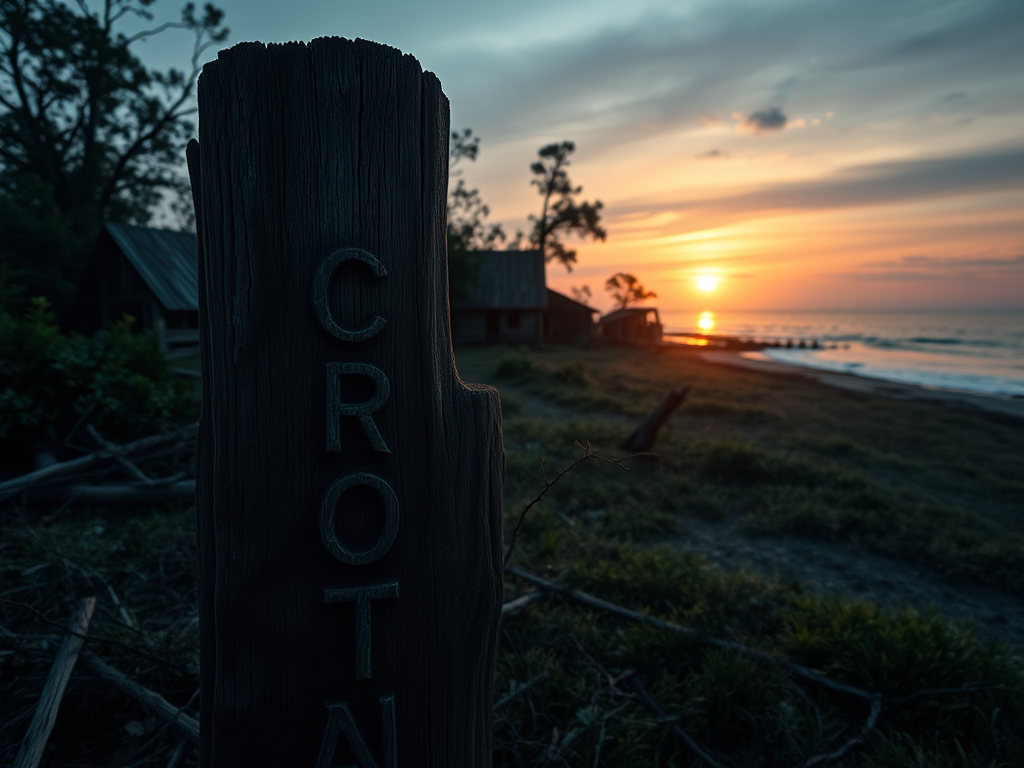
It is America’s oldest and most haunting unsolved mystery. In the late 16th century, more than two decades before the Pilgrims landed at Plymouth Rock, a group of over 100 English men, women, and children attempted to build a new life on Roanoke Island, a sliver of land off the coast of modern-day North Carolina. Three years later, a relief mission arrived to find the settlement deserted. There was no sign of a struggle, no bodies, and no distress signal—just an abandoned village and a single, cryptic word carved into a wooden post. The colonists had vanished, seemingly into thin air.
The fate of the “Lost Colony” has captivated historians, archaeologists, and storytellers for over 400 years, becoming a cornerstone of American folklore. But what is the true story behind the legend? By peeling back the layers of myth, we can uncover the fascinating, and perhaps less mysterious, reality of what likely happened to the settlers. Here are 10 facts about this iconic American enigma.
It Was England’s Second Attempt at Roanoke, Not the First
The famous “Lost Colony” of 1587 was not England’s first foray into the region. It was actually the second attempt, organised by Sir Walter Raleigh, to establish a foothold in the New World. The first colony, founded in 1585, was a very different affair. It consisted entirely of soldiers and adventurers whose primary goal was to establish a military fort and privateering base from which to raid Spanish treasure ships. This first group quickly ran into trouble. They had a disastrously poor relationship with the local Native American tribes, culminating in the English commander burning a village and its chief alive over a dispute about a missing silver cup. Plagued by dwindling supplies and hostile relations, the first colony was abandoned after just one year. This violent precedent would cast a long shadow over the next group of settlers.
The “Lost Colony” Included Families, Signifying a Permanent Settlement
Unlike the military venture that preceded it, the 1587 colony was intended to be a permanent English settlement. The inclusion of 17 women and 9 children among the roughly 115 colonists was a clear sign that this was a community meant to put down roots, build homes, and raise families in the New World. They were not there for conquest or quick riches, but to create a new English society. This domestic nature of the colony is what makes its disappearance so particularly poignant and tragic. They were families, not just soldiers, who vanished from the historical record.
It Was the Birthplace of the First English Child in the Americas
A remarkable and symbolic event took place shortly after the colonists arrived. On August 18, 1587, Eleanor Dare, the daughter of the colony’s governor, John White, gave birth to a baby girl. She was named Virginia Dare. As the first English child born in the Americas, Virginia has become a powerful and almost mythical figure in American folklore. She represents the hope and promise of a new beginning in a new land, a promise that was tragically cut short, at least in the eyes of the English. Her birth certificate is the continent itself, and her fate is inextricably linked to the mystery of the colony she was born into.
The Governor’s Supply Run Turned into a Three-Year Exile
Soon after landing, the colonists realised they were critically short on food and supplies to last the winter. They persuaded their governor, the artist John White, to sail back to England to plead their case for a relief mission. White, who was also the grandfather of the newborn Virginia Dare, reluctantly agreed, expecting to return within a year. However, his mission was catastrophically delayed. When he arrived in England, the country was preparing for war with Spain. The massive Spanish Armada was set to invade, and Queen Elizabeth I commanded that every available ship be used for the war effort. White’s desperate attempts to secure a vessel were thwarted for three long years, leaving his family and his colony to fend for themselves on the edge of a vast, unknown continent.
The Only Clue Left Behind Was the Word “CROATOAN”
When John White was finally able to return to Roanoke in August 1590—on his granddaughter Virginia’s third birthday—he found the settlement deserted. But it was not a scene of chaos or violence. The houses had been neatly dismantled, suggesting an orderly and planned departure. Heavy items had been buried, and the defensive palisade around the settlement was still standing. There were no bodies, no skeletons, and no signs of a battle. The only clues were two carvings. On a tree, he found the letters “CRO,” and on one of the main posts of the palisade, a single, clear word was carved: “CROATOAN.”
“Croatoan” Was Not a Mysterious Word, but a Clear Destination
While it has entered folklore as a cryptic, mysterious word, “CROATOAN” was anything but. To John White, its meaning was perfectly clear. Croatoan was the name of a nearby island (modern-day Hatteras Island), located about 50 miles south of the Roanoke settlement. It was also the name of the friendly, English-speaking Algonquian tribe who lived there, led by their chief, Manteo, who had travelled to England and was a key ally. Before White had left for England, he and the colonists had specifically agreed that if they had to move, they would carve their destination into a tree or post. Crucially, they also agreed that if they were in danger or had been forced to leave, they should carve a Maltese cross above the name. When White saw the word “CROATOAN” with no cross, he was filled with relief, believing his people had simply moved to a safer location among their friends.
A Hurricane Prevented the Final Rescue Attempt
John White was fully prepared to sail the short distance to Croatoan Island to reunite with his family and the colonists. The next morning, he and his crew were ready to weigh anchor and make the journey. Tragically, a powerful storm—likely a late-season hurricane—swept in with ferocious intensity. The storm snapped the anchor cable of the flagship, and the violent winds and seas nearly dashed the ships against the coast. With his ships damaged and his crew, who had already been at sea for months, refusing to risk a landing in the dangerous weather, the rescue mission was abandoned. A heartbroken John White was forced to return to England, never to see his family again.
The Leading Theory: They Assimilated with Native Americans
For centuries, wild theories involving disease, massacre, or a failed attempt to sail back to England have been proposed. However, the vast majority of modern historians and archaeologists support a much simpler and more logical explanation: assimilation. Faced with starvation, the threat of hostile tribes, and the failure of John White to return, the colonists likely made the sensible choice to abandon their settlement and seek refuge with their allies on Croatoan Island. Over time, this small group of about 100 English settlers would have integrated into the much larger Native American community, intermarrying, adopting their language and customs, and eventually becoming part of the tribe. They weren’t “lost” in a supernatural sense; they simply became Native Americans.
Recent Archaeology Has Uncovered Supporting Evidence
For a long time, the assimilation theory was based mostly on logic and circumstantial accounts. But in recent decades, archaeology has begun to provide tantalising physical evidence. At sites on Hatteras Island (the historical Croatoan) and inland along the Chowan River, archaeologists have found 16th-century English artifacts—pottery, metal tools, and even parts of a rapier sword—mixed directly with Native American artifacts in the remains of their villages. This archaeological mingling strongly suggests that at least some of the colonists moved and lived among the local tribes. Furthermore, a hidden symbol of a fort, drawn in invisible ink on one of John White’s own maps, points to an inland location where the colonists may have planned to move, a site where more English artifacts have been found.
It’s a Story of Adaptation, Not Just Disappearance
The popular narrative of Roanoke is a haunting tale of mystery and tragic failure. But when viewed through the lens of the available evidence, a more hopeful and compelling story emerges. The Roanoke settlers were not passive victims who simply vanished. They were resourceful people who, when faced with abandonment and the collapse of their original plan, made an active choice to survive. They left their English identity behind to join a new society. The story of Roanoke may therefore not be about a colony that was “lost,” but about a group of people who successfully adapted to a new world, creating a new, blended community. America’s oldest mystery may, in the end, be the story of America’s first mixed-race community.
Further Reading
For those who wish to explore this enduring mystery in greater detail, these books offer excellent and well-researched perspectives:
- The Lost Colony of Roanoke: New Perspectives edited by E. Thomson Shields and Charles R. Ewen
- Roanoke: The Abandoned Colony by Karen Ordahl Kupperman
- The Secret Token: Myth, Obsession, and the Search for the Lost Colony of Roanoke by Andrew Lawler
- A Kingdom Strange: The Brief and Tragic History of the Lost Colony of Roanoke by James Horn
Here at Zentara.blog, our mission is to take those tricky subjects and unlock them, making knowledge exciting and easy to grasp for everyone. But the adventure doesn’t stop on this page! We’re constantly exploring new frontiers and sharing discoveries across the digital universe. Want to dive deeper into more mind-bending Top 10s and keep expanding your world? Come join us on our other platforms – we’ve got unique experiences waiting for you on each one!
Get inspired by visual wonders and bite-sized facts: See the world through Zentara’s eyes on Pinterest!
Pin our fascinating facts and stunning visuals to your own boards. Explore Pins on Pinterest: https://uk.pinterest.com/zentarablog/
Discover quick insights and behind-the-scenes peeks: Hop over to Tumblr for snippets, quotes, and unique content you won’t find anywhere else. It’s a different flavour of discovery! Follow the Fun on Tumblr: https://www.tumblr.com/zentarablog
Ready for deep dives you can listen to or watch? We’re bringing our accessible approach to video and potentially audio! Subscribe to our YouTube channel and tune into future projects that make learning pop! Subscribe on YouTube: https://www.youtube.com/@ZentaraUK
Seeking even more knowledge in one place? We’ve compiled some of our most popular topic deep dives into fantastic ebooks! Find them on Amazon and keep the learning journey going anytime, anywhere. Find Our Ebooks on Amazon: https://www.amazon.co.uk/s?k=Zentara+UK&ref=nb_sb_noss
Connect with us and fellow knowledge seekers: Join the conversation on BlueSky! We’re sharing updates, thoughts, and maybe even asking you what wonders we should explore next. Chat with Us on BlueSky: https://bsky.app/profile/zentarablog.bsky.social
Perfect for learning on the move! We post multiple 10-minute podcasts per day on Spotify. Pop on your headphones and fill your day with fascinating facts while you’re out and about! Listen on Spotify: https://open.spotify.com/show/3dmHbKeDufRx95xPYIqKhJFollow us on Instagram for bytesize knowledge! We post multiple posts per day on our official Instagram account. https://www.instagram.com/zentarablog/ Every click helps us keep bringing honest, accessible knowledge to everyone. Thanks for exploring with us today – see you out there in the world of discovery!



Leave a Reply