
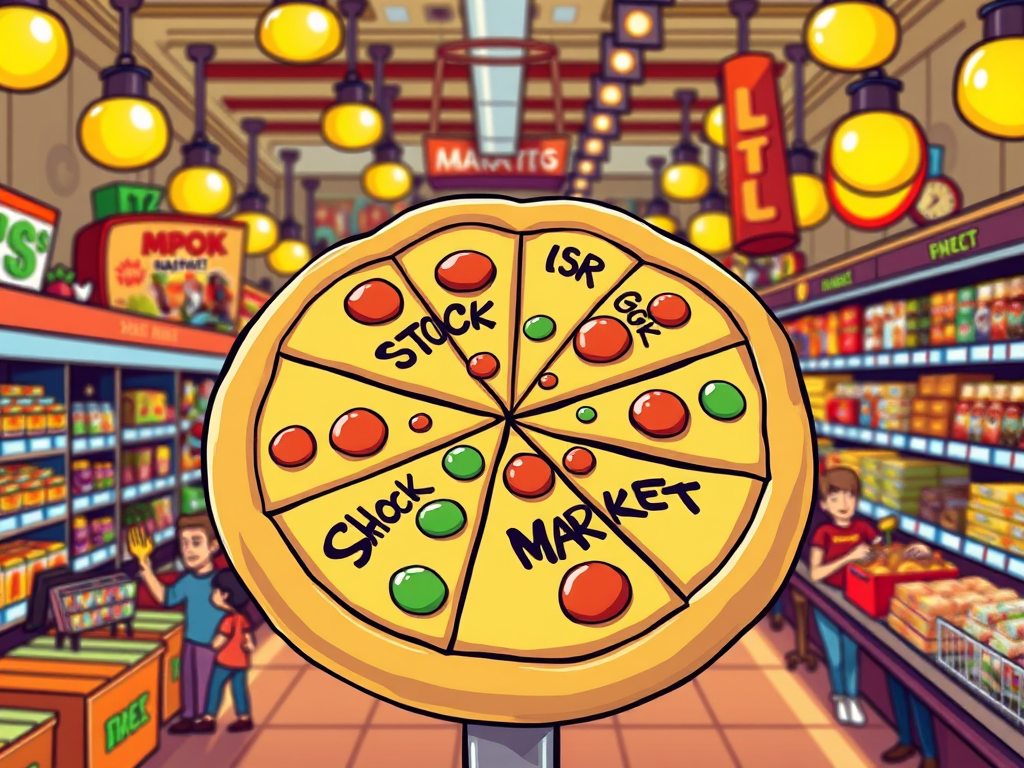
The stock market. The very phrase can conjure images of frantic traders in suits, shouting into phones while a dizzying ribbon of numbers scrolls across a screen. It can feel like an exclusive club with a secret language, designed to be intimidating and complex. But what if it isn’t? What if, at its heart, the stock market is based on a few simple ideas that are as easy to understand as sharing a pizza with friends?
The truth is, the stock market is simply a tool. It’s a way for regular people to own a tiny piece of the companies they know and love, from the business that makes their smartphone to the one that streams their favorite movies. It’s about participating in their success. The confusing jargon is just shorthand that people in the industry use, but the concepts behind the words are surprisingly straightforward. By breaking down the lingo, we can pull back the curtain and see the market for what it truly is: a fascinating intersection of business, human psychology, and everyday life.
This guide is your decoder ring. We’re going to unravel ten of the most common stock market terms using simple analogies and stories. Forget the complicated charts and financial wizardry. By the end of this list, you’ll have a foundational understanding that can empower you to see the world of finance not as a threat, but as an opportunity.
1. Stock (or Share): Owning a Tiny Slice of the Pie
Imagine your favourite company is a giant, delicious pizza. Let’s say it’s a company that makes amazing video games. This company is so big and successful that it would be impossible for one person to own the whole thing. So, to let other people be a part of its success (and to raise money to make even cooler games), the company decides to cut its giant pizza into millions and millions of tiny slices. Each one of these slices is called a stock, or a share.
When you buy one stock, you are buying one of those tiny slices. You are now a part-owner of the video game company! You don’t get to make decisions about the next game, but you do get to share in the company’s fortunes. If the company does really well—sells a ton of games and makes a lot of money—more people will want a slice of their pizza. This demand makes each slice more valuable, so the price of your stock goes up. If the company does poorly, your slice might become less valuable. It’s the simplest and most fundamental concept: a stock is just a small piece of ownership in a business.
2. The Stock Market: A Giant Supermarket for Company Slices
So, you have these millions of pizza slices, or stocks, from thousands of different companies. Where do you go to buy or sell them? You go to the stock market. Think of it as a massive, bustling supermarket. Instead of aisles for fruits, vegetables, and cereal, there are aisles for different companies. There’s an aisle for tech companies, an aisle for car companies, and an aisle for companies that make fizzy drinks.
This “supermarket” isn’t a physical place anymore; it’s mostly a global network of computers, like the New York Stock Exchange (NYSE) or the NASDAQ. When you hear that “the market is up,” it’s like saying that, on average, most of the items in the supermarket got a bit more expensive today because lots of shoppers (investors) were eager to buy. When “the market is down,” it means prices generally fell because there were more sellers than buyers. It’s simply the central place where buyers and sellers meet to trade their slices of company ownership.
3. Bull Market: When the Shopping Carts are Overflowing
You’ll often hear people on the news talk about a “bull market.” This is just a fancy term for a period when the stock market is doing really well for a sustained amount of time. The prices of most stocks are rising, and people are generally optimistic about the future.
Why a bull? Think of how a bull attacks: it thrusts its horns up into the air. That’s the image to keep in your head—prices are charging upward! In a bull market, people feel confident. They believe companies will continue to make more money, so they eagerly buy more stocks, which pushes prices even higher. It’s like a sunny day at our supermarket where everyone is in a great mood, the shopping carts are overflowing, and everyone expects the good times to continue. This happy, upward trend is what Wall Street calls a bull market. It’s a period of economic growth and investor confidence.
4. Bear Market: When Shoppers are Heading for the Exits
The opposite of a bull is a bear. A bear market is when the stock market is doing poorly, and prices have been falling for a significant period (usually a drop of 20% or more from recent highs). People are pessimistic and scared. They worry that companies will make less money or that the economy is in trouble.
The animal analogy works here, too. A bear attacks by swiping its powerful paws downward. That’s what stock prices are doing—going down. In a bear market, fear takes over. People rush to sell their stocks to avoid losing more money, which unfortunately causes prices to fall even further. It’s like a sudden thunderstorm has hit our supermarket. Shoppers get scared, abandon their carts, and rush for the exits, wanting to get out before things get worse. A bear market is a scary and painful time for investors, but historically, they have always been temporary.
5. Dividend: A ‘Thank You’ Treat from the Company
Let’s go back to our pizza company. Imagine it had an absolutely fantastic year. It sold more video games than ever before and has a lot of extra money (profit) sitting around. As a special “thank you” to all its loyal owners (the stockholders), the company decides to share some of that profit. This special bonus is called a dividend.
Think of it like this: you still own your slice of the pizza, but the company also hands you a free breadstick or a can of soda just for being an owner. It’s a small cash payment, usually made every three months, that companies give out to their shareholders. Not all companies pay dividends; many newer companies prefer to reinvest all their profits back into growing the business. But for established, profitable companies, dividends are a way of rewarding investors and sharing the success directly with them.
6. Stock Index (e.g., S&P 500): The Market’s Report Card
It would be impossible to track the price of every single stock in the entire market to see how things are going. It’s like trying to know if the supermarket is having a busy day by checking the price of every single apple, banana, and box of crackers. It’s too much information.
Instead, we use a shortcut called a stock index. An index is just a “report card” for a specific group of stocks. The most famous one is the S&P 500. This index tracks the performance of 500 of the largest and most important companies in the United States. By looking at whether the S&P 500 went up or down, you can get a very good snapshot of how the entire US stock market performed that day. If the S&P 500 is up, it means that, on average, the biggest companies had a good day. It simplifies a huge amount of data into one easy-to-understand number.
7. Portfolio: Your Personal Collection of Slices
You wouldn’t want your entire dinner to be just one slice of pepperoni pizza, right? What if you suddenly decide you don’t like pepperoni? It’s smarter to have a plate with a little bit of everything—a slice of pepperoni, a slice of veggie, and maybe a small salad. This idea of not putting all your eggs in one basket is crucial in investing, and your personal collection of investments is called your portfolio.
A portfolio is simply all the different stocks and other investments you own. A smart investor builds a diversified portfolio. This means they own slices from many different kinds of companies in different industries—maybe some tech, some healthcare, some energy. The reason is simple: if the video game companies (tech) have a bad year, maybe the companies that make medicine (healthcare) will have a good year. By spreading your investments out, you reduce your risk and protect yourself if one particular slice in your collection happens to do poorly.
8. Volatility: How Bumpy the Investment Ride Is
Imagine you’re on a road trip. Some parts of the road are perfectly smooth, flat highways. Other parts are bumpy country roads with lots of sudden ups and downs. In the stock market, volatility is just a word for how bumpy the ride is for a particular stock’s price.
A stock with low volatility is like that smooth highway; its price doesn’t change very much or very quickly. It’s a calm, steady ride. A stock with high volatility is like a roller coaster. Its price can shoot up dramatically one day and plummet the next. It’s a much more exciting, but also much scarier, ride. Generally, newer, unproven companies are more volatile, while large, stable, established companies are less so. Volatility isn’t necessarily good or bad; it’s simply a measure of how much a stock’s price swings around.
9. IPO (Initial Public Offering): A Company’s Public Debut
Let’s go back to a brand-new pizza shop that’s privately owned by its founder. It becomes incredibly popular, and now the owner wants to expand and open hundreds of shops all over the country. To get the huge amount of money needed for this expansion, the owner decides to “go public.” This means they will sell slices (stocks) of their company to absolutely anyone for the very first time.
This grand opening event is called an Initial Public Offering, or IPO. It’s the very first time a private company offers its shares for sale on the public stock market. Before the IPO, only a small group of insiders could own a piece of the company. After the IPO, any member of the public can buy a stock and become a part-owner. It’s a huge milestone for a company, marking its transition from a private business to a publicly-traded one.
10. Capital Gain: The Profit You Make When You Sell
Let’s say you bought your slice of the video game company’s pizza for $50. You hold onto it for a year, and during that time, the company releases a blockbuster game that everyone loves. The company becomes more successful and valuable, and now other people are willing to pay $80 for your slice. You decide to sell it.
The original $50 you paid is your “cost.” The $80 you sold it for is the sale price. The $30 difference is your profit. In the world of finance, this profit is called a capital gain. It’s the positive difference between what you paid for an asset and what you sold it for. This is one of the primary ways people make money in the stock market: they buy stocks in good companies, hold them as they become more valuable, and then sell them for a profit later on.
Further Reading
If these simple explanations have sparked your curiosity, here are a few highly-regarded books that dive deeper into the world of investing in an accessible and straightforward way.
- The Simple Path to Wealth: Your road map to financial independence and a rich, free life by JL Collins
- The Little Book of Common Sense Investing: The Only Way to Guarantee Your Fair Share of Stock Market Returns by John C. Bogle
- A Random Walk Down Wall Street: The Time-Tested Strategy for Successful Investing by Burton Malkiel
Here at Zentara.blog, our mission is to take those tricky subjects and unlock them, making knowledge exciting and easy to grasp for everyone. But the adventure doesn’t stop on this page! We’re constantly exploring new frontiers and sharing discoveries across the digital universe. Want to dive deeper into more mind-bending Top 10s and keep expanding your world? Come join us on our other platforms – we’ve got unique experiences waiting for you on each one!
Get inspired by visual wonders and bite-sized facts: See the world through Zentara’s eyes on Pinterest!
Pin our fascinating facts and stunning visuals to your own boards. Explore Pins on Pinterest: https://uk.pinterest.com/zentarablog/
Discover quick insights and behind-the-scenes peeks: Hop over to Tumblr for snippets, quotes, and unique content you won’t find anywhere else. It’s a different flavour of discovery! Follow the Fun on Tumblr: https://www.tumblr.com/zentarablog
Ready for deep dives you can listen to or watch? We’re bringing our accessible approach to video and potentially audio! Subscribe to our YouTube channel and tune into future projects that make learning pop! Subscribe on YouTube: https://www.youtube.com/@ZentaraUK
Seeking even more knowledge in one place? We’ve compiled some of our most popular topic deep dives into fantastic ebooks! Find them on Amazon and keep the learning journey going anytime, anywhere. Find Our Ebooks on Amazon: https://www.amazon.co.uk/s?k=Zentara+UK&ref=nb_sb_noss
Connect with us and fellow knowledge seekers: Join the conversation on BlueSky! We’re sharing updates, thoughts, and maybe even asking you what wonders we should explore next. Chat with Us on BlueSky: https://bsky.app/profile/zentarablog.bsky.social
Perfect for learning on the move! We post multiple 10-minute podcasts per day on Spotify. Pop on your headphones and fill your day with fascinating facts while you’re out and about! Listen on Spotify: https://open.spotify.com/show/3dmHbKeDufRx95xPYIqKhJFollow us on Instagram for bytesize knowledge! We post multiple posts per day on our official Instagram account. https://www.instagram.com/zentarablog/ Every click helps us keep bringing honest, accessible knowledge to everyone. Thanks for exploring with us today – see you out there in the world of discovery!




Leave a Reply