
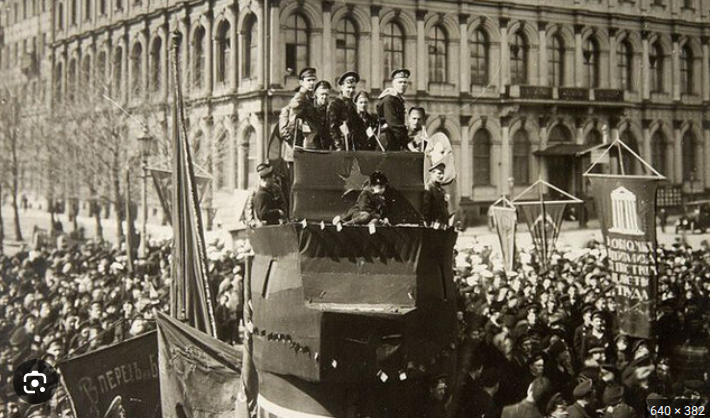
The year 1917 was a seismic turning point in world history, a year when the colossal Russian Empire, a centuries-old autocracy, crumbled in a matter of months. The Russian Revolution was not a single, tidy event, but a chaotic, sprawling, and profoundly human drama that unfolded in two major acts: the February Revolution and the October Revolution. It was a perfect storm of military defeats, food shortages, political ineptitude, and radical ideas that swept away the Tsar and ushered in the world’s first communist state. This momentous upheaval reshaped global politics for the next century, setting the stage for the Cold War and inspiring revolutionary movements across the globe. To understand how this monumental change happened, we must examine the key moments that pushed the Russian people from desperation to rebellion. Here are the top 10 events that defined the tumultuous year of the 1917 Russian Revolution.
1. International Women’s Day Protests Erupt in Petrograd (February 23)
The spark that ignited the revolution came from an unlikely source: women textile workers. On February 23, 1917 (according to the Julian calendar then used in Russia), thousands of women took to the streets of the capital, Petrograd (now St. Petersburg), to mark International Women’s Day. Their protest, however, quickly evolved beyond a planned demonstration. Fueled by desperation over severe food and fuel shortages and anger at the catastrophic losses of World War I, their chants for women’s rights turned into demands for bread and peace.
This was not just a protest; it was a dam breaking. The women marched to nearby factories, calling on the male workers to join them. To the surprise of revolutionary leaders, who had deemed the time unripe for action, the strike snowballed. Within days, hundreds of thousands of workers had downed their tools and flooded the streets. The authorities, initially dismissive, soon found themselves facing a city-wide general strike. This spontaneous uprising, led by women who had simply had enough, demonstrated the complete breakdown of public trust in the Tsarist regime and set the stage for its imminent collapse. It was the people’s patience finally snapping.
2. The Army’s Mutiny Seals the Tsar’s Fate (February 26-27)
A protest, no matter how large, can be crushed by a loyal army. For the first few days of the February uprising, the regime of Tsar Nicholas II held onto this hope. He ordered the military to suppress the strikes and restore order. Initially, some troops followed orders, firing on the crowds and killing dozens of protestors. However, this act of violence backfired spectacularly. The soldiers, mostly conscripted peasants and workers themselves, were weary of the endless, brutal war and sympathized with the demonstrators’ plight.
The turning point came when whole regiments, horrified at being ordered to fire on their own people, began to mutiny. Instead of suppressing the revolution, they joined it, turning their guns against the police and offering their support to the striking workers. This was the fatal blow to the Tsarist regime. Imagine a firewall designed to protect a system suddenly turning around and attacking the system itself. Without the loyalty of the military in the capital, the Tsar was powerless. The army’s defection transformed a massive protest into a full-blown revolution, leaving the 300-year-old Romanov dynasty defenseless and on the brink of extinction.
3. The Abdication of Tsar Nicholas II (March 2)
With Petrograd in the hands of revolutionaries and his own generals advising him that the situation was hopeless, Tsar Nicholas II faced the inevitable. On March 2, 1917, aboard the imperial train stalled at a station in Pskov, the last emperor of Russia signed the abdication manifesto. He initially sought to pass the throne to his young, chronically ill son, Alexei, but realizing the boy would likely be separated from the family, he instead named his brother, Grand Duke Michael, as his successor. However, the revolutionary tide was too strong. Michael, wisely reading the mood of the nation, refused the crown the very next day unless it was offered by a future constituent assembly.
This moment marked the unceremonious end of centuries of autocratic rule in Russia. The abdication was not a grand, dramatic finale but a quiet, almost anticlimactic event that underscored how completely the Tsar had lost control. His departure created an enormous power vacuum. With the monarchy gone, the central question became: who would now govern the vast Russian Empire? This uncertainty paved the way for a unique and unstable political arrangement that would define the months to come.
4. The “Dual Power” System Emerges (March)
Out of the ashes of the monarchy, not one, but two competing centers of authority arose. This inherently unstable situation became known as “Dual Power.” On one side was the Provisional Government, formed by members of the old parliament (the Duma). Led by liberals and moderate socialists, it was the official, internationally recognized government of Russia. Its primary goal was to continue the war effort against Germany and to steer Russia towards a Western-style liberal democracy, with a constitution to be written by a future Constituent Assembly.
On the other side was the Petrograd Soviet of Workers’ and Soldiers’ Deputies. This was a powerful, directly elected council representing the masses of the capital. It held real power on the ground, controlling the army, railways, and communications. Its famous “Order No. 1” stipulated that military orders from the Provisional Government were only to be obeyed if they did not conflict with the Soviet’s directives. This created a situation of paralysis. Think of it as a car with two drivers, each with their hands on the steering wheel, trying to go in different directions. The Provisional Government had authority without real power, while the Soviet had power without official authority. This rivalry defined Russian politics from February to October.
5. Lenin’s Return and his “April Theses” (April 3)
While the revolution was unfolding in Russia, Vladimir Lenin, the brilliant and ruthless leader of the radical Bolshevik party, was in exile in Switzerland. Sensing his moment, he arranged a deal with Germany—Russia’s enemy in the war—to transport him home. The Germans gambled that Lenin’s return would sow further chaos and pull Russia out of the war, a gamble that paid off handsomely. Lenin arrived at Finland Station in Petrograd on April 3 to a crowd of supporters.
He immediately electrified the political scene with what became known as the “April Theses.” While other socialists were cautiously cooperating with the Provisional Government, Lenin offered a clear, radical, and uncompromising program. He called for an immediate end to the war, the transfer of all power to the Soviets, the abolition of the police, army, and bureaucracy, and the nationalization of all land. His slogans—”Peace, Land, and Bread!” and “All Power to the Soviets!”—were simple, powerful, and perfectly attuned to the desires of the Russian masses. Lenin’s return and his theses transformed the Bolsheviks from a fringe group into the primary political alternative for Russians disillusioned with the Provisional Government.
6. The July Days Uprising Fails (July 3-7)
By the summer of 1917, frustration with the Provisional Government was boiling over. The war dragged on, food shortages worsened, and land reform was continually postponed. In early July, this frustration erupted into a spontaneous, armed uprising in Petrograd, known as the “July Days.” Soldiers, sailors from the nearby Kronstadt naval base, and factory workers, many of them armed, took to the streets calling for the Soviets to seize power. However, the uprising was disorganized and lacked clear leadership.
The Bolsheviks were caught off guard. While they sympathized with the protestors’ goals, they felt the timing was premature and that a successful seizure of power was not yet possible. The Provisional Government, with the help of loyal troops, successfully crushed the demonstrations. The aftermath was a disaster for the Bolsheviks. Their newspapers were shut down, warrants were issued for their leaders’ arrests, and Lenin was forced into hiding in Finland. Trotsky was imprisoned. For a moment, it seemed as if the Bolshevik movement had been broken and that the Provisional Government had weathered the storm. The July Days served as a dress rehearsal for October, teaching the Bolsheviks a crucial lesson about the need for disciplined, decisive leadership.
7. The Kornilov Affair Backfires (August 25-30)
In a desperate attempt to restore order and discipline after the July Days, the head of the Provisional Government, Alexander Kerensky, appointed a tough, conservative general named Lavr Kornilov as the supreme commander of the army. However, Kerensky soon came to fear that Kornilov was plotting a military coup to establish a right-wing dictatorship. In a panic, Kerensky publicly denounced Kornilov and called on the people to defend the revolution.
But Kerensky had a problem: the troops loyal to the Provisional Government were weak. To stop Kornilov’s advancing army, he was forced to turn to the one group with real organizational strength and armed militias: the Bolsheviks. He released their leaders from prison and armed their Red Guards. The Bolsheviks, in a brilliant tactical move, organized the defense of Petrograd. Railway workers diverted Kornilov’s trains, and Bolshevik agitators convinced his soldiers to stand down. The coup collapsed without a single shot being fired in the capital. The Kornilov Affair was a spectacular own goal for Kerensky. It destroyed his credibility, shattered the morale of the army, and, most importantly, resurrected the Bolsheviks as the saviors of the revolution, now armed and more popular than ever.
8. The Bolsheviks Seize Control of the Soviets (September)
The Kornilov Affair completely transformed the political landscape. The Provisional Government under Kerensky was left discredited and powerless, while the Bolsheviks, who had organized the successful defense of Petrograd, were hailed as heroes. Their popularity soared. Workers and soldiers, now completely disillusioned with the moderate socialists who had collaborated with Kerensky, flocked to the Bolshevik banner. This surge in support was reflected in the one place that truly mattered: the Soviets.
Throughout September 1917, the Bolsheviks began winning majorities in key city Soviets across Russia, most crucially in Petrograd and Moscow. Leon Trotsky, recently freed from prison, was elected chairman of the Petrograd Soviet. This was the decisive political turning point. With control of these powerful, democratically elected bodies, the Bolsheviks could now plausibly claim that they were acting in the name of the Russian masses. Lenin’s slogan, “All Power to the Soviets!”, was no longer just a call to action; it was a demand to recognize the political reality that the Soviets, now under Bolshevik leadership, were the true representatives of the people.
9. The Storming of the Winter Palace (October 25-26)
From his hiding place in Finland, Lenin, sensing the time was right, urged his party to prepare for an armed insurrection to seize power. On the night of October 25 (which is November 7 in the modern calendar), the October Revolution began. Unlike the spontaneous February Revolution, this was a carefully planned and executed coup organized by the Bolsheviks’ Military Revolutionary Committee, led by Leon Trotsky. Red Guard units, sailors, and loyal soldiers moved swiftly and efficiently to take control of key points in Petrograd—railway stations, post offices, bridges, and the state bank—with barely a shot fired.
The symbolic culmination of the coup was the seizure of the Winter Palace, the seat of the Provisional Government. While later Soviet propaganda depicted a heroic, mass storming of the palace, the reality was far less dramatic. With most of the city already in Bolshevik hands, a small contingent of Red Guards infiltrated the vast, poorly defended palace and arrested the ministers of the Provisional Government. Kerensky had already fled the city in a car borrowed from the American embassy. The seizure of the Winter Palace was the final, decisive act that toppled the weak Provisional Government and placed state power squarely in the hands of the Bolsheviks.
10. The Second All-Russian Congress of Soviets Approves the Seizure of Power (October 26)
As the Winter Palace was being taken, the Second All-Russian Congress of Soviets was convening in Petrograd. The Bolsheviks had timed their insurrection to coincide with this congress. As news of the successful seizure of power spread, the moderate socialist parties—the Mensheviks and Socialist Revolutionaries—denounced the Bolsheviks’ actions as an illegal coup and, in a fateful act of protest, walked out of the congress. This was a colossal political blunder. Their departure left the Bolsheviks and their Left SR allies in complete control of the congress.
Lenin, appearing in public for the first time since the July Days, addressed the remaining delegates and proclaimed the transfer of all power to the Soviets. The congress promptly passed two landmark decrees written by Lenin: the Decree on Peace, calling for an immediate end to the war, and the Decree on Land, legitimizing the peasants’ seizures of land. By having the highest representative body of the Soviets approve their actions and their initial decrees, the Bolsheviks established a claim of legitimacy for their new government. The October Revolution was complete, and the world’s first socialist state, which would soon become the Soviet Union, was born.
Further Reading
For those wishing to explore the Russian Revolution in greater detail, these books offer a fantastic starting point and are accessible to a general audience:
- A People’s Tragedy: The Russian Revolution, 1891-1924 by Orlando Figes – A comprehensive and gripping narrative that focuses on the human stories behind the epic events, considered one of the definitive accounts.
- Ten Days That Shook the World by John Reed – An electrifying, firsthand account of the October Revolution by an American journalist who was in Petrograd at the time. It offers an invaluable, if biased, ground-level view of the events as they happened.
- The Russian Revolution: A New History by Sean McMeekin – A more recent and revisionist history that challenges many traditional narratives, particularly focusing on the role of Germany and the financial aspects of the revolution.
- Towards the Flame: Empire, War and the End of Tsarist Russia by Dominic Lieven – This book provides a masterful analysis of the deep-seated causes of the revolution, focusing on the immense pressures that World War I placed on the Tsarist state.
Here at Zentara.blog, our mission is to take those tricky subjects and unlock them, making knowledge exciting and easy to grasp for everyone. But the adventure doesn’t stop on this page! We’re constantly exploring new frontiers and sharing discoveries across the digital universe. Want to dive deeper into more mind-bending Top 10s and keep expanding your world? Come join us on our other platforms – we’ve got unique experiences waiting for you on each one!
Get inspired by visual wonders and bite-sized facts: See the world through Zentara’s eyes on Pinterest!
Pin our fascinating facts and stunning visuals to your own boards. Explore Pins on Pinterest: https://uk.pinterest.com/zentarablog/
Discover quick insights and behind-the-scenes peeks: Hop over to Tumblr for snippets, quotes, and unique content you won’t find anywhere else. It’s a different flavour of discovery! Follow the Fun on Tumblr: https://www.tumblr.com/zentarablog
Ready for deep dives you can listen to or watch? We’re bringing our accessible approach to video and potentially audio! Subscribe to our YouTube channel and tune into future projects that make learning pop! Subscribe on YouTube: https://www.youtube.com/@ZentaraUK
Seeking even more knowledge in one place? We’ve compiled some of our most popular topic deep dives into fantastic ebooks! Find them on Amazon and keep the learning journey going anytime, anywhere. Find Our Ebooks on Amazon: https://www.amazon.co.uk/s?k=Zentara+UK&ref=nb_sb_noss
Connect with us and fellow knowledge seekers: Join the conversation on BlueSky! We’re sharing updates, thoughts, and maybe even asking you what wonders we should explore next. Chat with Us on BlueSky: https://bsky.app/profile/zentarablog.bsky.social
Perfect for learning on the move! We post multiple 10-minute podcasts per day on Spotify. Pop on your headphones and fill your day with fascinating facts while you’re out and about! Listen on Spotify: https://open.spotify.com/show/3dmHbKeDufRx95xPYIqKhJFollow us on Instagram for bytesize knowledge! We post multiple posts per day on our official Instagram account. https://www.instagram.com/zentarablog/ Every click helps us keep bringing honest, accessible knowledge to everyone. Thanks for exploring with us today – see you out there in the world of discovery!




Leave a Reply