
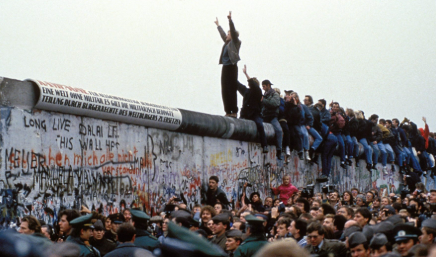
The Cold War was a conflict of ideologies, a tense global standoff fought not with armies clashing on a battlefield, but with espionage, propaganda, and the ever-present threat of nuclear annihilation. Two phrases, more than any others, came to symbolize this division: the Iron Curtain and the Berlin Wall. Though often used interchangeably, they were two distinct things. The Iron Curtain was a vast, ideological and physical barrier that separated the Soviet-controlled Eastern Bloc from the democratic West across the European continent. The Berlin Wall, on the other hand, was its most infamous and brutal physical manifestation—a concrete scar that tore a single city in two. Understanding these potent symbols is key to understanding the 20th century. Here are ten essential facts that illuminate the reality behind the rhetoric, exploring how a metaphorical curtain became a concrete reality for millions.
1. The “Iron Curtain” Was a Metaphor Long Before It Was a Wall
The term “Iron Curtain” entered the global lexicon on March 5, 1946, when former British Prime Minister Winston Churchill delivered his “Sinews of Peace” address in Fulton, Missouri. Standing alongside President Harry Truman, he famously declared: “From Stettin in the Baltic to Trieste in the Adriatic, an iron curtain has descended across the Continent.” Churchill’s powerful imagery perfectly captured the new post-war reality: the Soviet Union was sealing off its Eastern European satellite states from Western influence. 📜 However, he wasn’t the first to use the phrase. The term had been used before to describe impenetrable barriers, with some sources tracing it back to the 19th century. Even Nazi Propaganda Minister Joseph Goebbels used it in a 1945 article, predicting that a Soviet victory would lead to an “iron curtain” falling over Europe. Churchill’s speech, however, gave the metaphor its definitive Cold War meaning, transforming it into a rallying cry for Western nations and the defining image of a continent divided by suspicion and communist totalitarianism.
2. The Berlin Wall Was Built Overnight to Stop a “Brain Drain”
By 1961, the ideological divide of the Iron Curtain was causing a serious problem for the communist government of East Germany (the German Democratic Republic, or GDR). West Berlin, a prosperous, democratic enclave located deep inside East German territory, was a beacon of freedom and an easy escape route to the West. Between 1949 and 1961, an estimated 2.5 million East Germans, many of them highly skilled professionals like doctors, engineers, and teachers, fled to the West. This mass exodus, known as the “brain drain” (Republikflucht), was crippling the East German economy and was a profound public embarrassment for the communist regime. To stop the bleeding, East German leader Walter Ulbricht, with the backing of Soviet Premier Nikita Khrushchev, took drastic action. In the dead of night on August 13, 1961, soldiers and construction workers began to tear up streets and erect barbed wire fences, which were quickly replaced by a concrete wall. Families were separated in an instant, and the last gap in the Iron Curtain was violently slammed shut.
3. The Berlin Wall Was Actually Two Walls
When people picture the Berlin Wall, they usually imagine a single, graffiti-covered slab of concrete. The reality was far more complex and terrifying. The barrier was not just one wall but a sophisticated system of fortifications. It consisted of two parallel walls separated by a wide, barren area known as the “Death Strip.” This strip was a gauntlet of horrors designed to make escape nearly impossible. It was covered in raked sand or gravel to show footprints, floodlit at night, and patrolled by armed guards in watchtowers with orders to shoot to kill. It also contained anti-vehicle trenches, beds of nails (nicknamed “Stalin’s Carpet”), and trip-wire machine guns. For anyone attempting to cross, the journey meant surviving the initial climb over the inner wall, then navigating the deadly, open expanse of the Death Strip while under fire, before facing the final, taller outer wall. This brutal design turned a political boundary into a lethal trap.
4. Checkpoint Charlie Was Just One of Several Crossing Points
Thanks to countless spy novels and films, Checkpoint Charlie is the most famous crossing point of the Berlin Wall, but it was just one of several. Its fame comes from the fact that it was the main crossing point for foreigners, Allied military personnel, and diplomats. It was the site of a tense 1961 standoff between U.S. and Soviet tanks, a moment that brought the world to the brink of war. टैंक However, for West Germans, the main crossing was at the Friedrichstraße station, known as the Tränenpalast or “Palace of Tears,” because of the emotional goodbyes between Western visitors and their East German relatives who were not allowed to leave. There were other checkpoints for different purposes, such as trade and transit. Checkpoint Charlie’s high-profile, dramatic role in the Cold War narrative cemented its place in popular culture, but it’s important to remember it was part of a larger, more mundane system of control that governed the daily lives of divided Berliners.
5. Over 140 People Died Trying to Cross the Berlin Wall
The exact number of people who died trying to cross the Berlin Wall is debated, but the official figure from the Berlin Wall Memorial is at least 140 confirmed deaths. These victims came from all walks of life—men, women, and children—and their stories are a testament to the human desire for freedom. The first victim was Ida Siekmann, who died in August 1961 after jumping from her third-floor apartment window on a street that bordered the West. The last person to be shot and killed was 20-year-old Chris Gueffroy, in February 1989, just nine months before the wall fell. People attempted to escape in incredibly creative and desperate ways: through hand-dug tunnels, in hidden compartments in cars, by flying hot-air balloons, and even by ramming the barriers with armored vehicles. Each death was a tragedy that highlighted the brutal inhumanity of the wall and the regime that built it.
6. The Iron Curtain Was a Physical Barrier Hundreds of Miles Long
While the Berlin Wall was the most concentrated section, the Iron Curtain itself was a physical reality stretching across Europe. From the border between East and West Germany to the frontiers of Czechoslovakia and Hungary with Austria, communist regimes built a massive network of fences, walls, and watchtowers. The German-German border alone was over 860 miles (1,393 km) long. Much like the Berlin Wall, this border was heavily fortified. It included double or triple-layered barbed-wire fences, minefields, and automated firing devices. A strip of land on the eastern side was cleared to give guards a clear line of sight. This militarization of an entire continent was a monumental undertaking, designed to create a hermetically sealed bloc of nations. It physically manifested the political division, turning neighboring countries into hostile frontiers and severing centuries-old cultural and economic ties.
7. JFK’s Famous “Ich bin ein Berliner” Speech Was a Huge Morale Boost
In June 1963, U.S. President John F. Kennedy visited West Berlin to deliver a speech that would become one of the most memorable of the Cold War. Standing before hundreds of thousands of cheering West Berliners, he delivered a defiant message of solidarity. To underscore his point, he declared, “Ich bin ein Berliner” (“I am a Berliner”). This simple phrase was a powerful statement. It meant that all free people, wherever they lived, were citizens of Berlin in spirit and stood with them against communist oppression. While there is a popular urban legend that he mistakenly called himself a “jelly doughnut” (a “Berliner” is a type of pastry), this is incorrect. In context, his grammar was perfectly acceptable, and his audience understood his meaning perfectly. The speech was a massive morale boost for the isolated city, reassuring its inhabitants that the West, and particularly the United States, would not abandon them. 🎤
8. The Fall of the Wall in 1989 Was a Historic Accident
The Berlin Wall fell on the evening of November 9, 1989, but its sudden collapse was not planned. It was the result of a bureaucratic blunder. Amidst growing protests and pressure from reform movements across Eastern Europe, the East German government decided to slightly ease travel restrictions. On the evening news, a mid-level party official named Günter Schabowski was tasked with announcing the new regulations at a press conference. He hadn’t been fully briefed and, when pressed by a reporter about when the new rules would take effect, he shuffled through his papers and improvized, stating, “As far as I know… effective immediately, without delay.” The news spread like wildfire. Thousands of East Berliners streamed to the border crossings, stunning the guards who had received no new orders. Unwilling to open fire on the massive, peaceful crowds, the overwhelmed border guards eventually opened the gates. The party was on, as people from both sides climbed the wall, celebrating a moment nobody thought they would see.
9. Pieces of the Berlin Wall Are Scattered All Over the World
After its fall, the Berlin Wall was quickly dismantled, but it did not disappear. It was broken into thousands of pieces, which became powerful symbols of freedom’s triumph over tyranny. Segments of the wall can now be found in cities across the globe. There are pieces on display at the Ronald Reagan Presidential Library in California, in the gardens of the United Nations in New York, outside the Imperial War Museum in London, and even in a men’s restroom at the Main Street Station casino in Las Vegas. These scattered fragments serve as tangible reminders of the Cold War. They are both historical artifacts and works of art, often covered in the graffiti that came to define the wall’s western side. Owning a piece of the wall became a popular, if commercialized, way to own a piece of history, ensuring that the memory of what it stood for would not be forgotten.
10. The Iron Curtain Had a Surprising Environmental Legacy
One of the most unexpected long-term consequences of the Iron Curtain was the creation of a massive, accidental nature preserve. The heavily militarized and restricted border zones, particularly the one running through the heart of Germany, were largely untouched by human development for over 40 years. This “no-man’s-land” allowed nature to reclaim the territory. After the fall of the wall and the reunification of Germany, conservationists recognized the unique ecological value of this corridor. Today, this area is known as the European Green Belt. It is a chain of parks and nature reserves stretching for thousands of miles along the path of the former Iron Curtain, from Finland to the Black Sea. It is a remarkable habitat for rare and endangered species, including bears, wolves, and black storks. In a beautiful historical irony, a border designed to divide people and enforce a brutal ideology has transformed into a symbol of natural reconnection and ecological hope. 🌳
Further Reading
For those who wish to delve deeper into the history of the Cold War’s most iconic symbols, these books are excellent resources:
- “The Berlin Wall: A World Divided, 1961-1989” by Frederick Taylor
- “Iron Curtain: The Crushing of Eastern Europe, 1944-1956” by Anne Applebaum
- “Stasiland: Stories from Behind the Berlin Wall” by Anna Funder
- “The Tunnels: Escapes Under the Berlin Wall and the Historic Films the JFK White House Tried to Kill” by Greg Mitchell
- “Churchill’s Iron Curtain: The Cold War in Words and Deeds” by Patrick Wright
Here at Zentara.blog, our mission is to take those tricky subjects and unlock them, making knowledge exciting and easy to grasp for everyone. But the adventure doesn’t stop on this page! We’re constantly exploring new frontiers and sharing discoveries across the digital universe. Want to dive deeper into more mind-bending Top 10s and keep expanding your world? Come join us on our other platforms – we’ve got unique experiences waiting for you on each one!
Get inspired by visual wonders and bite-sized facts: See the world through Zentara’s eyes on Pinterest!
Pin our fascinating facts and stunning visuals to your own boards. Explore Pins on Pinterest: https://uk.pinterest.com/zentarablog/
Discover quick insights and behind-the-scenes peeks: Hop over to Tumblr for snippets, quotes, and unique content you won’t find anywhere else. It’s a different flavour of discovery! Follow the Fun on Tumblr: https://www.tumblr.com/zentarablog
Ready for deep dives you can listen to or watch? We’re bringing our accessible approach to video and potentially audio! Subscribe to our YouTube channel and tune into future projects that make learning pop! Subscribe on YouTube: https://www.youtube.com/@ZentaraUK
Seeking even more knowledge in one place? We’ve compiled some of our most popular topic deep dives into fantastic ebooks! Find them on Amazon and keep the learning journey going anytime, anywhere. Find Our Ebooks on Amazon: https://www.amazon.co.uk/s?k=Zentara+UK&ref=nb_sb_noss
Connect with us and fellow knowledge seekers: Join the conversation on BlueSky! We’re sharing updates, thoughts, and maybe even asking you what wonders we should explore next. Chat with Us on BlueSky: https://bsky.app/profile/zentarablog.bsky.social
Perfect for learning on the move! We post multiple 10-minute podcasts per day on Spotify. Pop on your headphones and fill your day with fascinating facts while you’re out and about! Listen on Spotify: https://open.spotify.com/show/3dmHbKeDufRx95xPYIqKhJFollow us on Instagram for bytesize knowledge! We post multiple posts per day on our official Instagram account. https://www.instagram.com/zentarablog/ Every click helps us keep bringing honest, accessible knowledge to everyone. Thanks for exploring with us today – see you out there in the world of discovery!




Leave a Reply