
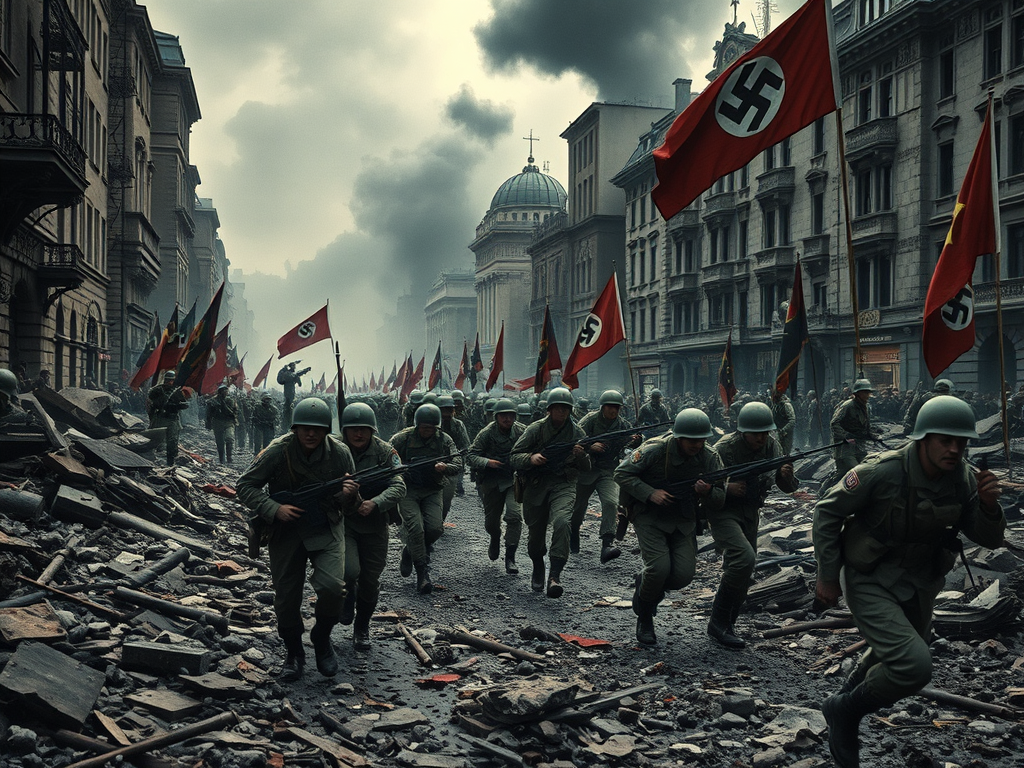
Imagine a powerful empire, once seemingly unstoppable, crumbling day by day, hour by hour. That’s exactly what happened to Nazi Germany, also known as the Third Reich, in the last few months of World War 2. From January to May 1945, the Allied armies, from both the West and the East, closed in on Hitler’s stronghold, leading to the dramatic and devastating period known as “The Final 100 Days.”
This was a time of intense fighting, desperate resistance, and unimaginable suffering, but also of ultimate victory for the forces of freedom. It saw the last major battles, the collapse of a brutal dictatorship, and the liberation of millions from Nazi tyranny. The Fall of the Reich wasn’t a sudden event, but a rapid, brutal, and ultimately inevitable end to a horrific chapter in human history. Let’s explore ten key moments and aspects of this crucial period.
1. The Desperate Last Stand: The Battle of the Bulge Aftermath
As 1945 began, Nazi Germany was reeling from its last major offensive, the Battle of the Bulge, which ended in January. Although the Germans had surprised the Allies and caused heavy casualties, their attack ultimately failed. This defeat drained Germany of its last reserves of men, tanks, and fuel. It was a desperate gamble that cost them dearly and left their armies exhausted and vulnerable.
The Allies, despite their own losses, quickly regained the initiative. From the west, American, British, and Canadian forces began pushing deeper into Germany. From the east, the powerful Soviet Red Army launched massive new offensives. The failure of the Battle of the Bulge meant that Germany no longer had the strength to launch major counterattacks, sealing their fate and setting the stage for the relentless advance of the Allied armies from both sides.
2. The Eastern Avalanche: The Soviet Drive to Berlin
While the Western Allies were pushing from the west, the Soviet Red Army launched an enormous offensive in January 1945 that would become unstoppable. They attacked across Poland and East Prussia, driving millions of German soldiers and civilians before them. The Soviets were determined to reach Berlin, the capital of the Third Reich, first, driven by years of immense suffering at Nazi hands on the Eastern Front.
The Soviet advance was incredibly fast and brutal. They overwhelmed German defenses, which were often manned by old men and young boys. Cities like Warsaw were liberated, but the fighting was fierce, and millions of German civilians fled westward, terrified of the approaching Red Army. This relentless drive from the east put immense pressure on Hitler’s regime, forcing Germany to fight a devastating two-front war against overwhelming forces.
3. Crossing the Rhine: The Western Allies Push In
As the Soviets advanced from the east, the Western Allies (primarily American, British, and Canadian forces) prepared for one of their most challenging operations: crossing the Rhine River. The Rhine was a major natural barrier and a heavily defended line that the Germans hoped to hold. Capturing bridges and establishing bridgeheads across the river was crucial for the final advance into the heart of Germany.
In March 1945, the Allies launched massive assaults, using specially designed amphibious vehicles and overcoming fierce German resistance. A crucial moment came when American forces unexpectedly captured the intact Remagen Bridge over the Rhine, allowing troops and tanks to pour across. Crossing the Rhine broke Germany’s last major defensive line in the west, and from there, the Allied armies fanned out, encircling German forces and advancing rapidly towards the Elbe River, where they would eventually meet the Soviets.
4. The Race to Berlin: Who Would Get There First?
As both the Soviet and Western Allied armies pushed into Germany, a silent race to Berlin began. The Soviets, having borne the brunt of the fighting on the Eastern Front for years, felt they had the right to capture the Nazi capital. The Western Allies, while also eager to finish the war, focused more on encircling German armies and securing industrial regions.
General Dwight D. Eisenhower, the Supreme Allied Commander, decided that the human cost of taking Berlin would be too high for his Western forces, and that the city was strategically less important than encircling German armies. He allowed the Soviets to take the lead in capturing Berlin. This decision, though debated, ultimately shaped the final days of the war in Europe, ensuring that the Soviets would have the bloody honor of taking Hitler’s capital.
5. The Battle for Berlin: The Final Showdown
The Battle for Berlin in April 1945 was one of the most intense and brutal urban battles in history. Over two million Soviet soldiers, supported by thousands of tanks and artillery pieces, launched a massive assault on the heavily defended German capital. Hitler, holed up in his bunker, ordered his remaining forces, including old men and even children, to fight to the death.
The fighting was street-by-street, building-by-building, as the Soviets systematically advanced through the ruined city. German resistance was fanatical in some areas, but ultimately hopeless. The city became a scene of utter devastation. This final showdown was a desperate, bloody end to the Third Reich, as the Soviet flag was eventually raised over the Reichstag (German parliament building), symbolizing the ultimate victory.
6. Hitler’s Last Days and Suicide in the Bunker
As the Red Army fought its way through Berlin, Adolf Hitler retreated into his underground bunker beneath the Reich Chancellery. In these final 100 days, his grip on reality slipped further, and he continued to issue impossible orders to non-existent armies. He refused to surrender, clinging to the bitter end to the delusion that Germany could still win.
On April 30, 1945, with Soviet troops just blocks away, Adolf Hitler committed suicide in his bunker, along with his new wife, Eva Braun. His death marked the final, symbolic end of the Nazi dictatorship. Without their leader, the remaining German resistance rapidly crumbled. His suicide was a desperate act of cowardice, avoiding the consequences of his horrific crimes and leaving his nation in ruins.
7. The End of the War in Europe: V-E Day
With Hitler dead and Berlin fallen, the remaining German forces had no choice but to surrender. On May 7, 1945, German representatives signed the unconditional surrender document at Reims, France, marking the end of World War 2 in Europe. The next day, May 8, 1945, was officially declared Victory in Europe (V-E) Day.
Celebrations erupted around the world, as millions rejoiced that the terrible war in Europe was finally over. People danced in the streets, parades were held, and the world breathed a collective sigh of relief. V-E Day marked the formal Fall of the Reich and the liberation of millions from Nazi tyranny, ushering in a new, albeit challenging, era of peace on the continent.
8. The Cost of Victory: Devastation and Casualties
The Final 100 Days of the war, though bringing victory, came at an immense cost. Germany itself was left in ruins, with its cities bombed, infrastructure destroyed, and millions displaced. The battles in the final weeks were incredibly bloody, with high casualties on both the Allied and German sides. The Soviet Union, having already lost tens of millions, continued to suffer immense losses in the push to Berlin.
Beyond the battlefield, the liberation of concentration camps revealed the full horror of the Holocaust, showing the world the true depths of Nazi evil. The sheer scale of destruction and human suffering left a lasting scar on Europe. The victory was hard-won and came at a price that would take decades to recover from, highlighting the terrible human cost of totalitarianism and war.
9. Liberation of Concentration Camps: Uncovering the Horrors
As the Allied armies advanced into Germany and Nazi-occupied territories, they began to discover and liberate the Nazi concentration and extermination camps. The sight that greeted them was horrifying beyond words: piles of bodies, emaciated survivors, and undeniable evidence of the systematic murder of millions of Jewish people and other victims of the Holocaust.
Soldiers, who had witnessed terrible combat, were often deeply traumatized by what they saw. They worked quickly to provide aid to the survivors and to document the atrocities. The discovery of these camps revealed the full extent of Nazi depravity to the world and underscored the moral imperative of defeating the Third Reich. The liberation of the camps was a somber but absolutely crucial part of the Fall of the Reich, exposing the ultimate evil the Allies had fought against.
10. The Legacy of the Fall: A World Transformed
The Fall of the Reich in its Final 100 Days had a profound and lasting impact on the world. It marked the end of World War 2 in Europe and the utter defeat of Nazi Germany, leading to the creation of a new global order. Germany was divided into East and West, and the Cold War between the Western Allies and the Soviet Union quickly emerged.
The lessons learned from the Nazi regime’s rise and fall heavily influenced the creation of the United Nations, a new commitment to human rights, and the determination to prevent such a terrible war from ever happening again. The incredible sacrifice and cooperation of the Allied nations to defeat such a powerful evil reshaped international relations forever. The final days of the war in Europe remind us of the desperate struggle for freedom and the ultimate triumph over tyranny.
Further Reading
- “The Fall of Berlin 1945” by Antony Beevor (A detailed but accessible account for older readers)
- “World War II: The European Theater” by Russell Freedman (Provides broader context of the European war)
- “Hidden in Plain Sight: The Story of World War II” by Andrew Glass (Covers key events in a kid-friendly way)
- “Escape From the Holocaust: A Kid’s Story” by Mike W. Barr (Focuses on the experiences of survivors and liberation)
- “V-E Day (Dates in History)” by Dale Anderson (Specifically about the end of the war in Europe)
Here at Zentara.blog, our mission is to take those tricky subjects and unlock them, making knowledge exciting and easy to grasp for everyone. But the adventure doesn’t stop on this page! We’re constantly exploring new frontiers and sharing discoveries across the digital universe.
Want to dive deeper into more mind-bending Top 10s and keep expanding your world? Come join us on our other platforms – we’ve got unique experiences waiting for you on each one!
- Get inspired by visual wonders and bite-sized facts: See the world through Zentara’s eyes on Pinterest! Pin our fascinating facts and stunning visuals to your own boards. Explore Pins on Pinterest: https://uk.pinterest.com/zentarablog/
- Discover quick insights and behind-the-scenes peeks: Hop over to Tumblr for snippets, quotes, and unique content you won’t find anywhere else. It’s a different flavour of discovery! Follow the Fun on Tumblr: https://www.tumblr.com/zentarablog
- Ready for deep dives you can listen to or watch? We’re bringing our accessible approach to video and potentially audio! Subscribe to our YouTube channel and tune into future projects that make learning pop! Subscribe on YouTube: https://www.youtube.com/@ZentaraUK
- Seeking even more knowledge in one place? We’ve compiled some of our most popular topic deep dives into fantastic ebooks! Find them on Amazon and keep the learning journey going anytime, anywhere. Find Our Ebooks on Amazon: https://www.amazon.co.uk/s?k=Zentara+UK&ref=nb_sb_noss
- Connect with us and fellow knowledge seekers: Join the conversation on BlueSky! We’re sharing updates, thoughts, and maybe even asking you what wonders we should explore next. Chat with Us on BlueSky: https://bsky.app/profile/zentarablog.bsky.social
- Perfect for learning on the move! We post multiple 10-minute podcasts per day on Spotify. Pop on your headphones and fill your day with fascinating facts while you’re out and about! Listen on Spotify: https://open.spotify.com/show/3dmHbKeDufRx95xPYIqKhJ
Every click helps us keep bringing honest, accessible knowledge to everyone. Thanks for exploring with us today – see you out there in the world of discovery!




Leave a Reply