
Table of Contents
In the vast, uncharted territory of 1970s science fiction—a decade that existed in the long shadow of Star Trek‘s cancellation and just before the explosion of Star Wars—one show stands alone. It was a high-concept, high-fashion, and high-budget epic of survival. That show was Space: 1999. It didn’t offer a hopeful future of exploration; it presented a terrifying accident, a story of 311 human beings ripped from their home and thrown into the cosmic void.
The show’s premise was as stark as it was unforgettable: on September 13, 1999, a massive explosion of nuclear waste stored on the Moon’s far side blasts the entire satellite out of Earth’s orbit, hurtling it into deep space. The inhabitants of Moonbase Alpha are, in an instant, a new, lost tribe of humanity. They are not explorers. They are survivors. This bleak, existential setup gave birth to one of the most visually stunning, philosophically ambitious, and famously troubled sci-fi series ever made. We’re opening the commlock and diving deep into 10 facts about this Gerry Anderson classic.
1. It Was the Most Expensive TV Show Ever Made (At the Time)
In the mid-1970s, science fiction was still largely considered “B-movie” fare for children. Gerry Anderson (along with his wife, Sylvia Anderson) wanted to change that. Coming off their massively successful “Supermarionation” puppet shows like Thunderbirds and Captain Scarlet, they wanted to create a live-action epic that looked as good as a feature film.
The result was Space: 1999, a British production that, at the time, was the most expensive television series ever produced. With a staggering budget of what would be tens of millions in today’s money, the show was a cinematic event every week. The money was all on the screen. It was spent on enormous, detailed sets for Moonbase Alpha, high-quality film stock (not cheap video), and, most importantly, groundbreaking Space: 1999 special effects. This budget gave the show its signature look: cold, beautiful, and vast. It was the Game of Thrones of its day, a massive financial gamble on a genre that was, at the time, still unproven on the small screen.
2. The Premise is Glorious, Poetic, Scientific Nonsense
Let’s get this out of the way: the science behind the show’s core premise is, to put it lightly, impossible. The idea that a single explosion—even a massive nuclear one—could propel the Moon out of orbit without shattering it into a billion pieces, killing all 311 inhabitants, or radically altering Earth’s tides, is pure fantasy. And the idea that it would then travel faster than light, visiting new star systems every week, is even more so.
But here’s the secret: it doesn’t matter. The show isn’t “hard” sci-fi; it’s a “science fantasy” premise, a brilliant and terrifying update on the “lost in space” trope. The premise is not a scientific problem to be solved; it’s a “supposal,” a thought experiment. It’s a Greek myth. The explosion is the capricious act of the gods, and the Alphans are the new Argonauts, cast out of their homeland (Earth’s orbit) to wander an endless, uncharted sea (deep space), searching for a new home.
3. The Eagle Transporter Is an Icon of “Practical” Sci-Fi Design
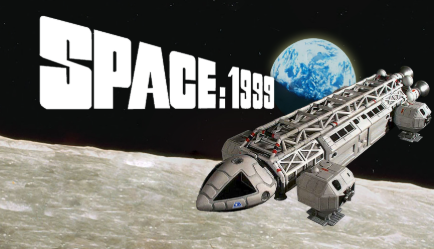
While the show’s premise was fantasy, its hardware was pure, believable grit. If Space: 1999 gave the world one enduring gift, it’s the Eagle Transporter. Designed by the legendary Brian Johnson (who, based on his work here, would be snapped up to work on Alien and The Empire Strikes Back), the Eagle is widely considered one of the most realistic spaceship designs in sci-fi history.
It’s not a sleek, aerodynamic “X-Wing.” It’s a workhorse. It is a “pickup truck,” not a “Ferrari.” The design is modular, with a central “pod” that can be swapped out for transport, reconnaissance, or rescue missions. Its exposed framework, functional landing gear, and visible maneuvering thrusters make it look less like a “spaceship” and more like a piece of 21st-century industrial equipment. It was the “used future” before Star Wars made it famous, and its influence on practical, functional sci-fi design is immeasurable.
4. It Starred a Real-Life Hollywood Power Couple
A huge chunk of that record-breaking budget went to securing its stars. To give the British show a necessary “American” appeal for international sales, the producers cast a real-life married couple: Martin Landau and Barbara Bain.
This was a massive “get.” The pair were a true Hollywood power couple, having just come off the global success of the hit series Mission: Impossible. Landau (as Commander John Koenig) and Bain (as Dr. Helena Russell) brought a level of acting prestige and gravitas that was rare for a sci-fi show. Their real-life relationship created a unique, subtle, and often cold on-screen chemistry. They weren’t a passionate TV couple; they were two weary, stressed professionals trying to lead, their intimacy shown through shared, quiet moments of desperation rather than grand romantic gestures.
5. Season 1 Was a Cold, Existential Horror Show
This is the Space: 1999 that die-hard fans and critics still rave about. The first season, produced by the Andersons, was not a fun space adventure. It was a bleak, philosophical, and often terrifying journey into the unknown. Influenced heavily by 2001: A Space Odyssey, the tone was one of existential dread.
The Alphans weren’t explorers; they were survivors. The universe they encountered was not full of friendly, humanoid aliens. It was a bizarre, hostile, and utterly incomprehensible place. Episodes like “Dragon’s Domain” featured a genuinely horrifying, tentacled monster that lived in a spaceship graveyard. “Black Sun” saw the Moon pass through a black hole, where the crew had a collective, god-like mystical experience. The show was slow, atmospheric, and asked big questions about humanity’s place in a cold, godless (or god-filled) universe. It was, in many ways, a prestige “horror-sci-fi” show, 40 years ahead of its time.
6. Season 2 Was a “Star Trek” Makeover That Got It Canceled
The philosophical, slow-burn first season was a critical darling for some, but a ratings puzzle for its American distributors. They demanded changes. For Space: 1999 Season 2, the Andersons were pushed out, and a new American producer was brought in: Fred Freiberger.
This name is infamous in sci-fi circles. Freiberger was the producer of… Star Trek Season 3. The season that got Star Trek canceled. He was known as the “show killer,” and his mandate for Space: 1999 was simple: more action, more monsters, more color, and more “fun.”
The changes were jarring. The moody, orchestral score was replaced with a disco-infused action theme. The uniforms got more colorful. Koenig became a fist-fighting action hero. And, most famously, they added a new alien character: Maya, a shape-shifter from the planet Psychon. Played by Catherine Schell, Maya was the “Spock” character, an outsider who could turn into any animal, which made the show a “monster of the week” action-adventure. The tonal shift alienated the original fans, failed to attract new ones, and the show was canceled after its second, deeply divisive season.
7. It Was the “Anti-Star Trek”
While Star Trek was about a utopian, optimistic Federation exploring the galaxy with a moral code, Space: 1999 was its dark mirror. The Alphans were not a unified utopia; they were 311 normal, flawed, and terrified people who frequently bickered, despaired, and made terrible choices.
There was no “Prime Directive.” The Alphans were desperate survivors. In one episode, they try to steal an engine from an alien ship. In others, they consider abandoning their sick and disabled to conserve resources. Their mission wasn’t to “seek out new life,” it was to survive. Commander John Koenig was not an idealistic Captain Kirk; he was a pragmatic, exhausted leader, making impossible choices to hold his fragile community together. The show argued that in the face of true, existential crisis, our “humanity” is the first thing to crack.
8. The “Look” Was Pure 1970s High-Fashion Sci-Fi
Beyond the ships, the show’s entire aesthetic, masterminded by Sylvia Anderson, was a time capsule of 1970s European high fashion. The sets for Moonbase Alpha were not cold, white, and sterile like in 2001. They were filled with designer Kar-Tell chairs, bright orange cushions, modular furniture, and “lounge” areas. It looked less like a NASA base and more like a high-end 1970s airport lounge that happened to be on the Moon.
The Space: 1999 uniforms are legendary. The Season 1 one-piece jumpsuits, with their single-sleeve zipper and flared bell-bottoms, are pure 70s chic. This “sci-fi-as-fashion” look created a unique, stylish, and slightly “camp” (in the high-art sense) world that no other sci-fi show has ever managed to replicate.
9. It Had a “Lost” Season 3… Sort Of
After the Season 2 cancellation, the Alphans were left still wandering in space, their story unfinished. For decades, this was a sore spot for fans. Then, in 1999—the actual year the show was set—a small miracle happened.
A fan convention in Los Angeles, celebrating the fictional “Breakaway” date, managed to produce a “lost” ending. This 7-minute short film, “Message from Moonbase Alpha,” was written by one of the original series writers, Johnny Byrne. It featured Barbara Bain reprising her role as Dr. Helena Russell, recording a final message 25 years after “Breakaway.” She explains that the Alphans finally found a habitable world, “Terra Alpha,” and are abandoning the now-failing Moonbase to settle it. It’s a beautiful, bittersweet, and “soft-canon” ending that finally gave the Alphans the home they were searching for.
10. Its Legacy Is in “Used Future” and High-Concept TV
Space: 1999 may not have the mainstream fame of Star Trek or Star Wars, but its influence of Space: 1999 is arguably just as profound. Its legacy is twofold.
First, its “hardware” created the “used future” aesthetic. The functional, industrial, and “believable” look of the Eagle Transporter was a direct influence on Star Wars and Alien. In fact, George Lucas originally approached Gerry Anderson’s effects team to work on his film.
Second, the high-concept, philosophical, and bleak tone of Season 1 was a direct precursor to modern “prestige” sci-fi. The reboot of Battlestar Galactica (a show about 50,000 survivors on the run, led by a weary commander) owes a massive debt to the themes Space: 1999 pioneered. It was a show ahead of its time, a crucial bridge between the optimism of the 60s and the grittier, more complex sci-fi that would define the 80s and beyond.
Further Reading
Want to explore the final frontier of the Alphans’ journey? Here are a few essential books that dive deep into the show’s complex history and stunning visuals.
- Space: 1999 – The Vault by Chris Bentley
- A gorgeous, large-format “coffee table” book packed with rare and unseen production photos, concept art, and behind-the-scenes stories from the making of the series.
- Destination: Moonbase Alpha – The Unofficial and Unauthorised Guide to Space: 1999 by Robert E. Wood
- An exhaustive, episode-by-episode guide that analyzes the plots, themes, and production history of both seasons. An essential companion for any deep-dive rewatch.
- Gerry Anderson: The Authorised Biography by Simon Archer
- To truly understand Space: 1999, you must understand its brilliant, ambitious, and often-conflicted creator. This biography provides the crucial context for why and how the show was made.
Here at Zentara.blog, our mission is to take those tricky subjects and unlock them, making knowledge exciting and easy to grasp for everyone. But the adventure doesn’t stop on this page! We’re constantly exploring new frontiers and sharing discoveries across the digital universe. Want to dive deeper into more mind-bending Top 10s and keep expanding your world? Come join us on our other platforms – we’ve got unique experiences waiting for you on each one!
Get inspired by visual wonders and bite-sized facts: See the world through Zentara’s eyes on Pinterest!
Pin our fascinating facts and stunning visuals to your own boards. Explore Pins on Pinterest: https://uk.pinterest.com/zentarablog/
Discover quick insights and behind-the-scenes peeks: Hop over to Tumblr for snippets, quotes, and unique content you won’t find anywhere else. It’s a different flavour of discovery! Follow the Fun on Tumblr: https://www.tumblr.com/zentarablog
Ready for deep dives you can listen to or watch? We’re bringing our accessible approach to video and potentially audio! Subscribe to our YouTube channel and tune into future projects that make learning pop! Subscribe on YouTube: https://www.youtube.com/@ZentaraUK
Seeking even more knowledge in one place? We’ve compiled some of our most popular topic deep dives into fantastic ebooks! Find them on Amazon and keep the learning journey going anytime, anywhere. Find Our Ebooks on Amazon: https://www.amazon.co.uk/s?k=Zentara+UK&ref=nb_sb_noss
Connect with us and fellow knowledge seekers: Join the conversation on BlueSky! We’re sharing updates, thoughts, and maybe even asking you what wonders we should explore next. Chat with Us on BlueSky: https://bsky.app/profile/zentarablog.bsky.social
Perfect for learning on the move! We post multiple 10-minute podcasts per day on Spotify. Pop on your headphones and fill your day with fascinating facts while you’re out and about! Listen on Spotify: https://open.spotify.com/show/3dmHbKeDufRx95xPYIqKhJFollow us on Instagram for bytesize knowledge! We post multiple posts per day on our official Instagram account. https://www.instagram.com/zentarablog/ Every click helps us keep bringing honest, accessible knowledge to everyone. Thanks for exploring with us today – see you out there in the world of discovery!




Leave a Reply