
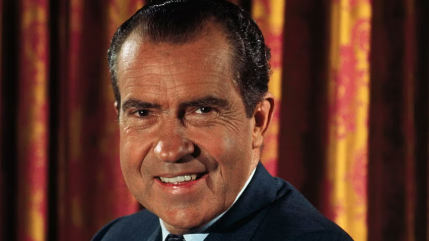
The Man Behind the Mask: Unraveling the Enigma of the 37th President
Table of Contents
Richard Nixon is perhaps the most scrutinized, analyzed, and caricatured figure in American political history. For most people, his name is synonymous with a single word: Watergate. The scandal that ended his presidency in 1974 has cast such a long shadow that it often obscures the rest of his complex, consequential, and often bizarre life. He is remembered as the villain in the history books, the “crook” who resigned in disgrace, the man with the jowls and the V-sign.
But to reduce Nixon to just his downfall is to miss the story of one of the most fascinating individuals to ever occupy the Oval Office. He was a man of immense contradictions: a Quaker who waged war, a conservative who created the Environmental Protection Agency, and a socially awkward introvert who dominated the world stage. He was a brilliant strategist with a crippling insecurity, a musical prodigy who preferred bowling, and a geopolitical giant who was once rejected for a job as a beat cop.
Whether you view him as a political genius or a cautionary tale, the details of his life read more like fiction than biography. Beyond the tapes and the resignation letter lies a treasure trove of strange and surprising trivia. Here are 10 interesting facts you probably didn’t know about Richard Nixon, the man they called “Tricky Dick.”
1. He Was Almost an FBI Agent (But Was Ghosted)
Long before he was the leader of the free world, young Richard Nixon had a very different career path in mind. In 1937, fresh out of Duke University Law School, he applied to become a special agent with the FBI. He was a serious, disciplined young man with a sharp legal mind—seemingly the perfect candidate for J. Edgar Hoover’s G-men.
He completed the interviews and physical exams, and by all accounts, he was qualified. He waited for the call that would start his career in law enforcement… but the phone never rang. Assuming he had been rejected, he moved back to California to practice law. Decades later, when he was Vice President, he finally asked J. Edgar Hoover what had happened. It turned out he had been accepted, but due to budget cuts, his appointment was canceled at the last minute, and the notification letter was never sent. If Congress hadn’t tightened the purse strings in 1937, Nixon might have spent his life chasing bank robbers instead of the presidency.
2. He Was a Musical Prodigy Who Played Five Instruments
When we think of Nixon, we usually picture him in a stiff suit, looking uncomfortable. We rarely picture him as a multi-instrumentalist who could have easily joined a band. Yet, Nixon was arguably the most musically talented president in U.S. history.
His primary instrument was the piano, which he played with genuine skill and emotion (famously performing his own composition on The Jack Paar Program in 1963). But he didn’t stop there. He could also play the saxophone, clarinet, accordion, and violin. His musical ability wasn’t just a parlor trick; it was a deep-seated passion that provided him an escape from the rigors of political life. During the Grand Ole Opry in 1974, he even played “God Bless America” on the piano while the crowd sang along. It remains a strange image: the buttoned-up Cold Warrior who could tickle the ivories like a pro.
3. He Used the “Madman Theory” to Scare World Leaders
In international relations, stability is usually the goal. Nixon, however, saw value in appearing completely unhinged. He and his National Security Advisor, Henry Kissinger, developed what they called the “Madman Theory.” The strategy was simple but terrifying: convince hostile nations (specifically North Vietnam and the Soviet Union) that Nixon was so volatile, so obsessed with stopping communism, and so irrational that he might push the nuclear button if provoked.
Nixon reportedly told his aide H.R. Haldeman, “I want the North Vietnamese to believe I’ve reached the point where I might do anything to stop the war.” To sell the ruse, he would occasionally have his military go on high alert or fly nuclear-armed bombers near Soviet airspace, just to make the threat look credible. It was a high-stakes game of geopolitical poker where Nixon’s “tell” was pretending to be on the verge of a nervous breakdown.
4. He Quietly Desegregated Southern Schools
This is one of the great paradoxes of the Nixon presidency. He is often associated with the “Southern Strategy,” a political tactic to win over white Southern voters by appealing to racial grievances. Yet, in practice, the Nixon administration oversaw the most rapid and peaceful desegregation of Southern public schools in history.
When Nixon took office in 1969, about 68% of Black children in the South attended all-Black schools. By 1974, that number had dropped to 8%. Unlike the high-profile, National Guard-enforced integration of the Eisenhower and Kennedy years, Nixon preferred a “low-key” approach. He set up biracial state committees and threatened to withhold federal funding from segregated districts. While his personal rhetoric on race was often troubling (as revealed in his private tapes), his administration’s actions broke the back of legal segregation in Southern education more effectively than any of his liberal predecessors.
5. He Built a Secret Bowling Alley in the White House
While many presidents enjoyed golf (Nixon did too), his true sporting love was bowling. He was an avid bowler, reportedly carrying an average of around 170. He found the sport relaxing, solitary, and perfect for blowing off steam after a long day of fighting the press.
To ensure he could bowl whenever the mood struck, he had a one-lane alley built in the basement of the White House in 1969. It was paid for by friends, not taxpayers, and became his private sanctuary. There are famous photos of Nixon, shirt sleeves rolled up, tie loose, awkwardly hurling a ball down the lane alone. It is a poignant image of the “lonely man in the White House,” finding comfort in the repetitive crash of pins in a basement bunker.
6. A Cocker Spaniel Saved His Political Career
Before he was President, Nixon was Dwight D. Eisenhower’s running mate in the 1952 election. Just weeks before the vote, a scandal broke. Nixon was accused of maintaining a secret “slush fund” of campaign donations for personal use. The pressure was immense; Eisenhower was on the verge of dropping him from the ticket, which would have ended Nixon’s career instantly.
Nixon responded by buying airtime on national television for a speech that would become legend: the “Checkers Speech.” He denied any wrongdoing but admitted to accepting one gift—a black-and-white Cocker Spaniel puppy that his daughter, Tricia, had named Checkers. He looked into the camera and famously declared, “The kids, like all kids, love the dog, and I just want to say this right now, that regardless of what they say about it, we’re gonna keep it.” The emotional appeal worked. The public loved it, telegrams of support flooded in, and Nixon was kept on the ticket. He owes his vice presidency (and eventual presidency) to a puppy.
7. He Created the EPA (Yes, That EPA)
In today’s political climate, environmental protection is often seen as a progressive or liberal priority. It may come as a shock, then, to learn that the Environmental Protection Agency (EPA) was created by Richard Nixon.
In 1970, responding to growing public concern about smog, polluted rivers, and oil spills, Nixon consolidated various federal environmental responsibilities into a single new agency. He also signed the Clean Air Act of 1970 and the Endangered Species Act of 1973. While Nixon wasn’t an environmentalist at heart (he famously complained about “environmental extremists”), he was a pragmatist who recognized the public demand for action. His signature is on the foundational laws that protect America’s air, water, and wildlife today.
8. He Made the Longest Long-Distance Call in History
On July 20, 1969, Neil Armstrong and Buzz Aldrin became the first humans to walk on the moon. While they were bouncing around the Sea of Tranquility, they received a phone call. The voice on the other end was Richard Nixon, speaking from the Oval Office.
It was a feat of engineering as impressive as the rocket itself. Nixon spoke to them via a phone patch that went from the White House to Houston, then up to the command module, and down to the lunar lander. He told them, “For every American, this has to be the proudest day of our lives.” The split-screen broadcast of Nixon holding a green telephone receiver while the astronauts stood on the lunar surface remains one of the defining images of the 20th century. Nixon later joked that it was the only time he made a collect call that he didn’t mind paying for.
9. He Proposed to His Wife on Their First Date
Richard Nixon was not known for his smooth romantic charm, but he was certainly persistent. He met Thelma “Pat” Ryan at a local community theater rehearsal in Whittier, California. He was instantly smitten. In fact, he was so sure she was “the one” that he proposed marriage to her on their very first date.
Pat, unsurprisingly, thought he was crazy and said no. But Nixon didn’t give up. He courted her for two years with an intensity that bordered on obsession. He would even drive her to dates with other men just to spend time with her in the car. He wrote her flowery letters and hung around where she worked. Eventually, his persistence wore her down (or won her over), and she said yes. They were married for 53 years, until her death in 1993, proving that sometimes, refusing to take “no” for an answer actually works out.
10. The Myth of the Great Wall of China Space View
In 1972, Nixon made his historic trip to China, opening diplomatic relations after decades of silence. It was the geopolitical masterstroke of his career. During the trip, he visited the Great Wall of China. The media coverage was breathless, and during the tour, a reporter or guide mentioned the popular “fact” that the Great Wall is the only man-made object visible from space.
Nixon, caught up in the grandeur of the moment, repeated and popularized this idea, using it to emphasize the scale of human achievement (and by extension, the scale of his diplomatic achievement). The irony? It’s not true. Astronauts, including Nixon’s own Apollo heroes, confirmed that the wall is generally not visible from low Earth orbit with the naked eye, and certainly not from the moon. Yet, Nixon’s visit was so culturally powerful that it cemented this myth in the global consciousness for decades.
Further Reading
To truly understand the enigma of Richard Nixon, beyond the caricature, these books are essential reading:
- “RN: The Memoirs of Richard Nixon” by Richard Nixon – To understand the man, you must hear his side of the story. It is defensive, detailed, and deeply revealing of his worldview.
- “President Nixon: Alone in the White House” by Richard Reeves – A fascinating, day-by-day account of his presidency that strips away the retrospective bias and shows you what it was like to be in the room as decisions were made.
- “Nixon and Kissinger: Partners in Power” by Robert Dallek – This book explores the toxic but brilliant co-dependency between Nixon and his foreign policy architect, explaining how they reshaped the world while suspecting everyone around them.
- “Richard Nixon: The Life” by John A. Farrell – Widely considered one of the best modern single-volume biographies, offering a balanced and gripping narrative of his rise and fall.
Keep the Discovery Going!
Here at Zentara, our mission is to take tricky subjects and unlock them, making knowledge exciting and easy to grasp. But the adventure doesn’t stop at the bottom of this page. We are constantly creating new ways for you to learn, watch, and listen every single day.
📺 Watch & Learn on YouTube
Visual learner? We publish 4 new videos every day, plus breaking news shorts to keep you smarter than the headlines. From deep dives to quick facts, our channel is your daily visual dose of wonder. Click here to Subscribe to Zentara on YouTube
🎧 Listen on the Go on Spotify
Prefer to learn while you move? Tune into the Zentara Podcast! We drop a new episode daily, perfect for your commute, workout, or coffee break. Pop on your headphones and fill your day with fascinating facts. Click here to Listen on Spotify
Every click, view, and listen helps us keep bringing honest knowledge to everyone. Thanks for exploring with us today—see you out there in the world of discovery!




Leave a Reply