
Since its haunting debut in 1986, Andrew Lloyd Webber’s The Phantom of the Opera has transcended the boundaries of traditional musical theater to become a global cultural phenomenon. It is a story of obsession, unrequited love, and the power of music, set within the labyrinthine depths of the Paris Opera House. For decades, it held the crown as the longest-running show in Broadway history, and as of June 2025, it continues to captivate audiences in London’s West End and through highly anticipated new international tours.
The production is a masterclass in theatrical stagecraft, blending high-romance storytelling with groundbreaking technical effects. But behind the velvet curtains and the iconic white mask lies a world of staggering statistics and hidden challenges. From the sheer logistics of moving a one-ton chandelier to the surprising materials used in the show’s 111 wigs, the “Phantastic” reality of this stage production is even more impressive than the fiction it portrays.
Whether you are a seasoned “Phan” or a newcomer to the opera house, understanding the fundamental and enduring aspects of this show reveals why it remains the go-to introductory resource for musical theater history. Here are the top 10 facts you didn’t know about The Phantom of the Opera stage show.
1. The Chandelier: A One-Ton Technical Marvel with a Real-Life Muse
The most famous moment in musical theater history is undoubtedly the plummeting of the Paris Opera House chandelier. However, this isn’t just a dramatic device dreamed up for the stage production; it is based on a terrifying real-life tragedy. In 1896, during a performance at the actual Palais Garnier in Paris, one of the counterweights of the great chandelier broke free, crashing through the ceiling and killing a construction worker. This incident served as the spark of inspiration for Gaston Leroux’s original novel and, subsequently, for Andrew Lloyd Webber’s masterpiece.
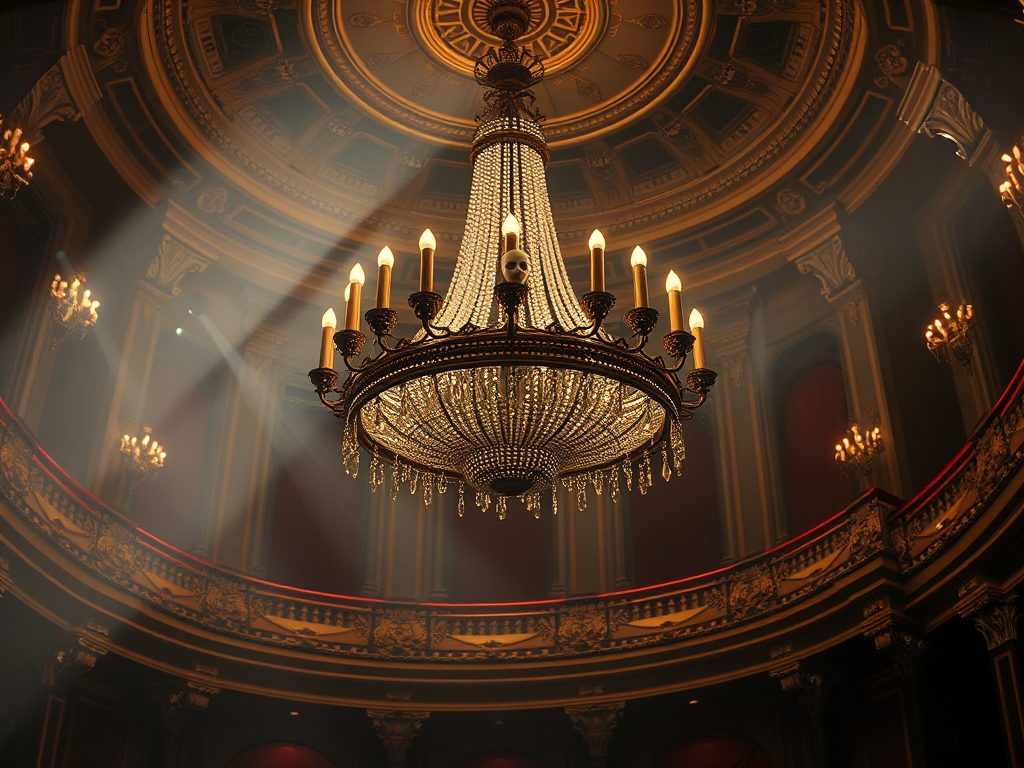
The stage prop itself is a triumph of engineering. The Phantom of the Opera chandelier features over 6,000 individual beads and weighs a staggering one ton. In the original Broadway run at the Majestic Theatre, it traveled an estimated 817 miles—just going up and down. To ensure the safety of the audience, the chandelier is fitted with multiple redundant safety cables and is controlled by a sophisticated computer system that monitors its descent at a rate of 10 feet per second. Despite its complexity, it has one of the best reliability records in the broadcasting and entertainment industry, proving that high-stakes stagecraft can be as safe as it is spectacular.
2. Michael Crawford’s Grueling Two-Hour Transformation
When Michael Crawford originated the titular role, he didn’t just step into a costume; he underwent a grueling physical transformation every single day. To achieve the “disfigured genius” look, Crawford had to spend two hours in the makeup chair. The process involved three layers of foam latex prosthetics, intricate scarring makeup designed by Christopher Tucker (who also worked on The Elephant Man), and a custom-molded Phantom mask. At the end of each performance, it took another 30 minutes and a team of artists to safely remove the adhesives from his skin.
This commitment to the role had significant physical costs. Crawford often had to subsist on liquid meals during days with two performances because the prosthetics made chewing solid food nearly impossible. Perhaps most surprisingly, Crawford had to personally shred his discarded masks every night to prevent “rabid fans” from stealing them out of the trash. This level of dedication helped define the character’s haunting presence and set a standard for every actor who has taken on the mantle of the masked man since.
3. A 24-Speaker “Ghostly” Soundscape
One of the reasons The Phantom of the Opera feels so immersive is the revolutionary use of surround sound. Long before modern cinema made immersive audio a standard, the creative team for Phantom installed 24 surround speakers throughout the theater. This technical setup is used to create a “ghostly” atmosphere, allowing the Phantom’s voice to seemingly move around the room, whispering from behind the audience or echoing from the rafters.
This use of acoustic engineering is vital for maintaining the “spectral” nature of the character. When the Phantom taunts the theater managers or lures Christine into his lair, the sound system creates a sense of spatial disorientation that heightens the psychological tension of the scene. Even in 2025, as digital sound technology has advanced, the original sound design remains a gold standard for how to use audio to enhance the narrative of a live performance. It ensures that the “Phantom” is felt as a presence throughout the entire building, not just as an actor on a stage.
4. Yak Hair and Human Locks: The Secret Life of 111 Wigs
The sheer scale of the production’s wardrobe is hard to fathom, but the hair department is particularly impressive. Every performance utilizes 111 wigs, each of which is meticulously hand-knotted and styled. These aren’t just standard synthetic wigs; they are crafted from a combination of human hair, synthetic fibers, and—most interestingly—yak hair. Yak hair is prized in the theatrical industry for its ability to hold a style and its unique texture, which looks more natural under the intense heat of stage lighting.
Maintaining this collection is a full-time job for a specialized crew. Because the actors often sweat under the heavy costumes and bright lights, the wigs must be cleaned, re-styled, and “blocked” (set on a wig head) after almost every show. The hair department’s work is essential for the visual storytelling of the musical, distinguishing between the polished world of the opera stars like Carlotta Giudicelli and the ragged, unkempt world of the basement-dwelling Phantom. It is this attention to minute detail that contributes to the show’s reputation for high-quality visual production.
5. The Underground Lake: 400 Pounds of Dry Ice Magic
The descent into the Phantom’s lair is one of the most visually stunning sequences in the show, featuring a gondola gliding across a misty, candle-lit underground lake. To create this “lake,” the production uses an incredible 400 pounds of dry ice per performance. When hot water is added to the dry ice, it creates a thick, low-lying fog that clings to the stage floor, perfectly concealing the tracks and motors that move the automated candelabras and the boat.
This effect is a prime example of traditional stagecraft meeting modern automation. In addition to the dry ice, the show employs 10 fog and smoke machines to ensure the atmosphere is perfectly calibrated. The timing must be precise; if the fog is too thin, the illusion of the water is broken; if it’s too thick, the actors can’t see their footings. The result is a hauntingly beautiful environment that has become a hallmark of Andrew Lloyd Webber’s visual style, creating a dreamlike transition from the reality of the opera house to the fantasy of the lair.
6. Scrapped Animatronics: The Rats and Horses that Didn’t Make the Cut
In the early stages of the show’s development in London, the creative team had even more ambitious—and perhaps slightly eccentric—plans for the special effects. Early rehearsals featured animatronic rats, a mechanical white horse, and even live doves that were supposed to fly through the theater. Director Harold Prince eventually decided to scrap these ideas before the show began its previews. The live doves proved too unpredictable, and the mechanical rats were deemed more distracting than frightening.
The decision to cut these elements shows the importance of editorial restraint in content creation. By removing the mechanical clutter, the production was able to focus on the emotional connection between the characters and the “unsettling energy” of the Phantom himself. Interestingly, a remnant of the rat subplot remains: the character of the “Rat Catcher” still appears in the show, carrying a net and dead rats (now props) as a nod to the darker, grimier history of the Paris Opera’s basement. It serves as a reminder that even the most successful stage productions go through a process of trial and error to find their true essence.
7. The World Record Holder: George Lee Andrews
While many fans focus on the famous actors who played the Phantom or Christine, the most enduring figure in the show’s history is an actor named George Lee Andrews. For many years, Andrews held the Guinness World Record for the most performances in the same Broadway show. He was a member of the original Broadway cast in 1988 and stayed with the production for a staggering 23 years, eventually racking up 9,383 performances before his retirement in 2011.
Andrews played multiple roles during his tenure, most notably Monsieur André, one of the bumbling theater managers. His longevity is a testament to the “community” that forms backstage during a long-running Broadway show. For the actors and crew, The Phantom of the Opera isn’t just a job; it becomes a life. This level of institutional knowledge ensures that the quality and “spirit” of the production are passed down through the generations, maintaining the show’s high standards long after the original stars have moved on.
8. The “Rat Catcher” and the Hidden Ensemble Roles
The ensemble of Phantom is one of the hardest-working in the industry. Because the show features multiple “operas-within-the-opera” (Hannibal, Il Muto, and Don Juan Triumphant), the cast members must constantly undergo rapid costume and character changes. One of the most intriguing hidden roles is the “Rat Catcher.” As mentioned earlier, this character is a holdover from the cut animatronic rat scenes. Though he has no lines, he adds a layer of “gothic realism” to the show, representing the lower depths of the social hierarchy within the opera house.
Furthermore, the “Ballet Chorus of the Opéra Populaire” consists of professionally trained ballerinas who must perform legitimate classical choreography while also acting in the background of the main scenes. This dual requirement for dancing and acting talent is part of what makes the casting of the show so rigorous. Every person on that stage, from the leading soprano to the quietest stagehand, is a vital cog in a massive machine designed to transport the audience to 19th-century Paris.
9. A Wardrobe fit for an Empire: 230 Costumes Per Show
The visual splendor of the show is largely due to the late Maria Björnson’s brilliant costume design. Each performance features 230 costumes, ranging from the elaborate, silk-heavy gowns of the “Masquerade” sequence to the delicate tutus of the ballet corps. To manage this logistical mountain, a team of 14 dressers works backstage to facilitate the dozens of lightning-fast wardrobe changes that happen in every act.
These costumes are built to last but require constant repair. The “Masquerade” outfits, in particular, are heavy and encrusted with beads and embroidery, making them physically taxing for the actors to wear while singing at full volume. The wardrobe department uses a mix of traditional tailoring and modern fabrics to ensure the clothes can withstand the rigors of eight shows a week. This dedication to visual production ensures that every time the curtain rises, the audience sees a world that is as lush and detailed as a historical painting.
10. The 2025 Global Legacy: A New Era of Touring
As of June 2025, The Phantom of the Opera has entered a vibrant new chapter. Following the closure of the original Broadway production in 2023, the show has been “revitalized” with a major new North American tour launching in late 2025. This production maintains the brilliant original design of Maria Björnson and the direction of Harold Prince but utilizes modern theater technology to make the show more portable and visually crisp than ever before.
The global reach of the show is unparalleled. It has been performed in 21 languages across 47 territories and nearly 200 cities. From Seoul to London, the story of the masked genius continues to resonate across cultural and linguistic barriers. The 2025 tour represents the show’s transition from a stationary landmark into a living, breathing legacy that can reach a new generation of theatergoers. It remains a cornerstone of the digital economy and the performing arts, proving that some stories—and some melodies—are truly timeless.
Further Reading
- Phantom of the Opera: The Official Companion by Peter J. Smith – An authorized, behind-the-scenes look at the making of the musical with stunning photography.
- The Complete Phantom of the Opera by George Perry – A detailed history of the story from Gaston Leroux’s novel to the global stage success.
- Andrew Lloyd Webber: Unmasked (A Memoir) by Andrew Lloyd Webber – The composer’s own account of his life and the creation of his most famous works.
- The Phantom of the Opera by Gaston Leroux – The original 1910 novel that started it all, essential for understanding the source material’s darker roots.
Keep the Discovery Going!
Here at Zentara, our mission is to take tricky subjects and unlock them, making knowledge exciting and easy to grasp. But the adventure doesn’t stop at the bottom of this page. We are constantly creating new ways for you to learn, watch, and listen every single day.
📺 Watch & Learn on YouTube
Visual learner? We publish 4 new videos every day, plus breaking news shorts to keep you smarter than the headlines. From deep dives to quick facts, our channel is your daily visual dose of wonder.
Click here to Subscribe to Zentara on YouTube
🎧 Listen on the Go on Spotify
Prefer to learn while you move? Tune into the Zentara Podcast! We drop a new episode daily, perfect for your commute, workout, or coffee break. Pop on your headphones and fill your day with fascinating facts.
Click here to Listen on Spotify
Every click, view, and listen helps us keep bringing honest knowledge to everyone. Thanks for exploring with us today—see you out there in the world of discovery!




Leave a Reply