
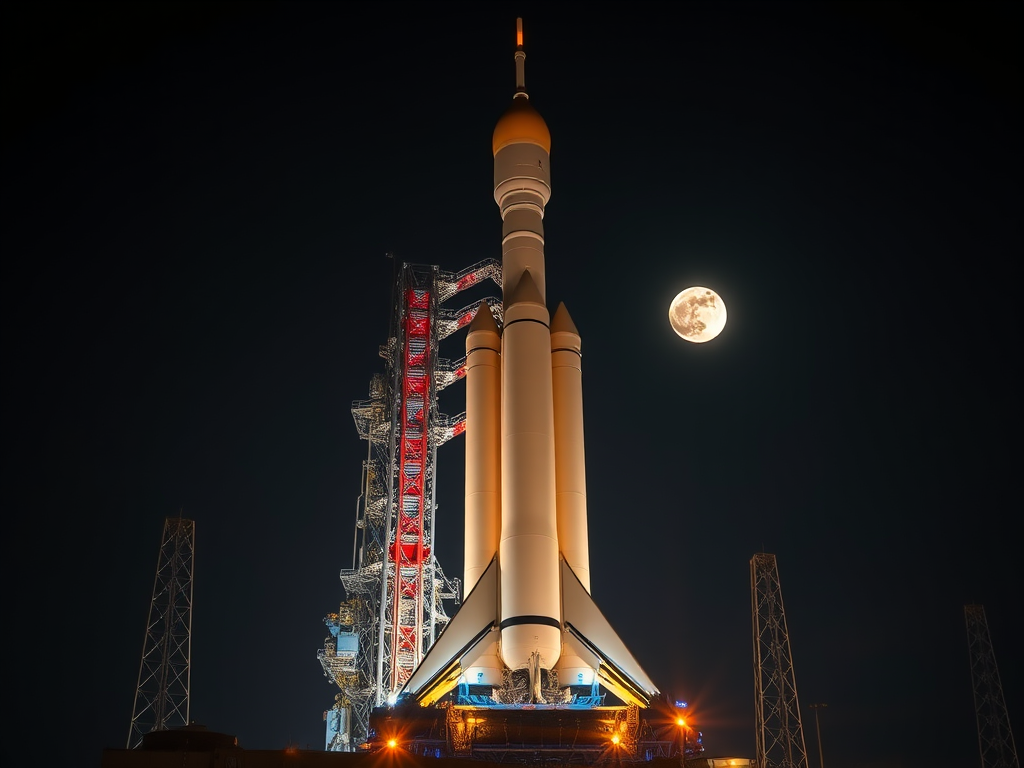
For more than half a century, the Moon has remained a silent witness to humanity’s progress from afar. While robotic explorers have mapped its craters and sampled its dust, no human heart has beaten in the vicinity of our lunar neighbor since the final Apollo mission in 1972. That is about to change. The Artemis II mission represents the giant leap between “testing the hardware” and “returning the explorers.”
As a crewed lunar flyby mission, Artemis II is the critical second act in NASA’s plan to establish a long-term presence on the Moon and, eventually, send humans to Mars. It is a mission of “firsts”—the first time a woman, the first person of color, and the first non-American will leave low Earth orbit. But beyond the history-making milestones, the mission is a grueling technical checklist. Every maneuver, from the roar of the Space Launch System (SLS) to the splashdown in the Pacific, is designed to prove that we are ready to stay.
Here are the top 10 goals of the Artemis II mission that will define the future of deep space exploration.
1. Human-Rating the Space Launch System (SLS) Rocket
While the uncrewed Artemis I mission proved that the Space Launch System rocket could successfully reach orbit and send a payload toward the Moon, Artemis II is the “human-rating” certification flight. There is a profound difference between launching a mannequin and launching four human beings. This goal focuses on the performance of the rocket’s core stage and solid rocket boosters under the ultimate pressure: the safety of a live crew.
Think of it like test-driving a new car model. The first test (Artemis I) used crash-test dummies to see if the frame held up. Artemis II is the first time the designers are putting their own families in the seats. NASA engineers will be monitoring the SLS rocket performance with extreme precision, looking at vibration levels, acoustic stress, and the “smoothness” of the ascent. The goal is to ensure that the massive 8.8 million pounds of thrust doesn’t just work, but works within the specific tolerances required for human endurance. This validation is a mandatory hurdle before the rocket can be trusted for the more complex Artemis III landing mission.
2. Testing the Orion Life Support System in Deep Space
One of the most critical Artemis II technical challenges is the first operational test of the Environmental Control and Life Support System (ECLSS) within the Orion spacecraft. During Artemis I, many of these systems were replaced with sensors or inert weights. On Artemis II, the system must perform the miraculous task of scrubbing carbon dioxide, generating oxygen, and maintaining a perfect “shirt-sleeve” environment for four people over a 10-day journey.
The goal here is to verify that the CO2 scrubbing units and nitrogen/oxygen tanks can handle the biological load of four active astronauts. Space is an unforgiving vacuum, and the Orion capsule is essentially a tiny, pressurized bubble. If the air circulation is off by even a fraction, pockets of toxic gas can form. By monitoring the “habitability” of the cabin in real-time, NASA can refine the settings for future, longer-duration missions to the Lunar Gateway and the lunar surface. It is the ultimate test of the spacecraft’s ability to function as a self-sustaining ecosystem.
3. The Proximity Operations Demonstration (Prox Ops)
Before the crew leaves Earth’s orbit for the Moon, they will perform a high-stakes “dance” in space known as the proximity operations demonstration. After the Orion capsule separates from the SLS rocket’s upper stage—the Interim Cryogenic Propulsion Stage (ICPS)—the crew will use the manual controls to move the spacecraft around the spent stage.
This goal is essentially a dress rehearsal for future spacecraft docking maneuvers. While the Orion is designed to be highly automated, the crew must demonstrate that they can manually pilot the ship with surgical precision. Imagine trying to park a trailer while moving at 17,000 miles per hour; that is the level of coordination required. By using the ICPS as a target, the crew validates the Orion guidance and navigation systems, ensuring that if an automated system fails during a future docking with a lunar lander or the Gateway station, the human pilots can take over and save the mission.
4. Executing the Trans-Lunar Injection (TLI) Burn
To leave the “well” of Earth’s gravity and head toward the Moon, the spacecraft must perform a massive engine fire called the Trans-Lunar Injection (TLI). For Artemis II, this goal is about timing and precision. The burn must happen at the exact microsecond necessary to put the crew on a path that intersects with the Moon’s future position.
In the world of orbital mechanics, this is like throwing a football to a receiver who is running a deep route across a field—you don’t throw to where they are, but to where they will be in three days. The technical hurdle is managing the fuel efficiency of the European Service Module (ESM) engines. If the burn is too short, they miss the Moon; if it’s too long, they could over-shoot and head into deep space. Successfully executing this maneuver proves that NASA’s navigation teams can handle the complex “slingshot” physics required for deep space transit.
5. Validating the Hybrid Free-Return Trajectory
Safety is the north star of the Artemis program, and the free-return trajectory is the ultimate insurance policy. The goal of Artemis II is to follow a path that uses the Moon’s gravity to naturally pull the spacecraft back toward Earth without needing a second major engine burn.
Think of it like a boomerang. Once the crew is “thrown” toward the Moon, the lunar gravity acts as a curved wall that redirects them home. This is a critical safety feature; if the main engine were to fail after the crew reached the Moon, they would still return to Earth’s atmosphere automatically. By flight-testing this specific path, NASA ensures that the lunar flyby mission provides a “safe exit” at every stage. It allows the crew to venture 230,000 miles away with the confidence that the physics of the solar system are working in their favor to bring them home.
6. Achieving the Furthest Distance from Earth
One of the more awe-inspiring goals of Artemis II is to take humans further into the cosmos than ever before. While the Apollo missions orbited the Moon closely, the Artemis II mission profile includes a “high-altitude” flyby that will take the crew thousands of miles beyond the lunar far side. This will set a new record for the furthest distance humans have ever traveled from their home planet.
While the record is great for the history books, the technical goal is to test deep space communication and navigation at extreme ranges. As the spacecraft moves further away, the “lag” in radio signals increases, and the Earth shrinks to a tiny blue marble. This pushes the Deep Space Network (DSN) to its limits. This “deep-range” test is essential preparation for Mars missions, where crews will be millions of miles away and must rely entirely on their onboard systems and long-range comms to survive.
7. Testing Deep Space Optical (Laser) Communications
For decades, space missions have relied on radio waves to talk to Earth. However, radio has limited bandwidth—it’s like trying to download a movie over a 1990s dial-up connection. One of the high-tech goals of Artemis II is to test the Orion Optical Communications System (O2O), which uses infrared lasers to transmit data.
This technology allows for “broadband” speeds in deep space. Instead of grainy photos taking hours to transmit, laser comms could allow for 4K live streaming from the vicinity of the Moon. This isn’t just for public relations; it allows engineers on the ground to receive massive amounts of “health and status” data from the spacecraft in seconds. If the Artemis II crew can successfully “ping” Earth with a laser from 240,000 miles away, it will revolutionize how we conduct science and stay connected during the next century of exploration.
8. Monitoring Deep Space Radiation Exposure
Once a crew leaves the protection of Earth’s magnetic field, they are pelted by Galactic Cosmic Rays and solar radiation. A major goal of Artemis II is to use the crew as a “living laboratory” to understand how deep-space radiation affects the human body over a 10-day period.
The Orion capsule is equipped with advanced radiation shielding and the crew will wear specialized dosimeters to track their exposure. Unlike the International Space Station, which is shielded by the Van Allen belts, the Artemis II crew will be in “the wild.” NASA’s goal is to gather high-fidelity data on how much radiation actually penetrates the hull and the crew’s “storm shelter” (a reinforced area of the capsule). This information is vital for designing the long-term habitats for Artemis III and the future Mars transit vehicles, where radiation is the #1 health risk for astronauts.
9. Refining High-Speed Reentry and Splashdown
Returning from the Moon is much more violent than returning from the International Space Station. When the Orion capsule hits the Earth’s atmosphere, it will be traveling at 25,000 miles per hour (Mach 32). A primary goal of Artemis II is to validate the “skip reentry” maneuver and the performance of the Orion heat shield.
The heat shield must endure temperatures of 5,000 degrees Fahrenheit—half as hot as the sun. During this phase, the goal is to see how the Avcoat material (the protective outer layer) wears down. Additionally, the mission concludes with a precision splashdown in the Pacific Ocean. NASA and the U.S. Navy must work together to recover the crew and the capsule within a very tight window to ensure the astronauts don’t suffer from “seasickness” or heat exhaustion after their return to Earth’s gravity. Perfecting this recovery chain is the final “pass/fail” for the mission.
10. Establishing the Foundation for Artemis III and Mars
Ultimately, the overarching goal of Artemis II is to “clear the path.” Every piece of data collected—from the vibration of the SLS to the taste of the space food—is a building block for the Artemis III lunar landing. By proving that humans can safely navigate to the Moon and back, NASA reduces the risk for the next mission, which will involve the complex task of docking with a SpaceX Starship lander.
This mission is the bridge. It turns “experimental” technology into “operational” technology. By the time the Artemis II crew splashes down, NASA will have a complete “flight-proven” manual for how to operate in cislunar space. This mission is the final green light for humanity to return to the surface of the Moon and begin the long-term journey toward the red sands of Mars.
Further Reading
- “Apollo 8: The Thrilling Story of the First Mission to the Moon” by Jeffrey Kluger
- “Artemis: The Next Step in Human Exploration” by NASA (Official Program Guide)
- “How We’ll Live on Mars” by Stephen Petranek
- “The Apollo Murders” by Chris Hadfield (A technical thriller with deep-space accuracy)
Keep the Discovery Going!
Here at Zentara, our mission is to take tricky subjects and unlock them, making knowledge exciting and easy to grasp. But the adventure doesn’t stop at the bottom of this page. We are constantly creating new ways for you to learn, watch, and listen every single day.
Watch & Learn on YouTube
Visual learner? We publish 4 new videos every day, plus breaking news shorts to keep you smarter than the headlines. From deep dives to quick facts, our channel is your daily visual dose of wonder.
Click here to Subscribe to Zentara on YouTube
Listen on the Go on Spotify
Prefer to learn while you move? Tune into the Zentara Podcast! We drop a new episode daily, perfect for your commute, workout, or coffee break. Pop on your headphones and fill your day with fascinating facts.
Click here to Listen on Spotify
Every click, view, and listen helps us keep bringing honest knowledge to everyone. Thanks for exploring with us today—see you out there in the world of discovery!




Leave a Reply