
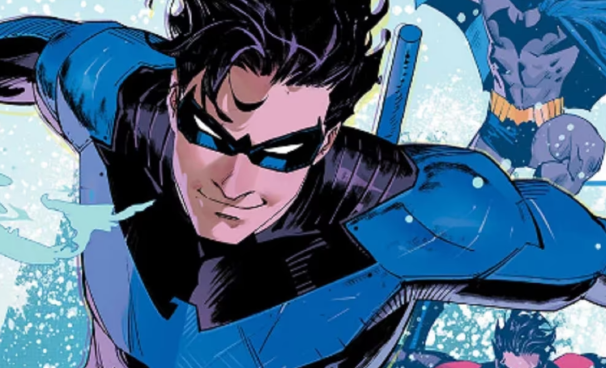
In the sprawling urban jungle of the DC Comics universe, few characters possess a legacy as vibrant and transformative as Nightwing. Known to the world as Dick Grayson, he began his journey as the first “Boy Wonder,” the brightly colored contrast to Batman’s brooding shadows. However, his evolution from a junior partner into a legendary independent hero is one of the most compelling arcs in literary history. Dick Grayson didn’t just grow up; he broke the mold of what a sidekick could be, eventually becoming the “moral compass” of the entire superhero community.
Whether you are a veteran reader of the Nightwing comics or a newcomer curious about the man behind the blue bird insignia, understanding Nightwing requires looking beyond the mask. As of June 12, 2025, his popularity has never been higher, fueled by iconic runs in print and a growing presence in global media. Here are ten fascinating facts about the man who taught the world that you don’t need to be dark to be a knight.
1. The Kryptonian Origin of the Name “Nightwing”
One of the most poetic “interesting facts” about Nightwing is that his name wasn’t inspired by his mentor, Batman, but rather by the Man of Steel himself. When Dick Grayson realized he could no longer stay under the shadow of the Bat, he sought advice from Superman. Kal-El told him an ancient Kryptonian legend about a hero who had been cast out of his family and chose to protect the helpless as a lone vigilante. That hero’s name was Nightwing.
By choosing this name, Dick honored his relationship with two of the world’s greatest heroes. It represents a “middle path”—combining Batman’s tactical prowess and detective skills with Superman’s unyielding optimism and belief in the inherent goodness of people. This origin story serves as a beautiful analogy for the “immigrant” or “found family” experience; Dick took a piece of someone else’s culture and history to build a foundation for his own identity. It’s why Nightwing feels like the ultimate bridge between the gritty streets of Gotham and the cosmic heroism of the Justice League.
2. From the First “Boy Wonder” to Independent Icon
Before he was Nightwing, Dick Grayson was the original Robin the Boy Wonder. Debuting in 1940, he was created to give younger readers a character they could relate to—a gateway into the dangerous world of Batman. For over forty years, he was the junior member of the “Dynamic Duo,” but by the mid-1980s, the character had outgrown the short-shorts and the role of a perpetual ward.
The transition occurred in the seminal “Judas Contract” storyline within the Teen Titans series. Dick officially handed over the Robin mantle to Jason Todd, signaling his graduation into adulthood. This wasn’t just a costume change; it was a cultural milestone. It proved that comic book characters could age, evolve, and move out of their “parents’ basement.” For an 11th-grade reader, Dick’s journey mirrors the universal struggle of late adolescence—the difficult, often messy process of defining oneself outside of the expectations of one’s mentors and family.
3. The Master of Escrima and “Wing-Dings”
While Batman relies on brute strength and heavy gadgets, Nightwing’s combat style is a masterclass in fluidity and precision. His signature weapons are a pair of Escrima sticks, based on Filipino martial arts. These dual batons allow him to strike with blinding speed, parry incoming attacks, and even deliver non-lethal electrical shocks. When combined, they can sometimes form a staff or be used as grappling hooks.
In addition to his sticks, he uses “Wing-Dings,” his own variation of the Batarang. Because Nightwing is often moving through the air at high speeds, his weapons are designed for momentum and balance. Think of his combat style as a “combat dance”; where Batman is a hammer, Nightwing is a rapier. He doesn’t just hit his enemies; he uses their own weight and momentum against them, often incorporating his environment in ways that look more like a parkour routine than a street fight. This focus on agility over power makes him one of the most visually exciting fighters in the DC Universe.
4. The “Heart and Soul” of the DC Social Circle
If Batman is the brain of the DC Universe and Superman is its symbol, Nightwing is undoubtedly its heart. Because he has been a hero since he was eight years old, he has grown up alongside almost every major figure in the community. He is one of the few characters who can call both Wonder Woman and a street-level thief like Catwoman and expect a respectful answer.
In many “crisis” events, it is often Nightwing who rallies the troops. His ability to connect with others is his true superpower. He possesses an emotional intelligence that his mentor notoriously lacks, allowing him to mediate disputes between the Bat-Family and the Justice League. This social connectivity is an “evergreen” aspect of his character; he represents the idea that heroism isn’t just about punching villains—it’s about the bonds of trust we build with those standing next to us. He is the “connective tissue” that keeps the superhero community from fracturing under the weight of their own egos.
5. Why He Rejected the Mantle of the Bat (Mostly)
A recurring question in Nightwing trivia is: “Why doesn’t he just become Batman?” On several occasions, most notably after the events of Knightfall and Final Crisis, Dick Grayson has actually taken up the cape and cowl. However, he has always done so with great reluctance. To Dick, the Batman persona is a burden—a symbol of trauma and isolation that he has worked his whole life to move past.
When he does serve as Batman, he brings a different energy to the role. During his time as the Dark Knight alongside Damian Wayne (the fifth Robin), Dick was a smiling, encouraging mentor, providing a stark contrast to the way Bruce Wayne usually treats his sidekicks. Ultimately, Dick always returns to the Nightwing identity because it represents freedom. He doesn’t want to be a shadow; he wants to be the light that shows the way out of the shadow. This rejection of the “family business” is a powerful analogy for any young person choosing their own career path despite heavy pressure to follow in their parents’ footsteps.
6. Protecting the Corruption of Blüdhaven
Just as Batman has Gotham, Nightwing has Blüdhaven. In the mid-90s, Dick moved to this neighboring city to establish his own territory. Blüdhaven is often described as “worse than Gotham,” a place where the corruption isn’t just in the alleys, but in the mayor’s office and the police precinct. Unlike Gotham, which is Gothic and haunting, Blüdhaven is gritty, industrial, and economically depressed.
To better serve the city, Dick actually joined the Blüdhaven Police Department for a time, attempting to fight the system from within while patrolling the rooftops as a vigilante at night. This “dual life” added a layer of complexity to the Nightwing comics, exploring the limits of the law and the necessity of justice. His commitment to a city that everyone else had given up on showcases his resilience. He isn’t just a hero in a vacuum; he is an urban revitalizer, a man who believes that no place is too broken to be saved if someone is willing to do the work.
7. The “Flying Grayson” Acrobatics in Combat
Before he was a hero, Dick Grayson was a world-class acrobat in “Haly’s Circus.” He was the only person in the world who could perform a quadruple somersault without a net—a skill he still utilizes in his crime-fighting career. This background is what makes him the most agile person in the DC Universe. While other heroes “patrol,” Nightwing “leaps.”
His movement is like a language. In the middle of a fight, he might use a backflip to gain distance or a mid-air twist to avoid a hail of bullets. This isn’t just for show; it’s a tactical advantage. By staying in constant motion, he makes it impossible for enemies to pin him down. This “circus heritage” is a core part of his character development. He views the world as a giant trapeze, and he is the one person brave enough to let go of the bar, trusting that he’ll catch the next one. This sense of “controlled risk” is what makes his adventures so breath-taking for readers.
8. The Iconic Blue and Black Costume Evolution
The Nightwing costume has become one of the most recognizable designs in fiction, but it didn’t start that way. His first outfit in 1984 featured a high collar and “disco-inspired” yellow feathers—a look fondly (and sometimes mockingly) remembered as “Disco-wing.” It wasn’t until 1995 that he adopted the sleek, black unitard with the blue bird across the chest and down the arms.
This design is a masterpiece of minimalist superhero branding. The “finger-stripes” (the blue lines extending to his fingertips) emphasize his movement and hand-to-hand combat. The suit is made of a triple-weave Kevlar and Nomex material, making it bulletproof and fire-resistant while remaining light enough for high-level gymnastics. The evolution of his suit mirrors his own maturation; he moved from the flashy, attention-seeking colors of his youth to a more professional, focused, and “cool” aesthetic that commands respect without needing to scream for it.
9. Leading the Titans and The Outsiders
While Batman is often a “loner” who works with others out of necessity, Nightwing is a natural-born leader. As a founding member of the Teen Titans, he led a team of sidekicks (including Donna Troy, Wally West, and Garth) as they transitioned into heroes of their own. Later, he took charge of the Outsiders, a more proactive and covert team.
His leadership style is built on consensus and mutual respect. He doesn’t bark orders; he earns loyalty. This is why many fans consider him the “best” leader in DC, even surpassing the likes of Cyclops or Captain America in terms of interpersonal management. He understands the strengths and weaknesses of his teammates better than they do themselves. This leadership role is an “evergreen” topic because it highlights the importance of teamwork and the idea that the strongest person isn’t the one with the most power, but the one who can bring everyone together.
10. His Relationships with Barbara Gordon and Starfire
No discussion of Nightwing is complete without his complicated romantic life. For decades, fans have been split between “Team Barbara” and “Team Kory.” Barbara Gordon (Batgirl/Oracle) represents his deep roots in Gotham—his intellectual equal and childhood sweetheart. Their relationship is grounded in shared trauma and mutual respect.
On the other hand, Starfire (Koriand’r) represents his growth beyond Earth—an alien princess who taught him how to be passionate and open with his emotions. These relationships aren’t just “love interests”; they are mirrors for his internal struggle between his past and his future. Whether he is with the librarian-turned-hacker or the orange-skinned warrior, Dick Grayson remains a romantic at heart. He is a man who believes in love as much as he believes in justice, making him one of the most relatable and human characters in the DC Comics pantheon.
Further Reading
- Nightwing: Year One by Chuck Dixon and Scott Beatty — The definitive retelling of how Dick left the Robin mantle behind.
- Nightwing: Leaping into the Light by Tom Taylor — A modern classic that perfectly captures the “heart” of the character and his dog, Haley (Bitewing).
- Batman: The Black Mirror by Scott Snyder — A darker look at Dick Grayson’s time as Batman, exploring his relationship with the city of Gotham.
- Robin: Year One by Chuck Dixon and Scott Beatty — A great companion piece to see the origins of his training under Bruce Wayne.


Leave a Reply