
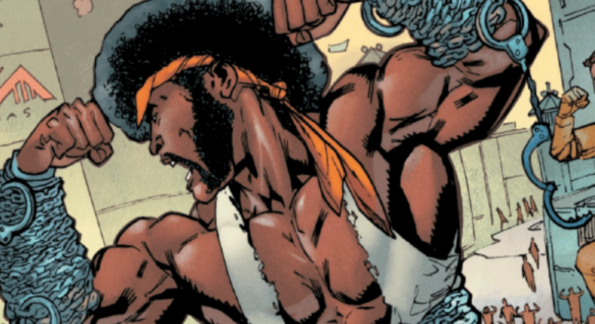
In the vibrant, often chaotic tapestry of the Marvel Universe, few characters stand as firmly as a pillar of their community as Luke Cage. Often known by his moniker, Power Man, Cage is more than just a man with indestructible skin and superhuman strength. He is a trailblazer, a businessman, a devoted father, and a symbol of resilience who rose from a wrongful prison sentence to lead the Avengers themselves.
While many recognize him as a staple of street-level heroism in New York City’s Harlem, his history is deep, occasionally bizarre, and culturally significant. Luke Cage didn’t just break chains in his origin story; he broke the “glass ceiling” of the comic book industry. He represents a grounded form of heroism where the stakes aren’t always galactic threats, but rather the rent, the safety of the neighborhood, and the pursuit of a name cleared of past sins.
From his 1970s “Hero for Hire” roots to his evolution into a top-tier Marvel leader, Luke Cage’s journey is a masterclass in character growth. Whether he is teaming up with his “odd couple” partner Iron Fist or navigating the complexities of marriage with Jessica Jones, Cage remains one of the most relatable and principled figures in fiction. Below, we dive into the hidden history and surprising truths behind the man who proved that you don’t need a cape to be a legend.
1. A Milestone in Representation: The First Black Solo Lead
While characters like the Black Panther and the Falcon preceded him in the Marvel Universe, Luke Cage holds a historic distinction that changed the industry forever. In 1972, with the debut of Luke Cage, Hero for Hire #1, he became the first Black superhero to headline his own self-titled solo comic book series. Created by Archie Goodwin, George Tuska, Roy Thomas, and John Romita Sr., Cage was a response to the “Blaxploitation” cinema movement of the era, which featured tough, independent protagonists navigating urban landscapes.
However, Cage quickly transcended the tropes of the genre. His series wasn’t just about action; it was a gritty, street-level look at crime, poverty, and the struggle for justice in a system that had failed him. By giving a Black man his own title, Marvel opened the door for a new kind of storytelling that focused on the specific social and cultural realities of inner-city life. This milestone proved that audiences were hungry for diverse perspectives, cementing Luke Cage as a pioneer whose legacy paved the way for dozens of characters who followed in his footsteps.
2. The Burstein Process: A Failed Super-Soldier Attempt
The origin of Luke Cage’s powers is rooted in a dark experiment within the walls of Seagate Prison. Born Carl Lucas, he was wrongfully imprisoned for a crime he didn’t commit. While incarcerated, he volunteered for an experimental cell-regeneration procedure led by Dr. Noah Burstein. The experiment was actually an attempt to recreate a variation of the Super-Soldier Serum that birthed Captain America. However, the procedure was sabotaged by a racist prison guard named Albert Rackham, who hoped to kill Lucas by cranking the machine’s controls past their safe limits.
Instead of dying, Lucas’s body underwent a radical transformation. The “Burstein Process” resulted in his skin becoming as hard as titanium and his muscle tissue becoming exponentially denser than a normal human’s. This gave him his signature invulnerability and superhuman strength. The sabotage, intended to destroy him, ended up granting him the power to punch his way out of the prison and escape into the night. It was at this moment that Carl Lucas died, and Luke Cage—a man who took his name as a symbol of the “cage” he had escaped—was born.
3. The Infamous Debt: Flying to Latveria for 200 Dollars
One of the most legendary and humorous stories in Luke Cage’s history involves his confrontation with the monarch of Latveria, Doctor Doom. Early in his career as a “Hero for Hire,” Cage was hired by a man who turned out to be Doctor Doom in disguise. Doom used Cage to hunt down rogue robots but left the country without paying Cage his standard 200-dollar fee. While most heroes would let a small debt go when dealing with a global dictator, Luke Cage is a man of principle—and he had bills to pay.
Cage managed to borrow a jet from the Fantastic Four and flew all the way to Latveria. He fought his way through Doom’s robotic army and eventually cornered the armored villain in his own castle. The sight of a street-level hero from Harlem demanding “Where’s my money, honey?” from one of the world’s most dangerous villains became an instant classic moment. Doom, likely more annoyed than threatened, actually paid the debt. This story highlights Cage’s no-nonsense attitude and his belief that no one, not even a king, is above the fair exchange of labor.
4. The Symbolism of the Tiara and the Chains
For decades, Luke Cage’s “classic” look consisted of a bright yellow shirt, blue leggings, a silver headband (often called a tiara), and heavy chains around his waist. To modern readers, this outfit might seem like a relic of 1970s fashion, but for Luke, the elements were deeply symbolic. The chains, in particular, were not just a fashion accessory; they were the literal shackles he wore in Seagate Prison. He wore them as a belt to symbolize that he was no longer bound by them—he had turned the instruments of his oppression into a part of his strength.
The silver headband and wristbands were also part of the equipment used during the Burstein Process. While he eventually moved toward more modern, tactical, or casual clothing, these early design choices were meant to reflect a man who was reclaiming his identity. He didn’t wear a traditional mask because he wanted the people of Harlem to know exactly who was standing up for them. He wasn’t a “hidden” guardian; he was a visible neighbor, and his flamboyant early costume ensured that his presence was felt whenever he entered a room.
5. The Business of Heroism: Heroes for Hire, Inc.
Unlike most superheroes who fight crime out of a sense of abstract duty or because of a personal tragedy, Luke Cage viewed his work as a legitimate profession. He established “Heroes for Hire,” a business where he offered his protection and investigative services for a fee. This made him one of the first “working-class” heroes. He realized that in a world where the police were often corrupt or indifferent to his neighborhood, a private, superhuman security force was a necessity.
This business model led to his legendary partnership with Danny Rand, the Iron Fist. The “Power Man and Iron Fist” duo became the definitive “odd couple” of Marvel Comics. Danny, the wealthy heir to a corporate empire and a master of mystical martial arts, provided a contrast to Luke’s gritty, practical, and street-wise approach. Together, they ran Heroes for Hire for years, proving that heroism could be both a service to the community and a way to make a living. This partnership broke down barriers of class and race, showing two men from vastly different worlds finding common ground through mutual respect and business integrity.
6. A Medical Nightmare: The Difficulty of Surgery
Having indestructible skin is a massive advantage in a fistfight, but it presents a terrifying challenge during a medical emergency. On several occasions in the comics, Luke Cage has suffered internal injuries—from powerful concussive blasts or internal poisons—that required surgery. Because his skin cannot be pierced by standard surgical steel, lasers, or even industrial-grade diamond-tipped drills, doctors have often been helpless to treat him.
This unique biological hurdle adds a layer of vulnerability to a character who seems invulnerable. Writers have often used this “medical stalemate” to create high-stakes tension. In some instances, doctors had to use specialized Kree technology or high-powered industrial lasers just to make an incision. This reminds the audience that Luke Cage’s powers are a “permanent” change; he cannot turn them off. His skin is a suit of armor he can never take off, turning a simple medical procedure into a high-stakes engineering project.
7. From Fugitive to Leader of the Avengers
Perhaps the most significant arc in Luke Cage’s history is his transition from a street-level “Hero for Hire” to the leader of the world’s premier superhero team. During a time of great upheaval in the superhero community, Captain America himself hand-picked Luke Cage to lead a new iteration of the Avengers. Steve Rogers saw in Luke something that many others had missed: a man of impeccable character who understood the “real world” better than anyone in a high-tech tower.
As the leader of the New Avengers, Cage moved the team’s headquarters from a private island or a mansion to a regular brownstone in the city. He wanted the Avengers to be accessible to the people. Under his leadership, the team became more grounded and focused on protecting those who were often overlooked by the “big” heroes. His tenure as a leader proved that Luke Cage had the tactical mind, the moral authority, and the respect of his peers to stand at the very top of the Marvel hierarchy. He didn’t just join the Avengers; he redefined what being an Avenger meant.
8. The Legacy of the Name “Power Man”
While he is most commonly referred to by his real name today, Luke Cage’s code name “Power Man” was actually the subject of a significant in-universe legal battle. He adopted the name early in his career to boost his marketability as a hero for hire. However, he wasn’t the only person using it. A villain named Erik Josten had previously used the name Power Man before changing his moniker to Goliath and eventually Atlas.
When Josten returned to challenge Cage for the rights to the name, it led to a physical and legal confrontation. Luke eventually won the right to keep the name, but over time, he grew to prefer his birth name (or rather, his adopted name). He felt that “Luke Cage” commanded more respect and authenticity than a flashy superhero alias. Interestingly, the “Power Man” title was eventually passed down to a young hero named Victor Alvarez, whom Luke mentored. This transition allowed Luke to move beyond the tropes of “superheroing” and stand as a man whose reputation was built on his deeds rather than his branding.
9. A Father and a Husband First
In a medium where status quos often reset and relationships are frequently fleeting, Luke Cage’s marriage to Jessica Jones stands as one of the most stable and well-developed romances in comics. Their relationship began in the pages of Alias, evolving from a complicated, gritty bond into a deep, committed partnership. Together, they have a daughter named Danielle (named after Danny Rand).
Becoming a father profoundly changed Luke’s character. His primary motivation shifted from clearing his name or making money to ensuring a safe world for his daughter. He has famously walked away from the Avengers or refused to participate in “superhero wars” because his priority was his family’s safety. This domestic side of Luke Cage makes him incredibly relatable. He is a man trying to balance the responsibilities of saving the world with the responsibilities of changing diapers and being a present husband. His love for Jessica and Danielle provides him with a “human” core that makes his indestructible skin feel like a secondary trait.
10. The Real-World Inspiration for Nicholas Cage
The cultural impact of Luke Cage extends far beyond the pages of comic books and into the halls of Hollywood. One of the most famous actors in the world, Nicolas Cage (born Nicolas Coppola), chose his stage name specifically as a tribute to Luke Cage. Wanting to distance himself from his famous uncle, director Francis Ford Coppola, and forge his own identity in the industry, the young actor looked to the comics he loved for inspiration.
He chose the name “Cage” because he identified with the character’s strength, his struggle for independence, and his “hero for hire” spirit. This fact serves as a testament to the character’s resonance. Even in the 1980s, before superheroes were a dominant force in global cinema, Luke Cage’s story of self-reinvention was powerful enough to inspire a real-world artist to redefine his own identity. It is a full-circle moment where the first Black solo lead inspired one of the most eccentric and successful actors of a generation.
Further Reading
- Luke Cage: Hero for Hire Vol. 1 by Archie Goodwin and George Tuska
- New Avengers: Breakout by Brian Michael Bendis and David Finch
- Power Man and Iron Fist: Epic Collection by Mary Jo Duffy and Kerry Gammill
- Luke Cage: Everyman by Anthony Del Col and Jahnoy Lindsay
- Alias by Brian Michael Bendis and Michael Gaydos




Leave a Reply