
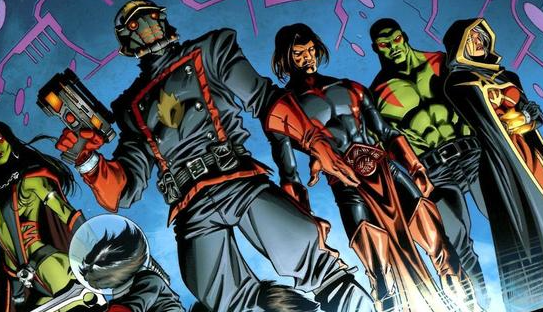
To the average moviegoer, the Guardians of the Galaxy are a lovable band of misfits—a ragtag family of outlaws who save the universe to the beat of a groovy pop soundtrack. However, if you were to step into the long-standing archives of the comic book medium, you would find a version of this team that is vastly different, significantly darker, and rooted in high-concept science fiction that spans thousands of years. Before they were the “A-Holes” of the silver screen, they were a desperate frontline defense against cosmic extinction, featuring a rotating roster of some of the strangest beings in the multiverse.
The transition from the printed page to the global stage often involves streamlining complex backstories, but for this specific team, the “streamlining” removed some of the most fascinating lore in Marvel’s history. The comic book Guardians have been through multiple iterations, survived the literal heat death of the universe, and counted among their ranks everything from a Soviet space dog to a 31st-century freedom fighter wielding Captain America’s shield. To truly appreciate the “Guardians” is to understand that they are more than just a team; they are a legacy that has been reimagined across generations.
Whether you are a casual fan of the films or a dedicated reader of the cosmic sagas, these ten insights into the comic book source material will reveal a side of the galaxy you never knew existed. Strap into your star-jumper—it’s time to explore the true history of the Guardians.
1. The Original Team Lived in the 31st Century
Long before the modern lineup of Peter Quill and Rocket Raccoon ever formed, the first “Guardians” were a group of freedom fighters from a different millennium altogether. Operating in a possible future—specifically the 31st century—the original team consisted of Major Vance Astro, Martinex T’Naga, Charlie-27, and Yondu Udonta. They weren’t space pirates or treasure hunters; they were the last survivors of their respective planets, united in a desperate rebellion against the Badoon, a reptilian race that had conquered the solar system.
This original iteration was a high-concept adventure that leaned heavily into the “Last of My Kind” trope. Vance Astro, for instance, was a 20th-century astronaut who traveled for a thousand years in a state of suspended animation, only to wake up and realize he was an obsolete relic in a world he no longer recognized. This version of the team is the reason the name exists in the first place, and their adventures often involved complex time-travel plots that eventually brought them into contact with the heroes of the modern Marvel era.
2. Drax the Destroyer Was Originally a Human Named Arthur
While the modern version of the Destroyer is a purple-skinned alien with a literal interpretation of metaphors, the comic book origin of Drax is far more tragic and grounded in Earthly roots. He was originally Arthur Douglas, a simple human real estate agent and saxophone player from California. While driving through the desert with his wife and daughter, their car was spotted by a scouting ship piloted by the mad titan Thanos. Fearing he had been seen, Thanos destroyed the car, seemingly killing the entire family.
However, the cosmic entity known as Kronos needed a champion to defeat Thanos. He intercepted Arthur’s astral form and placed it into a powerful, artificially created body, wiping his memories and focusing his entire existence on one goal: the destruction of the Titan. This makes the comic book Drax a “living weapon” rather than a biological alien. His daughter, Heather, also survived and eventually became the powerful telepath known as Moondragon. This human connection gives Drax a much deeper, more personal grudge against the cosmic threats of the universe than his film counterpart.
3. The Team Name Was “Borrowed” Through Time Travel
The modern version of the Guardians (the Star-Lord led team) didn’t actually come up with their own name. In the comics, the team formed in the wake of a massive cosmic war that left the universe in a state of fragile recovery. While they were struggling to find their identity as a unit, they encountered the time-traveling Major Vance Astro from the 31st-century team mentioned earlier. Astro, who was still wielding the legendary shield of Captain America, suggested the name “Guardians of the Galaxy.”
Essentially, the modern team named themselves after a group that hadn’t technically been founded yet in their timeline, but had existed in the “future” history of the multiverse. This meta-textual connection is a staple of Marvel’s cosmic writing, where the past and the future are constantly in dialogue. It turned the name into a legacy—a title that must be upheld by the most capable defenders of the era. It also established Peter Quill’s team as the spiritual successors to a group of warriors they would eventually fight alongside in multiple “Time-Twister” crossovers.
4. Star-Lord’s Original Origin Was a Sci-Fi “Chosen One” Saga
Peter Quill’s modern identity is that of a charming, music-loving rogue, but his original comic book debut was much more in line with a grand “Space Opera” or a fantasy epic. In his first appearances, Peter was a NASA astronaut-in-training with a bit of a chip on his shoulder. He didn’t have a celestial father like Ego; instead, he was granted the mantle of Star-Lord by a mysterious cosmic being known as the “Master of the Sun” after essentially cheating his way into a competition.
In this version, “Star-Lord” was a title of high office rather than a nickname Peter gave himself. He was a stoic, powerful figure who traveled the galaxy on a sentient ship named “Ship” (who was also a woman he had a telepathic connection with). Over the years, this origin was retconned and simplified to make him the son of J’son, the Emperor of the Spartax Empire. The “music-loving outlaw” persona was a much later addition that eventually aligned with the character’s cinematic popularity, but the original Peter Quill was a much more traditional, hard-boiled science-fiction hero.
5. Groot Used to Be a Chatty, Arrogant Conqueror
The “I am Groot” vocabulary is one of the character’s most defining traits today, but when Groot first appeared in the early days of Marvel’s monster comics, he was anything but a man of few words. In his debut, he was the “Monarch of Planet X,” an alien invader who came to Earth specifically to kidnap a human village and take them back to his world for scientific study. Most shockingly, he spoke in perfectly articulated, highly sophisticated English—and he was incredibly arrogant.
He was portrayed as a classic “B-Movie” monster, complete with a villainous laugh and a desire for planetary domination. It wasn’t until much later that his character was reimagined as a misunderstood, noble creature. The explanation for his modern speech patterns is that as his species ages, their larynxes harden, making it impossible for them to form complex words. To the average listener, it sounds like he’s repeating the same phrase, but to those who can sense the nuances of his tone (like Rocket), he is still the same highly intelligent, philosophical being he always was.
6. Rocket Raccoon’s Origin is “Psychiatric” Science Fiction
Rocket Raccoon is often described as a “genetic experiment,” but the comic book details are much more specific and bizarre. He hails from a planet called Halfworld in the Keystone Quadrant. Centuries ago, a group of humanoid scientists founded a massive psychiatric facility on the planet to house and study the “Loonies.” When the scientists lost their funding and left, they left their sentient robotic assistants in charge of the patients.
To help manage the facility, the robots genetically engineered the animals on the planet—giving them human-level intelligence and bipedal forms—to act as guards and companions for the patients. Rocket was the “Chief Ranger” of this facility. His tactical mind and love for heavy weaponry were literal biological imperatives designed to help him protect a colony of the mentally ill. This backstory adds a layer of caretaker-responsibly to Rocket’s character; he wasn’t just made to be a weapon; he was made to be a protector of the vulnerable, which explains his fierce loyalty to his teammates.
7. Mantis is the “Celestial Madonna”
In other versions of the story, Mantis is often portrayed as an innocent, socially awkward empath. In the comics, however, Mantis is one of the most powerful and important figures in the entire Marvel Universe. Born on Earth and raised by a sect of Kree priests known as the Priests of Pama, she was trained to be the “Celestial Madonna”—the perfect human being who would give birth to a new cosmic messiah destined to change the universe.
Mantis is a master of martial arts, capable of taking down heavyweights like Thor by striking their pressure points. She also has a sophisticated form of “cosmic consciousness,” allowing her to sense the emotions and intentions of the universe itself. She didn’t join the Guardians because she was a lost soul; she joined because she was a cosmic power-player who understood the strategic importance of the team’s mission. Her green skin and “alien” look were also later developments; for much of her history, she appeared human, reflecting her complex dual heritage.
8. The Team Formed to Stop a Universal “Cancer”
The modern lineup of the Guardians wasn’t a group of friends who met in a prison. They were brought together during the “Annihilation: Conquest” event, a massive war where an AI-driven cult tried to assimilate all life in the universe. In the aftermath of this near-apocalypse, Peter Quill realized that the universe was “broken.” The fabric of space-time was thinning, and “fissures” were appearing that threatened to let in horrors from other dimensions.
Quill recruited the team specifically because they were the “best of the worst”—hardened survivors of the war who were willing to do the dirty work that the Avengers or the Fantastic Four wouldn’t. Their first mission wasn’t a heist; it was a proactive attempt to “seal the cracks” of the universe. This gives the team a much more militaristic and desperate tone in the comics. They weren’t looking for a family; they were looking for a way to stop the universe from bleeding to death, often operating on the fringes of space where nobody would ever know of their sacrifice.
9. Yondu Was Originally a Spiritual Noble
The version of Yondu that most people know is a blue-skinned space pirate with a mechanical fin and a deadly whistle-arrow. However, the original comic book Yondu was a deeply spiritual hunter from the Centauri IV colony. He didn’t have a mechanical fin; the red crest on his head was a natural biological feature of his race. He was a master archer who used “Yaka” arrows that he could control through high-pitched whistling, but his motivations were purely honorable.
He was a pacifist by nature, forced into war only when the Badoon destroyed his home. He acted as the moral compass for the 31st-century Guardians, often clashing with the more aggressive members of the team. The “Ravager” persona was a complete departure from his roots, created to add a more “gritty” element to the cosmic landscape. While the pirate version is iconic, the original Yondu represents a lost culture of mysticism and harmony that provided a stark contrast to the cold, technological threats of the future.
10. Cosmo the Spacedog is the Head of Security
One of the most beloved members of the comic book Guardians is Cosmo, a golden retriever with powerful telepathic abilities. Cosmo was a test animal for the Soviet space program during the Cold War. His capsule was knocked off course, sending him drifting into deep space where he was bombarded with cosmic rays. Instead of dying, he evolved, gaining a massive IQ and the ability to communicate and move objects with his mind.
Cosmo eventually became the Head of Security for “Knowhere,” the severed head of a Celestial that serves as a space station and the Guardians’ headquarters. Cosmo is not just a pet; he is a formidable strategist and one of the team’s most powerful assets. He often acts as the “man in the chair,” coordinating the team’s movements and shielding their minds from psychic attacks. His rivalry with Rocket Raccoon (who doesn’t like being told what to do by a dog) provides some of the best humor in the series, but his dedication to the safety of Knowhere is absolute.
Further Reading
- Annihilation: Conquest by Dan Abnett and Andy Lanning – The definitive modern origin of the team.
- Guardians of the Galaxy: Cosmic Avengers by Brian Michael Bendis – A great entry point for those familiar with the cinematic versions.
- Guardians of the Galaxy: Tomorrow’s Avengers by Arnold Drake and Gene Colan – Collects the original 1969 team adventures.
- Rocket Raccoon & Groot: The Complete Collection by Bill Mantlo and Keith Giffen – Explores the weird and wonderful history of the duo.




Leave a Reply