
In the storied history of science fiction, few moments are as seismic as the day audiences first saw a man dodge a bullet in slow motion. When The Matrix first arrived, it didn’t just provide a summer blockbuster; it provided a philosophical framework that would haunt the collective consciousness for decades. It is a story that asks the most uncomfortable question imaginable: How do you know that what you see, feel, and touch is real?
Directed by the visionary Wachowskis, the series is a masterclass in “layered storytelling.” It functions simultaneously as a high-octane action spectacle, a deep-dive into existential philosophy, and a socio-political allegory. It is a world where gravity is a suggestion, digital code is the fabric of reality, and humanity is a biological battery for an empire of machines. To truly understand The Matrix is to look past the leather trench coats and the “bullet time” and see the intricate clockwork beneath the surface. This guide breaks down ten essential facts that change the way you perceive the simulation, Neo’s journey, and the very nature of choice.
1. The Green “Rain” is Actually a Sushi Recipe
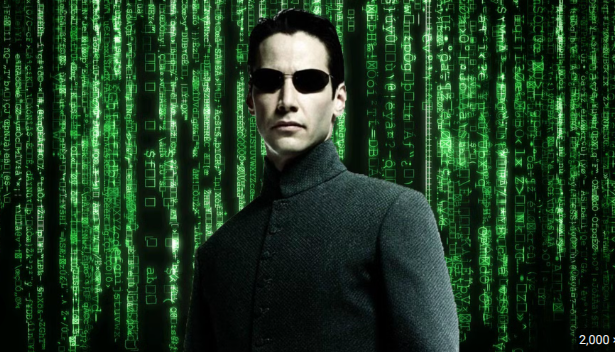
One of the most iconic visual elements in cinematic history is the “Matrix Digital Rain”—the cascading green characters that represent the code of the simulation. For years, fans speculated that these symbols held a profound, cryptic meaning related to quantum physics or ancient languages. However, the truth is far more culinary than cosmic. The production designer, Simon Whiteley, has revealed that the “code” is actually a digitized version of his wife’s Japanese cookbooks.
Whiteley scanned the characters from several sushi recipes, flipped them, and randomized them to create the falling effect. This fact changes the way you see the movie’s most serious moments; while Neo is realizing his destiny as the savior of mankind, the screen is essentially displaying the instructions for a spicy tuna roll or a perfect batch of nigiri. This choice highlights the “found object” nature of great design—taking something mundane and domestic and transforming it through art into something alien and intimidating. It’s a perfect metaphor for the Matrix itself: a complex system built out of the ordinary pieces of human culture.
2. The Trans Allegory: A Story of Personal Transformation
For a long time, viewers interpreted the “splinter in the mind” that Neo feels as a general metaphor for being an outsider or a rebel. However, in later years, Lilly and Lana Wachowski confirmed that the series was always intended as a trans allegory. The story of Neo is the story of a person who feels that the world’s perception of them is “wrong” and must undergo a painful, transformative “awakening” to embrace their true identity.
This perspective is most evident in the character of Switch. In the original script, Switch was intended to be played by a male actor in the “real world” and a female actor inside the Matrix—a literal “switch” of gender identity within the simulation. While the studio eventually leaned toward a single actor for both worlds, the subtext remains. Neo’s choice of a new name, his rejection of the identity “Mr. Anderson” imposed by the system, and the theme of shedding a false skin are all deeply rooted in the trans experience. Seeing the film through this lens transforms it from a generic “chosen one” story into a poignant, personal narrative about the courage required to exist as one’s authentic self.
3. The Colors of Reality: Green vs. Blue vs. Grit
The cinematography of The Matrix uses color as a psychological weapon to tell the viewer exactly where they are without a single word of dialogue. When characters are inside the simulation, the entire film is passed through a distinct green filter. This was done to give the world a sickly, artificial hue, mimicking the glow of an old monochrome computer monitor from the early days of computing. It suggests that the “beauty” of the simulation is a facade built on decaying technology.
Conversely, scenes set in the “real world” (on the ship or in the city of Zion) were shot with a cold, blue tint or a gritty, desaturated palette. The filmmakers even went so far as to ensure that there was no green anywhere in the real-world sets—not even in the clothing or the props. This stark contrast forces the audience to subconsciously feel the “wrongness” of the green world and the harsh, unfiltered truth of the blue world. It is a visual representation of the choice between the “Blue Pill” (the comfortable, tinted lie) and the “Red Pill” (the cold, hard reality).
4. Keanu Reeves Trained Through Excruciating Pain
Before filming even began, the main cast was subjected to months of intensive martial arts training under legendary choreographer Yuen Woo-ping. However, Keanu Reeves faced a challenge that would have sidelined most actors. He had recently undergone major neck surgery to resolve a spinal issue that was causing paralysis in his legs. Throughout the entire four-month training period, Reeves was forced to wear a neck brace and perform his kicks and strikes with extreme caution.
This fact recontextualizes Neo’s movement in the first film. Because he was recovering from surgery, many of his fight scenes emphasize hand-to-hand combat and upper-body movement rather than high-flying kicks. The physical struggle Reeves endured in real life mirrors Neo’s struggle to adapt to his new body after being “unplugged.” When Neo says, “My eyes hurt,” and Morpheus responds, “You’ve never used them before,” there is a genuine physical weight to the performance. Reeves’ dedication to the role, despite the risk of permanent injury, is what gave Neo his signature stoic, determined presence.
5. Jean Baudrillard and the “Desert of the Real”
The philosophy of the franchise isn’t just a collection of cool-sounding ideas; it is explicitly rooted in the work of French philosopher Jean Baudrillard. In an early scene, Neo hides his illegal software inside a hollowed-out book titled Simulacra and Simulation. This book argues that modern society has replaced all reality and meaning with symbols and signs—a state Baudrillard calls “hyperreality.” According to him, the “simulation” is more real to us than the actual world.
Morpheus even quotes the book directly when he welcomes Neo to the “desert of the real.” Interestingly, Baudrillard himself was famously unimpressed with the film, claiming that the Wachowskis misunderstood his work by suggesting there was still a “real world” to escape to. Regardless of the philosopher’s critique, the inclusion of his work turns the movie into a high-level academic exercise. It challenges the viewer to look at their own life: Do we live in reality, or do we live in a world of curated digital images and social constructs that have become our “Matrix”?
6. The “Seventh Version” of the One
A common misconception is that Neo is a unique, one-time miracle. However, the encounter with the Architect in the second installment reveals a much darker truth: Neo is part of a recurring system. He is the “Sixth Version” of the One (with the story eventually progressing to a seventh). The Architect explains that the “One” is actually a calculated feature of the system designed to act as a “release valve” for the inherent instability of the human mind.
This revelation completely changes Neo’s status as a “Chosen One.” He isn’t a glitch that the machines can’t handle; he is a glitch that the machines expect. His purpose was originally to reboot the system and select a group of humans to “re-seed” Zion, keeping the cycle of control going indefinitely. What makes our Neo different is his choice to reject the “rational” path of saving the species in favor of the “irrational” path of saving Trinity. This shift from a mathematical inevitability to a genuine human choice is what finally breaks the cycle of the Matrix, making Neo the first true individual in the machine’s history.
7. The Bullet Time Technique: Practical Meets Digital
The “Bullet Time” sequence—where the camera pans around Neo as he dodges bullets—is often cited as the birth of modern CGI. However, the technique is actually a brilliant fusion of old-school photography and new-school digital stitching. To achieve the effect, the crew set up 120 still cameras in a massive green-screen circle. They then triggered the cameras in a specific sequence, milliseconds apart, creating the illusion of movement through frozen time.
Because the cameras were still-frame, the production had to use sophisticated interpolation software to “fill in the gaps” between the photos, creating a smooth, fluid motion. This wasn’t just a “filter” or a digital model; it was a physical capture of a moment in time from 120 different angles. This fact highlights the innovative spirit of the production—they didn’t wait for technology to catch up to their vision; they hacked existing technology to create something the world had never seen. It remains one of the few special effects that still looks convincing decades later.
8. Will Smith and the “What If” Casting
It is almost impossible to imagine anyone other than Keanu Reeves as Neo, but he was far from the first choice. The role was famously offered to Will Smith, who turned it down to star in Wild Wild West. Smith has since admitted that at the time, he didn’t “get” the concept, particularly the pitch for the “Bullet Time” scene. Other actors considered included Nicolas Cage, Brad Pitt, and even Sandra Bullock (who the studio considered changing the role to a female lead for).
The fact that Will Smith turned down the role is a major “sliding doors” moment in cinema. Smith’s high-energy, charismatic persona would have resulted in a vastly different film—likely more of a traditional action movie. Keanu Reeves brought a specific “blank slate” quality to Neo, allowing the audience to project themselves onto him. His quiet, internal performance allowed the heavy philosophical themes of the film to breathe. This casting fluke proves that sometimes the “perfect” movie is the result of a series of fortunate rejections.
9. The Religious and Mythological Weaving
The names and terminology in the franchise are a dense tapestry of global mythology and religion. “Neo” is an anagram for “One,” but it also means “New” in Greek. “Morpheus” is the Greek god of dreams, fitting for a man who “wakes people up.” The ship, the Nebuchadnezzar, is named after a Babylonian king who was obsessed with dreams and their interpretations. The city of “Zion” is a direct reference to the promised land in Judeo-Christian tradition.
Furthermore, the story heavily incorporates Buddhist and Gnostic themes. The idea that the physical world is an illusion (Maya) that one must transcend through “enlightenment” is central to Buddhist thought. The “Spoon Boy” scene is the ultimate expression of this: “There is no spoon.” By weaving these ancient threads into a high-tech cyberpunk setting, the Wachowskis created a story that feels both futuristic and primordial. It suggests that while our technology changes, our spiritual quest for truth and liberation remains the same across millennia.
10. The “Matrix Within a Matrix” Theory
One of the most debated facts among hardcore enthusiasts is the “Double Matrix” theory. Fans point to the moment where Neo is able to use his powers in the “real world”—specifically stopping the Sentinels with his mind at the end of the second film—as proof that the “real world” is actually just another level of simulation. This “Level 2” Matrix would serve to catch those who “unplug” from the first level, giving them a false sense of rebellion while still keeping them under control.
While the sequels offer a different explanation (that Neo’s connection to the Source allows him to interface with any machine wirelessly), the “Matrix Within a Matrix” theory remains a compelling way to view the story. It adds a layer of cosmic horror to the franchise, suggesting that humanity may never truly be free. Even if the theory is purely speculative, the fact that the film’s internal logic allows for such a debate is a testament to its depth. It forces the viewer to remain skeptical, reminding us that in a world of code and control, “the truth” is always a moving target.
Further Reading
- The Matrix and Philosophy: Welcome to the Desert of the Real by William Irwin
- Simulacra and Simulation by Jean Baudrillard
- The Art of the Matrix by Lana and Lilly Wachowski
- The Ultimate Matrix and Philosophy: More Red Pill Decisions by William Irwin




Leave a Reply