
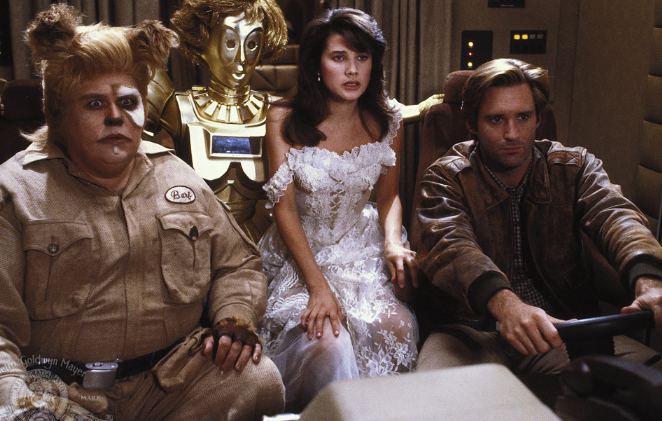
In a galaxy far, far away—or perhaps just in a studio backlot in Southern California—one of the most enduring satires in cinematic history was born. When the legendary Mel Brooks decided to set his sights on the burgeoning science fiction genre, the result was a comedic explosion that would echo through the decades. Spaceballs is not merely a spoof; it is a masterclass in meta-humor, breaking the fourth wall with such frequency that the screen itself feels like a suggestion. At its core, the film is a loving, if irreverent, jab at the massive space operas that dominated the late 1970s and 1980s, specifically the sprawling Star Wars saga.
For many fans, the film serves as an entry point into the world of satire, demonstrating how a filmmaker can deconstruct a beloved property while simultaneously celebrating its cultural impact. From the gargantuan scale of the Spaceball One ship to the diminutive wisdom of Yogurt, the movie manages to capture the awe of space travel and promptly deflate it with a well-timed gag. To truly appreciate the “Schwartz” in all its glory, one must look beyond the screen and into the production hurdles, the legal oddities, and the comedic genius that fueled its creation. This guide delves into the essential history of this evergreen comedy, ensuring you never look at a canned air canister the same way again.
1. The George Lucas “No Merchandising” Handshake Agreement
Perhaps the most famous piece of lore surrounding the production is the “gentleman’s agreement” between Mel Brooks and Star Wars creator George Lucas. Brooks, a veteran of the industry who understood the power of intellectual property, reached out to Lucas to get his blessing before filming. Lucas, surprisingly, was a fan of Brooks’ earlier work like Blazing Saddles and gave him the green light with one very specific, very ironclad condition: there could be no Spaceballs merchandise.
Lucas feared that a line of parody toys—specifically action figures that looked like Rick Moranis or John Candy—would confuse consumers and potentially cannibalize the sales of his own multibillion-dollar toy empire. Brooks, valuing the creative freedom to lampoon the saga more than the potential royalty checks from plastic dolls, agreed. This lead to one of the most brilliant meta-jokes in the film: “Spaceballs: The Merchandising.” Every time we see Yogurt surrounded by lunchboxes, towels, and flame-throwers, the audience is witnessing a defiant, hilarious nod to the very legal restriction that prevented those items from existing in the real world.
2. The Weighty Burden of Rick Moranis’s Dark Helmet
Rick Moranis created one of the most iconic villains in comedy history with Lord Dark Helmet, a diminutive tyrant with an ego as oversized as his headgear. However, the physical reality of the role was far from comfortable. The massive helmet was not just a visual gag; it was a heavy, cumbersome prop that Moranis had to balance while delivering his sharp, fast-paced dialogue. To make matters more difficult, the visor frequently obscured his vision, making it hard to navigate the sleek, often slippery sets of the Spaceball One bridge.
Moranis’s performance is a masterclass in comedic physicality. He used the helmet’s size to his advantage, leaning into the absurdity of a villain who literally couldn’t see past his own gear. The “private time” scene, where Dark Helmet plays with his dolls, was largely improvised, showcasing Moranis’s ability to find the humor in the mundane even while encased in several pounds of plastic. The costume served as a perfect metaphor for the character: a man desperately trying to appear imposing while being physically dwarfed by the very symbols of his power.
3. High-Quality Effects from the Very People Being Spoofed
One might expect a parody film to use low-budget, “cheap” looking effects to emphasize the joke. Mel Brooks, however, took the opposite approach. He believed that for the satire to truly land, the world of the film needed to look as “real” as the movies it was mocking. To achieve this, Brooks hired Industrial Light & Magic (ILM)—the legendary visual effects house founded by George Lucas himself—to handle the space sequences. This created the bizarre and wonderful situation where the same artists who built the Millennium Falcon were now building the Eagle 5 Winnebago.
By utilizing high-tier motion-control photography and professional model-making, the film achieved a visual fidelity that rivaled major sci-fi blockbusters. When the Spaceball One ship takes nearly two full minutes to cross the screen in the opening shot, the joke works because the ship looks genuinely massive and detailed. The juxtaposition of “prestige” visual effects with low-brow humor (like the ship being so large it has a “We Brake For Nobody” bumper sticker) is a cornerstone of Brooks’ comedic philosophy: play it straight so the punchline hits harder.
4. John Candy and the Mechanics of Being a “Mog”
John Candy’s portrayal of Barf, the half-man, half-dog (or “Mog”), is the emotional heart of the crew. But transforming the late, great comedian into a canine companion was a technical nightmare. The costume featured animatronic ears and a tail that were controlled via a remote-control system by off-screen technicians. In the late 1980s, these systems were notoriously finicky. Frequently, the ears would twitch at the wrong time, or the tail would refuse to wag during a take, requiring multiple restarts for what should have been simple scenes.
Despite the technical frustrations, Candy remained a consummate professional, often joking that he had to be his own “best friend” on set. He had to wear a heavy battery pack under his costume to power the ear-motors, which made his physical movement even more taxing. His performance shines through the prosthetics because he didn’t just play a man in a dog suit; he adopted canine mannerisms, from the way he panted during high-stress situations to his unyielding loyalty to Lone Starr. It remains one of the most beloved “creature” performances in the genre.
5. The Dangerous Gold Makeup of Yogurt
Mel Brooks didn’t just direct and write the film; he took on two demanding roles: the corrupt President Skroob and the wise, gold-skinned master of the Schwartz, Yogurt. The transformation into Yogurt was particularly grueling. The makeup team applied thick, gold-tinted prosthetic paint to Brooks’ face and hands to give him a shimmering, otherworldly glow. However, the skin-tight nature of the makeup and the chemicals used in the metallic pigment caused Brooks to break out in a severe allergic reaction.
Throughout the filming of the Yogurt scenes, Brooks was often in significant physical discomfort, yet he never let it dampen his comedic energy. The character was a direct parody of Yoda, but Brooks added a “Borscht Belt” comedian twist, turning the spiritual mentor into a savvy businessman obsessed with “moichendising.” The irony of a character who preaches about the “Schwartz” while selling t-shirts is heightened when you realize the actor was literally suffering for his art behind the gold paint. It is a testament to Brooks’ commitment to the gag.
6. Joan Rivers and the Robotic Struggles of Dot Matrix
To parody the fastidious C-3PO, Brooks cast the sharp-tongued Joan Rivers as the voice of Dot Matrix, Princess Vespa’s “virgin-alarm” equipped droid. While Rivers provided the iconic voice and comedic timing, the physical acting was done by Lorene Yarnell, a professional mime and one half of the famous duo “Shields and Yarnell.” This division of labor was necessary because the Dot Matrix suit was an incredibly rigid, gold-plated nightmare that allowed for almost no natural movement.
Yarnell’s background in mime was essential for giving the robot its staccato, mechanical fluidity. However, the suit was so restrictive that she had to be bolted into it, and she couldn’t sit down between takes. Because the metal reflected the hot studio lights, the temperature inside the suit would often skyrocket, leading to exhaustion. Rivers, recording her lines later, brought a “Brooklyn aunt” energy to the character that perfectly countered the sleek, robotic exterior. Together, they created a character that was simultaneously a technical marvel and a comedic firecracker.
7. Breaking the Fourth Wall with the “Instant Cassette”
One of the most revolutionary comedic sequences in the film occurs when the villains use a “Spaceballs: The Movie” home video cassette to find out where the heroes are hiding. This moment of meta-commentary was a direct satire of the burgeoning home video market of the era. By having the characters watch the very movie they are currently in, Brooks shattered the fourth wall in a way that had rarely been seen in mainstream cinema. It was a joke about the nature of time, sequels, and the commercialization of film.
This scene required careful planning to ensure the “movie within the movie” matched the footage already shot. It remains a fan favorite because it acknowledges the audience’s presence and the medium’s limitations. It also perfectly encapsulated the film’s philosophy: nothing is sacred, not even the timeline of the story being told. The confused dialogue between Dark Helmet and Colonel Sandurz as they navigate “now,” “then,” and “next Friday” is a dizzying piece of wordplay that remains a highlight of 20th-century screenwriting.
8. Bill Pullman’s Reluctant Hero and the Lone Starr Persona
Before he was a blockbuster leading man, Bill Pullman was cast as Lone Starr, the “Han Solo” of the Spaceballs universe. Brooks chose Pullman because he possessed a “generic” leading-man quality that could be easily molded into a parody of the space-hero archetype. Lone Starr is a blend of Luke Skywalker’s destiny and Han Solo’s cynicism, though he is ultimately revealed to be a prince—a jab at the “secret royal” tropes common in high fantasy and sci-fi.
Pullman played the role with a “straight man” earnestness that allowed the absurdity around him to shine. While John Candy and Rick Moranis were chewing the scenery, Pullman provided the grounded center necessary for the plot to move forward. His chemistry with Daphne Zuniga (Princess Vespa) mirrored the bickering-to-romance arc of many classic films, but with the added “Brooksian” twist of having to rescue a pampered princess whose primary concern is her matching luggage. It was a breakout role that proved Pullman had the comedic chops to handle a big-budget satire.
9. The Musical Legacy of “The Schwartz” and Beyond
Music plays a crucial role in grounding the parody of Spaceballs. The score, composed by John Morris, mimics the sweeping, operatic themes of John Williams while subtly injecting comedic motifs. The main title theme sounds heroic and grand, but as the camera lingers on the interminable length of the opening ship, the music begins to feel hilariously overwrought. This auditory satire is just as important as the visual gags in establishing the film’s tone.
Additionally, the film features a theme song performed by The Spinners, which was a departure from the typical orchestral themes of sci-fi. This move toward a “pop” sensibility for the credits was a nod to the growing trend of using chart-topping hits to market films. The lyrics, which explicitly mention the “Schwartz” and the characters, turned the movie’s lore into a catchy earworm. This blend of “prestige” scoring and pop-culture marketing further emphasized the film’s central theme: that even the most epic stories are eventually packaged and sold as a catchy tune and a lunchbox.
10. A Timeless Spoof of the “Sequel Culture”
Perhaps the most evergreen aspect of Spaceballs is its prediction of “sequel culture.” The film is obsessed with the idea of its own continuation, from Yogurt’s “Search for More Money” line to the ending that teases Spaceballs II: The Search for More Money. Brooks was lampooning the trend of franchises that refuse to end as long as there is a profit to be made. While many fans have spent years waiting for an actual sequel, the joke is that the lack of a sequel is the ultimate punchline to the film’s critique of greed.
The movie remains relevant because the tropes it mocks—reboots, endless sequels, and aggressive merchandising—have only become more prevalent in the modern film industry. It serves as a reminder that the “business” of show business is often as absurd as any plot involving a giant maid with a vacuum cleaner. By satirizing the industry’s mechanics, Spaceballs secured its place as a “forever” comedy. It doesn’t just mock a specific movie; it mocks the entire culture of blockbuster filmmaking, ensuring that as long as studios are making space operas, Spaceballs will be there to make fun of them.
Further Reading
- All About Me!: My Remarkable Life in Show Business by Mel Brooks
- The 21st-Century Screenplay: A Comprehensive Guide to Writing Tomorrow’s Movies by Linda Aronson (for context on satire structure)
- Industrial Light & Magic: The Art of Innovation by Pamela Glintenkamp
- George Lucas: A Life by Brian Jay Jones
- Podcast Episode: Classic Films And Horror Icons
- 10 The Exorcist III (1990) Movie Facts You Didn’t Know
- 10 Scream (1996) Movie Facts That Changed Horror
- 10 The Lion King (1994) Facts That Made It Iconic – Classic Movie
- 10 Forrest Gump (1994) Facts That Make It Timeless – Classic Movie
- 10 Fight Club (1999) Facts That Still Surprise Fans – Classic Movie
- 10 Hostel (2005) Movie Facts That Shocked Viewers
- 10 Avatar (2009) Facts That Changed Cinema – Classic Movie
- 10 Hellraiser (1987) Movie Facts That Built Its Legacy
- 10 Jurassic Park (1993) Facts That Changed Movies Forever – Classic Movie



