
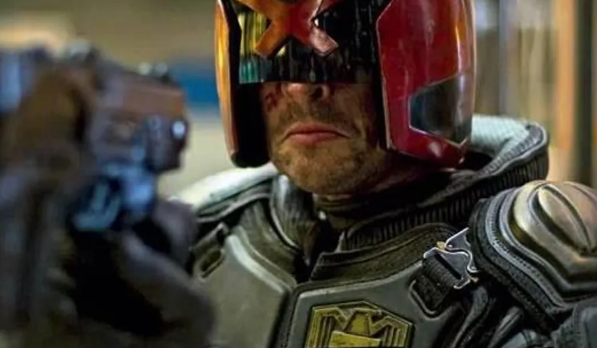
In the grim, neon-soaked sprawl of the future, where millions are packed into towering mega-structures and the chaos of human nature threatens to boil over at every street corner, there is only one thing standing between civilization and total anarchy: The Law. And in the world of comic book icons, no one embodies that law with more terrifying, iron-fisted resolve than Judge Dredd.
Emerging from the pages of the legendary British sci-fi anthology 2000 AD, Judge Dredd is not your typical superhero. He doesn’t have a secret identity, he doesn’t wear a cape, and he certainly doesn’t believe in “second chances.” He is a Street Judge—a specialized police officer granted the instantaneous power of judge, jury, and executioner. To understand Dredd is to understand a world where freedom has been traded for a brutal, necessary security. Whether you are a newcomer to the “Big Meg” or a veteran of the Iso-Cubes, these ten pillars of Dredd lore are essential for navigating the toughest beat in the galaxy.
1. The Faceless Symbol of Absolute Authority
One of the most defining characteristics of Judge Dredd is that he never removes his helmet. Since his first appearance, readers have never seen the full face of Joseph Dredd. This is not a gimmick or a mystery to be “solved” with a dramatic reveal; it is a fundamental narrative philosophy. In the world of the Judges, the man is irrelevant—only the office matters. By keeping Dredd’s face obscured, the artists emphasize that he is not a person with personal feelings or a private life; he is the literal face of the Law.
This facelessness serves as a powerful metaphor for the impartial—and often cold—nature of justice in Mega-City One. If Dredd were to show his face, he would become human, vulnerable, and subjective. Hidden behind his iconic visor, he remains a relentless, unwavering force of nature. This design choice ensures that the character remains an archetype rather than an individual, reinforcing the idea that anyone wearing the badge and helmet carries the same terrifying weight of authority. It is a visual representation of the sacrifice required to maintain order in a dystopian nightmare.
2. The Sprawling Madness of Mega-City One
To know Dredd, you must know his home: Mega-City One. Stretching along the entire Eastern Seaboard of what was once the United States, this gargantuan metropolis is home to hundreds of millions of citizens living in state-of-the-art “city-blocks”—massive skyscrapers that can house up to 50,000 people each. Because automation has rendered 90% of the population unemployed, the city is a powder keg of boredom, eccentricity, and crime.
Life in the “Big Meg” is a surreal blend of high-tech marvels and primitive desperation. From “Block Wars” where neighboring towers engage in full-scale military conflict, to bizarre fads like “Ugly Clinics” or competitive eating (practiced by the “Fatties”), the environment is a satirical reflection of modern urban decay. The city itself is a character, constantly evolving and frequently facing near-total destruction from nuclear strikes, alien invasions, or undead plagues. Dredd is the only constant in this shifting sea of madness, patrolling the sky-rails and concrete canyons to keep the population from tearing itself apart.
3. The Judge System: Jury, Executioner, and All
The legal system in Dredd’s world is far removed from our own. In the wake of a devastating global nuclear conflict, the traditional democratic branches of government collapsed. In their place rose the Justice Department, a paramilitary organization that runs the city with total control. As a Street Judge, Dredd has the legal authority to apprehend a suspect, pass a sentence on the spot, and carry out that sentence immediately—whether it be a fine, five years in an Iso-Cube, or the death penalty.
The training for this role is grueling. Recruits are taken as children and spend fifteen years in the Academy of Law, where they are subjected to intense physical conditioning and mental indoctrination. Any sign of weakness or moral hesitation results in immediate expulsion. Those who survive the training become the most formidable law enforcement officers in existence. This system is designed to create a “perfect” officer, but it also creates a society where the police are the masters. Dredd is the ultimate product of this system—a man who has completely sublimated his humanity to serve the code of the Justice Department.
4. The Lawgiver: More Than Just a Pistol
A Judge is only as effective as his equipment, and the Lawgiver is arguably the most advanced handgun in fiction. This voice-activated weapon is DNA-coded to a specific Judge; if anyone else attempts to fire it, the weapon will self-destruct, usually taking the thief’s arm with it. The Lawgiver is essentially a handheld artillery piece, capable of firing several different types of specialized ammunition depending on the situation.
A Judge can cycle through rounds with a simple voice command. Standard execution rounds handle basic threats, while heat-seekers lock onto a target’s thermal signature. Incendiary rounds can melt through armor, ricochet rounds allow for trick shots around corners, and high-explosive rounds provide anti-tank capabilities. This versatility is crucial for a Judge who must face everything from petty muggers to rogue robots. The Lawgiver is not just a tool for killing; it is a symbol of the technological superiority that allows a single Judge to hold back a riotous crowd of thousands.
5. Real-Time Aging: A Rare Comic Book Feat
Unlike most comic book characters who exist in a “sliding timeline”—where Spider-Man or Batman stay roughly the same age for decades—Judge Dredd ages in real-time. Since his debut in the late 1970s, every year that has passed in the real world has also passed for Joseph Dredd. This is a revolutionary narrative device that gives the series an incredible sense of weight and consequence.
We have watched Dredd grow from a hard-nosed young lawman into a grizzled, veteran senior Judge, and eventually into an aging legend who must occasionally confront his own mortality. He has suffered permanent injuries, witnessed the passing of multiple Chief Judges, and seen the city he loves fall and rise again. This commitment to chronological progression means that Dredd’s history is a cohesive, decades-long epic. It allows for deep character development, as Dredd’s views on the law have slowly shifted and softened—ever so slightly—as he sees the repetitive cycle of violence and the toll his brand of justice takes on the citizenry.
6. The Dark Judges and the Terror of Judge Death
Every great hero needs a nemesis, and Dredd has the most terrifying one in the multiverse: Judge Death. Hailing from an alternate dimension known as “Deadworld,” Judge Death is the leader of the Dark Judges. His logic is chillingly simple: since all crime is committed by the living, life itself is a crime. Therefore, the only way to achieve perfect justice is to exterminate all living things.
Alongside his lieutenants—Fear, Fire, and Mortis—Judge Death represents a supernatural, nihilistic mirror to Dredd’s own rigid beliefs. While Dredd wants to control life through the law, Death wants to end it. Their battles are legendary, often taking place across dimensions and involving the psychic powers of the Psi-Division. Judge Death is more than just a monster; he is a philosophical challenge to Dredd. He shows what happens when the “purity” of the law is taken to its absolute, insane extreme, forcing Dredd to act as a protector of life, even if he views that life as inherently disorderly.
7. The Cursed Earth: Life Outside the Walls
While Mega-City One is a nightmare, the world outside is even worse. The Cursed Earth is the radioactive wasteland that covers the interior of the North American continent, a remnant of the global nuclear war. It is a lawless desert populated by mutants, religious cults, scavenger gangs, and prehistoric monsters brought back through rogue cloning technology.
Dredd has traversed the Cursed Earth on several famous “long marches,” usually to deliver a cure for a plague or to hunt down a high-profile fugitive. These stories allow the series to shift genres, moving from cyberpunk police procedurals to post-apocalyptic Westerns. The Cursed Earth serves as a stark reminder of why Mega-City One exists in the first place. As terrible as the Judges are, the alternative is the absolute, lawless horror of the wastes. It also highlights Dredd’s physical endurance and survival skills; even without the backup of the Justice Department, he is a force to be reckoned with in any environment.
8. Satire as a Weapon: Dredd’s Hidden Depth
On the surface, Judge Dredd might look like a celebration of authoritarian power, but he was actually created as a sharp political satire. Originating in the United Kingdom during a period of significant social unrest, the comic was designed to critique fascism, police brutality, and the loss of civil liberties. The writers use the absurdity of Mega-City One to poke fun at consumerism, celebrity culture, and the American political landscape.
This satirical edge is what gives the series its longevity. Dredd himself is often the “straight man” in a world that has gone completely insane. The comedy is often dark and dry, highlighting the ridiculousness of a man who will give a citizen ten years in prison for “littering” while a giant monster is eating a nearby skyscraper. By presenting Dredd as an uncompromising, almost robotic figure, the creators force the reader to question whether his version of “order” is actually worth the price. It is a complex, layered work that functions as both a high-octane action comic and a sophisticated piece of social commentary.
9. Judge Anderson and the Psi-Division
Not all Judges rely on guns and brawn. The Psi-Division is a branch of the Justice Department made up of individuals with extraordinary mental abilities, such as telepathy, precognition, and pyrokinesis. The most famous of these is Cassandra Anderson, a powerful telepath who has become Dredd’s closest ally and moral foil.
Unlike the stoic and rigid Dredd, Judge Anderson is empathetic, witty, and prone to questioning the morality of the Judge system. Her stories often deal with the supernatural, the mystical, and the psychological. The dynamic between Dredd and Anderson is one of the best in comics; she provides the “heart” that Dredd lacks, while he provides the unwavering stability she often needs. Through the Psi-Division, the Dredd universe expands into the realm of horror and high fantasy, showing that the Justice Department’s reach extends even into the dreams and nightmares of the citizens.
10. The Origin of Joseph Dredd: A Product of Science
The final fact you must know is that Joseph Dredd was quite literally “born” to be a Judge. He is a clone of Chief Judge Eustace Fargo, the man known as the “Father of Justice.” Created in a laboratory to be the perfect lawman, Joseph and his brother, Rico Dredd, were accelerated to physical maturity and placed in the Academy of Law. They carried the DNA of the founder of the system, making them the ultimate scions of the Justice Department.
However, genetics are not destiny. While Joseph became the greatest Judge in history, his brother Rico turned to a life of crime and corruption, eventually forcing Joseph to arrest and later execute him. This family tragedy is the cornerstone of Dredd’s character. It proves that even with the “perfect” DNA and the most rigorous training, the law is a choice. Dredd chooses to be the Law every single day, and his commitment to his duty over his own blood remains his most powerful—and most tragic—defining trait.
Further Reading
To fully immerse yourself in the world of the Big Meg, start with these essential graphic novels:
- Judge Dredd: Case Files Vol. 05 (Includes the legendary “Apocalypse War”)
- Judge Dredd: America by John Wagner and Colin MacNeil
- Judge Dredd: The Cursed Earth Saga by Pat Mills and various artists
- Judge Dredd: Necropolis by John Wagner and Carlos Ezquerra




Leave a Reply