
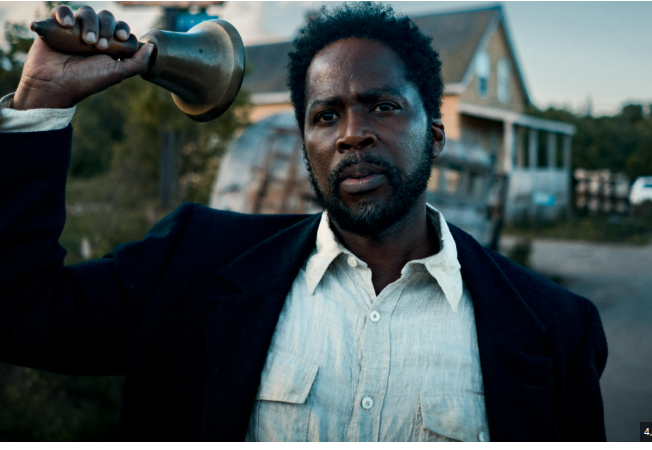
No Way Out: 10 Bone-Chilling Secrets and Spoilers from the First Season of From
In the vast landscape of modern “mystery box” television, few shows have managed to grip the collective throat of the audience quite like the inaugural season of this harrowing series. The premise is the ultimate nightmare: a forgotten town in middle America that traps everyone who enters, forcing them into a nightly battle for survival against creatures that wear human faces and a polite, terrifying smile. It is a show built on the foundation of dread, isolation, and the agonizing question of whether hope is a lifeline or a cruel joke.
To navigate the first season is to step into a labyrinth where the rules of physics and logic no longer apply. There are no maps out, no cell service, and no mercy once the sun dips below the horizon. The series masterfully blends elements of folk horror, psychological thriller, and survival drama, creating a cocktail of tension that leaves viewers perpetually off-balance. For those looking to dissect the intricate lore or simply survive their first viewing, these ten pivotal points serve as the essential guide to the mysteries of the town.
1. The Fallen Tree and the Raven’s Warning
The gateway to the town is always the same, yet it is never in the same place twice. Every resident shares a hauntingly similar origin story: they were driving on a rural road, encountered a massive fallen tree blocking the path, and saw a murder of crows circling overhead. This is the “Point of No Return.” Once a traveler turns the car around to find a detour, they find themselves driving down the main street of a dilapidated town that they can never leave.
The fallen tree acts as a supernatural threshold, a physical manifestation of the trap being sprung. It doesn’t matter if you were in Arizona or Maine; the “From-verse” pulls you into its localized pocket of reality. This loop is the first psychological blow to the characters. They drive in circles, passing the same motel and the same diner over and over again, until the crushing realization sets in: they are no longer in the world they recognize. The crows serve as the harbingers of this transition, their caws acting as a mocking soundtrack to the moment a person’s life is permanently diverted into a waking nightmare.
2. The Monsters Who Walk and Smile
The primary antagonists of the town are not your typical cinematic monsters. They don’t run, they don’t scream, and they don’t hide in the shadows. Instead, they appear as ordinary people from the 1950s—nurses, milkmen, and friendly neighbors—who walk at a leisurely, rhythmic pace. They only come out at night, and their goal is not just to kill, but to mutilate and “play” with their victims in a way that suggests a profound, sadistic intelligence.
The horror of these creatures lies in their civility. They will stand outside a window and politely ask to be let in, using the names of loved ones or appealing to a person’s sense of loneliness. They represent the ultimate subversion of small-town hospitality. Once they are invited across a threshold, or if a person is caught outside after dark, the “human” facade slips, revealing rows of needle-like teeth and a physical strength that defies nature. They are the reason the townspeople live by a strict, sun-governed schedule, turning the simple act of sunset into a terrifying countdown for survival.
3. The Power of the Ancient Talismans
For a long time, the residents of the town lived in constant terror, hiding in crawlspaces and hoping the monsters wouldn’t hear their breathing. That changed when Boyd Stevens, the town’s sheriff and de facto leader, discovered the talismans. These small, stone slabs engraved with mysterious runes are the only things keeping the inhabitants safe. When hung near a doorway or window in an enclosed space, they create a metaphysical barrier that the monsters cannot cross—provided the “invitation” is never extended.
The discovery of the talismans transformed the show from a story of hopeless slaughter into one of strategic survival. However, they are not a “get out of jail free” card. They only work if the space is completely sealed; a broken window or an unlatched door renders the talisman useless. They also raise one of the show’s biggest questions: who made them? The fact that a protective force exists suggests that the town operates on a set of occult rules. The talismans represent the fragile line between the order of the day and the chaos of the night.
4. The Schism Between the Town and Colony House
Survival in the town is split into two distinct philosophies. On one side is “The Town,” led by Boyd, which maintains a semblance of pre-trap society. People live in individual houses, keep jobs, and follow a strict set of laws. It is a life defined by structure and the hope of eventually returning to the “real” world. On the other side is “Colony House,” a massive estate on the hill led by the pragmatic Donna. Life there is communal, hedonistic, and focused on the present moment.
This divide creates a fascinating social dynamic. Colony House residents share everything—food, beds, and experiences—believing that since they are likely going to die anyway, they might as well live with total freedom. The Town residents view this as a dangerous abandonment of the human spirit. This tension comes to a head during the first season, illustrating that even in the face of literal monsters, human beings will still find ways to tribalize and argue over the “right” way to exist. It asks the audience: would you prefer the safety of a cage or the freedom of a doomed party?
https://zentara.blog/category/story-recaps
5. The Arrival of the Matthews Family
The catalyst for the events of the first season is the arrival of the Matthews family: Jim, Tabitha, and their children, Julie and Ethan. Their entry is unique because it coincides with another vehicle—a bus—entering the town at the same time, leading to a high-stakes crash that forces the townspeople to risk their lives during the “Golden Hour” (the time just before sunset). The Matthews family represents the audience’s perspective, experiencing the sheer disbelief and terror of the town for the first time.
Each family member reacts differently to the trauma. Jim, an engineer, immediately looks for a logical, technical way out. Tabitha finds herself drawn to the domestic mysteries of their “new” home, discovering hidden markings and strange basement occurrences. Ethan, the youngest, begins to see things that others can’t—most notably “The Boy in White.” The family’s presence acts as a disruptor to the town’s status quo, pushing the community to stop just “surviving” and start actively investigating the nature of their prison.
6. Victor: The Keeper of the Town’s History
Victor is arguably the most important character in the series. A man who has clearly been in the town since he was a child, he is the sole survivor of a previous “cleansing” event where everyone else was killed. Because of his trauma, Victor communicates primarily through drawings and cryptic observations. He understands the rhythms of the town better than anyone, but his mind is a fractured map of symbols, colors, and warnings.
Victor’s drawings are essentially a historical record of the town’s supernatural cycles. He tracks the movement of the trees (which are slowly moving closer to the town) and the reappearance of certain omens. While many residents dismiss him as eccentric or “crazy,” it becomes clear that Victor is the bridge to the past. He remembers the “Boy in White,” a mysterious entity who appears to children and seems to guide them—though whether the boy is benevolent or a malevolent puppet master remains one of the show’s most haunting ambiguities.
7. Sara and the Voices of the Town
While the monsters are the external threat, Sara represents the internal danger. A quiet worker at the diner, Sara begins hearing voices that claim to be the town itself—or at least the forces controlling it. These voices promise her that if she kills certain people (specifically the young Ethan Matthews), everyone else will be allowed to go home. This plunges her into a state of murderous psychosis, leading to the deaths of several residents.
Sara’s arc highlights the psychological warfare at play. The “voices” know things they shouldn’t—personal secrets, names, and future events. This suggests that the town is a sentient or at least semi-intelligent entity that feeds on fear and moral compromise. When Boyd discovers Sara’s crimes, he doesn’t execute her; instead, he takes her into the woods to use her connection to the voices as a compass. Her presence is a constant reminder that the town can get inside your head just as easily as the monsters can get inside your house.
8. The Faraway Trees and the Randomness of Space
One of the most surreal elements introduced in the first season is the “Faraway Trees.” These are specific trees with hollow trunks that act as localized wormholes. If you step into one, you are instantly transported to another location within the town’s perimeter. The catch? You have no control over where you end up. You might land in a cellar, a field, or a high-altitude spot with no way down.
The Faraway Trees reinforce the idea that the town is not part of our physical reality. They are glitches in the map. Victor is the only one who seems to have a rudimentary understanding of which trees lead where, using them to escape the monsters. For the other characters, the trees represent a desperate, “hail mary” gamble. Stepping into a Faraway Tree is an act of total surrender to the town’s whims, symbolizing the loss of agency that every resident feels. They are a literal representation of the show’s title: you are always going from one nightmare to another.
9. The Radio Tower and the Voice on the Other Side
As the first season reaches its climax, Jim Matthews leads a desperate project to build a radio tower on top of Colony House. The goal is simple: use the mysterious, plug-less electricity that powers the town to send a high-frequency signal to the outside world. This represents the ultimate test of the town’s boundaries. If they can reach the outside, the “spell” might be broken.
The result is one of the most chilling moments in television history. Just as the storm rolls in and the tower begins to function, a voice crackles through the radio. It doesn’t offer help. Instead, it speaks directly to Jim, calling him by name and telling him that his wife shouldn’t be digging in the basement. This reveal shattered the theory that the town was simply a “lost” place no one was looking for. It proved that someone—or something—is actively watching the residents, monitoring their every move like ants in a glass farm.
10. The Lighthouse and the Expanding Mystery
The first season concludes with a series of massive cliffhangers that expanded the scale of the mystery. While Boyd and Sara venture into the deep woods and encounter a lighthouse in the middle of the forest, Tabitha digs a hole in her basement only to fall into the very tunnels where the monsters sleep during the day. The season ends with the arrival of a new bus at the diner, suggesting a fresh influx of victims and a new set of challenges.
The lighthouse is a pivotal discovery because it suggests a larger, more ancient structure to the “From-verse.” It implies that the town is just one small part of a much larger, darker ecosystem. The ending leaves the audience with a sense of “cosmic horror”—the realization that the characters are up against a force so vast and organized that a simple radio or a few talismans may never be enough to truly escape. It sets the stage for a story where the question isn’t just “how do we get home,” but “where are we actually?”
Further Reading
- Wayward Pines by Blake Crouch
- Under the Dome by Stephen King
- The Mist by Stephen King
- The Lottery and Other Stories by Shirley Jackson
- From – Season 1 Full Recap and Spoilers Explained
- Stranger Things – Season 5 Full Recap and Spoilers Explained
- Stranger Things – Season 4 Full Recap and Spoilers Explained
- Stranger Things – Season 3 Full Recap and Spoilers Explained
- Stranger Things – Season 2 Full Recap and Spoilers Explained
- Stranger Things – Season 1 Full Recap and Spoilers Explained
- 10 Things You Should Know About Age Of Apocalypse (1995 to 1996) Storyline – Marvel Comics
- 10 Things You Should Know About Infinity Crusade (1993) Storyline – Marvel Comics
- 10 Things You Should Know About Infinity War (1992) Storyline – Marvel Comics
- 10 Things You Should Know About Secret Wars II (1985 to 1986) Storyline – Marvel Comics



