
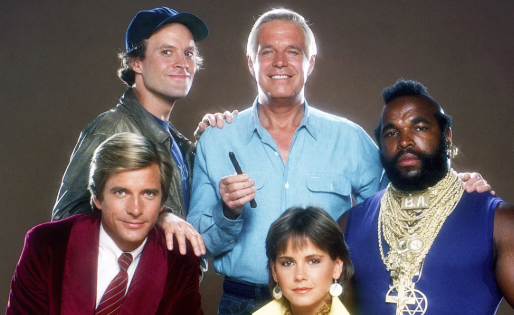
If you have a problem, if no one else can help, and if you can find them, maybe you can hire… the greatest action ensemble in television history. For enthusiasts of high-octane adventure and classic storytelling, few names carry as much weight as The A-Team. This cultural juggernaut didn’t just capture the imagination of a generation; it defined an entire era of televised heroics.
At its core, the show is a masterclass in the “found family” trope. We follow four former Special Forces soldiers, wrongly accused of a crime they didn’t commit, as they survive as soldiers of fortune in the underground. While the premise sounds gritty, the execution was a vibrant, often hilarious, and always action-packed spectacle. To truly appreciate why this show remains a titan of the genre, one must look past the explosions and the iconic red-striped van to the intricate machinery that made the series a global phenomenon.
Whether you are a newcomer curious about the legend or a lifelong fan who can quote every “plan coming together,” these ten deep dives offer a comprehensive look at the soldiers of fortune who made the impossible look easy.
1. The Alchemy of the Core Four Archetypes
The enduring power of the series lies in its perfect balance of character archetypes. Each member of the team represents a specific psychological and tactical niche, creating a unit that feels invincible because it is complete. Colonel John “Hannibal” Smith is the visionary leader, the man who lives for the adrenaline of a successful “plan.” Lieutenant Templeton “Face” Peck is the silver-tongued scrounger, capable of procuring a tank or a tuxedo with nothing but a smile. Sergeant B.A. Baracus provides the muscle and the mechanical genius, while Captain “Howlin’ Mad” Murdock offers the unpredictable wild card of “insanity” that keeps enemies—and his own team—on their toes.
This dynamic works because of the inherent friction between the personalities. Hannibal’s recklessness often puts Face in debt, Murdock’s antics drive B.A. to the brink of fury, and Face’s vanity is a constant source of amusement for the others. By utilizing these distinct roles, the show ensured that every episode felt like a complex puzzle being solved by a specialized toolset. This “specialist team” format became the blueprint for countless ensemble action shows that followed, proving that a group of outcasts is often more effective than a single lone wolf.
2. The GMC Vandura: More Than Just a Getaway Car
In the world of iconic television vehicles, the black and metallic grey GMC Vandura with the signature red stripe stands alongside the most famous cars in history. However, the van was never just a means of transportation; it was a mobile fortress, a character in its own right, and the heartbeat of the team’s operation. Outfitted with high-tech surveillance gear, an array of weaponry, and the legendary “build” supplies, it served as the team’s primary base of operations while they remained on the run from the military police.
The van’s aesthetic was carefully crafted to project both power and mystery. The custom spoiler, the turbine mag wheels, and the rooftop light bar transformed a standard utility vehicle into a symbol of rebellion. Interestingly, while the van is often remembered as being solid black, the area above the red stripe was actually a dark metallic grey—a detail that true enthusiasts use to spot replicas. The vehicle represented the team’s mobility and their status as fugitives; as long as the van was rolling, the A-Team was still in the fight.
3. The Paradox of Bloodless High-Octane Action
One of the most fascinating aspects of the series is the “cartoonish” nature of its violence. Despite thousands of rounds of ammunition being fired, cars flipping into spectacular fireball-inducing crashes, and grenades exploding in confined spaces, characters rarely sustained serious injuries. It was a stylistic choice that allowed the show to maintain a family-friendly rating while still delivering the spectacle of a big-budget action movie. Villains would regularly crawl out of wreckage, dusting off their suits and looking dazed but essentially unharmed.
This bloodless approach created a unique tonal atmosphere. It allowed the audience to enjoy the choreography of the stunts and the ingenuity of the team’s traps without the somber reality of casualties. It turned every episode into a modern-day myth or a fable where the “good guys” always won through cleverness and superior tactics rather than through lethality. This design choice was essential for the show’s evergreen appeal, ensuring the content remained accessible to younger viewers while still providing the kinetic energy required by adult fans.
4. Hannibal Smith and the Art of the Cigar-Chomping Plan
George Peppard’s portrayal of Hannibal Smith remains one of the most charismatic leadership roles in fiction. Hannibal is defined by his love for “the jazz”—the high-stakes thrill of a dangerous mission. He is a master of disguise, frequently appearing in the “aquamaniac” suit or as an elderly man to vet potential clients. His signature cigar wasn’t just a prop; it was a visual shorthand for his calm demeanor in the face of absolute chaos. When Hannibal lights up, the audience knows he has already calculated the outcome of the battle.
His catchphrase, “I love it when a plan comes together,” is the ultimate payoff for every episode. It signals the moment where the team’s disparate efforts—Face’s scrounging, B.A.’s engineering, and Murdock’s piloting—coalesce into a singular victory. Hannibal represents the “happy warrior,” an officer who truly loves his work and views every obstacle as an opportunity for creative problem-solving. This infectious optimism is what makes him the glue holding four disparate outcasts together under the constant threat of court-martial.
5. B.A. Baracus: The Man, the Gold, and the Fear of Flying
Mr. T’s portrayal of Bosco Albert “B.A.” (Bad Attitude) Baracus propelled him to global superstardom. B.A. is the team’s mechanical wizard, capable of turning a lawnmower and some scrap metal into an armored vehicle. However, his character is built on a series of wonderful contradictions. He is a formidable warrior draped in pounds of gold jewelry, yet he has a deep-seated tenderness for children and a moral code that forbids him from using his strength for anything other than justice.
The most famous running gag involves B.A.’s paralyzing fear of flying. To get him into any aircraft, the team had to resort to increasingly creative ways of sedating him—usually through “special” milk, drugged hamburgers, or even hypnosis. This vulnerability made the toughest man on television relatable. His constant bickering with “that crazy fool” Murdock provided the show’s best comedic beats, grounding the high-stakes action in a relatable, brotherly rivalry that fans still adore.
6. The Method Behind Murdock’s Madness
Captain H.M. “Howlin’ Mad” Murdock, played with manic energy by Dwight Schultz, is arguably the most complex character in the ensemble. Officially declared insane and residing in a Veterans Affairs psychiatric hospital, Murdock is the team’s ace pilot. The ambiguity of his mental state—whether he is truly delusional or simply using a “crazy” persona as a coping mechanism or tactical distraction—is a central theme of his character. He often engages in elaborate fantasies, speaking to invisible dogs or adopting bizarre alter-egos.
Murdock provides the levity that balances the show’s more intense moments. His relationship with B.A. is the heart of the series’ comedy; Murdock delights in annoying B.A., yet he is the first person to defend him in a fight. Despite his eccentricities, Murdock’s skill in the cockpit is unmatched. He represents the idea that “normalcy” is a matter of perspective and that those who operate on the fringes of society often possess the most extraordinary talents when the pressure is on.
7. The Masterful Art of the Improvised Weapon
A hallmark of every episode is the “build montage.” Usually occurring in the second act, the team finds themselves trapped in a garage, warehouse, or barn with limited resources. Under B.A.’s technical guidance and Hannibal’s tactical vision, they begin a frantic process of welding, sawing, and assembling. These sequences are edited with rhythmic precision, showing the team transforming everyday objects—cabbage launchers, armored buses, or homemade flamethrowers—into the tools of their salvation.
This element of the show tapped into the DIY spirit and celebrated American ingenuity. It suggested that no matter how outgunned you are, you can win if you are smarter and more resourceful than your opponent. These montages became so iconic that they influenced the “maker” culture and became a trope in themselves. They emphasized that the A-Team’s greatest weapon wasn’t their guns, but their ability to look at a pile of junk and see a solution.
8. Templeton “Face” Peck and the Charismatic Grift
Dirk Benedict brought a sophisticated, “James Bond-lite” energy to the role of Face. While B.A. provided the muscle and Hannibal the strategy, Face provided the logistics. His ability to talk his way into restricted areas or convince a mark to part with expensive equipment was essential for a team that had no official funding or government support. Face is the quintessential “scrounger,” a character type common in military fiction, but elevated here by Benedict’s effortless charm and wit.
Face’s character also highlights the team’s status as fugitives. He is the one who has to maintain the “front” of legitimacy, often assuming the identities of wealthy businessmen or high-ranking officials. His constant pursuit of luxury—fine suits, expensive cars, and beautiful women—contrasts sharply with the team’s gritty reality on the run. This dynamic adds a layer of aspiration and class to the show, ensuring that even as outlaws, the A-Team always maintained a certain level of style.
9. The Off-Screen Friction That Fueled the Fire
While the chemistry on screen appeared seamless, the production of the series was famously fraught with tension, particularly between George Peppard and Mr. T. Peppard was a classically trained film actor who struggled with the fact that Mr. T, a relative newcomer to acting, was becoming the breakout star and the face of the show’s merchandising. This rivalry reportedly led to long periods where the two leads would not speak to each other on set, often using Dirk Benedict as a messenger.
Surprisingly, this off-screen friction may have actually benefited the show’s energy. The competitive nature of the lead actors translated into a certain “spark” in their scenes. The tension between Hannibal and B.A. felt authentic because, in many ways, it was. Despite the personal difficulties, the cast remained professional enough to deliver high-quality performances for years, creating a legacy that far outlasted the interpersonal squabbles of the production.
10. A Cultural Phenomenon That Redefined the Hero
The show’s impact on pop culture cannot be overstated. It arrived at a time when audiences were hungry for heroes who were unashamedly “the good guys” but operated outside the traditional system. The A-Team weren’t police officers or government agents; they were vigilantes for hire who only took cases where the law had failed the innocent. This “champion of the underdog” theme resonated globally, making the show a massive hit in dozens of countries.
Furthermore, the series revolutionized merchandising for television. From action figures and lunchboxes to the iconic van toys, the show proved that an action series could be a commercial powerhouse. It paved the way for the “team-based” action genre that dominates modern cinema and television. The A-Team’s legacy is one of pure entertainment, reminding us that with a little ingenuity, a lot of courage, and a reliable van, any problem can be solved.
Further Reading
- The A-Team: The Comprehensive Guide by James E. Thomas
- Confessions of a Kamikaze Cowboy by Dirk Benedict
- Mr. T: The Man with the Gold by Mr. T
- Action TV: In the Trenches of 80s Adventure by Sarah J. Mills
- 10 Twin Peaks TV SHOW Facts That Still Puzzle Fans
- 10 Poltergeist (1982) Movie Facts That Are Still Creepy
- 10 Hellraiser (1987) Movie Facts That Built Its Legacy
- 10 Essential Facts About Predator (1987) – Movie Facts
- 10 Things You Probably Didn’t Know About The Actor Eddie Murphy
- 10 Things You Should Know About Ferris Bueller’s Day Off (1986) – Movie Facts and Hidden Details
- 10 Things You Should Know About Beverly Hills Cop (1984) – Movie Facts and Hidden Details
- 10 Things You Should Know About Ghostbusters 2 (1989) – Movie Facts and Hidden Details
- 10 Things You Should Know About The Thing (1982) – Movie Facts and Hidden Details
- Stranger Things – Season 5 Full Recap and Spoilers Explained



