
The Blue Revolution: 10 Jaw-Dropping Facts About Avatar That Rewrote the Rules of Hollywood
In the history of cinema, there are moments that act as a “before and after” for the entire industry. Just as the transition from silent film to “talkies” or the shift from black-and-white to Technicolor changed the landscape of storytelling, the release of James Cameron’s Avatar in 2009 signaled a seismic shift in what was possible on the silver screen. It wasn’t just a movie; it was a technological manifesto that declared the traditional boundaries between live-action and animation were officially dead.
The story of Jake Sully and the Na’vi of Pandora captured the global imagination, but the real magic happened behind the curtain. To create a world that felt truly alien yet tangibly real, a team of thousands had to invent entirely new ways to capture light, movement, and emotion. This film serves as the “go-to” case study for any film student or tech enthusiast wanting to understand the birth of modern digital cinematography. From the lush, glowing jungles to the nuanced twitch of a blue-skinned alien’s eyelid, every frame was a breakthrough. Here is a deep dive into the ten revolutionary facts that built the legacy of Pandora.
1. The Fifteen-Year Wait for “The Digital Dawn”
The most incredible thing about this production is that the script was actually completed in the mid-1990s. James Cameron, fresh off the successes of Aliens and Terminator 2, had a vision for a sprawling sci-fi epic, but he faced a significant problem: the technology to execute it simply did not exist. At the time, CGI characters were still struggling with “stiffness,” and the ability to render a believable organic world like Pandora was a pipe dream.
Instead of compromising his vision by using practical suits or early, clunky digital effects, Cameron chose to shelve the project for over a decade. He waited until he saw the work done on Gollum in the Lord of the Rings trilogy, which proved that digital characters could carry immense emotional weight. This patience changed cinema by proving that a director’s vision shouldn’t be limited by current tools; sometimes, the industry must wait for the imagination to lead the way. It set a precedent for “long-game” filmmaking that influenced everything from the revival of space epics to the modern superhero era.
2. The Birth of the Virtual Camera System
Before this film, a director working with CGI characters often had to guess what the final scene would look like while filming actors in gray suits against a green screen. Cameron found this disconnected and frustrating. To bridge the gap, he and his team developed the Virtual Camera. This wasn’t a camera in the traditional sense; it was a handheld monitor that allowed the director to see the digital world of Pandora in real-time as he moved around a bare stage.
When the director pointed this device at the actors, he wouldn’t see humans in spandex; he would see 10-foot-tall blue Na’vi standing in a glowing jungle. This allowed for an unprecedented level of cinematic spontaneity. He could adjust angles, zoom in on a digital leaf, or follow a flying creature as if he were physically on Pandora. This technology effectively “erased” the wall between the digital and physical worlds, a technique that has since become the standard for every major blockbuster involving heavy visual effects.
3. Performance Capture: Moving Beyond “Motion”
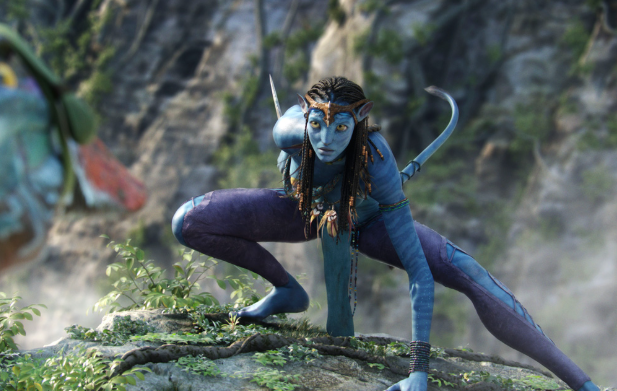
While earlier films used “motion capture” to track the movement of an actor’s limbs, Avatar pioneered what is now called “performance capture.” The goal was to move beyond just the body and capture the “soul” of the performance. The technical team realized that the most important part of an actor’s work happens in the tiny, subtle movements of the facial muscles and the eyes.
To achieve this, actors wore specially designed head-rigs equipped with a small camera positioned just inches from their faces. This camera tracked every blink, every quivering lip, and every micro-expression. The data was then mapped onto the digital Na’vi models with pinpoint accuracy. This ensured that Zoe Saldaña’s ferocity and Sam Worthington’s wonder weren’t just “animated” on top of them; they were the actual performances. This shift fundamentally changed how actors viewed digital roles, turning them from “voice-over work” into a respected form of physical acting.
4. The Linguistic Architecture of the Na’vi Tongue
Most sci-fi films settle for “gibberish” when it comes to alien languages, but the creators of this film wanted a world that felt biologically and culturally consistent. They hired Dr. Paul Frommer, a professor of linguistics at USC, to create a fully functioning language from scratch. The Na’vi language was designed with its own syntax, grammar rules, and a vocabulary of over 1,000 words.
Dr. Frommer spent years developing the sounds, ensuring they were pronounceable by the actors but distinctly “un-human” in their rhythm. The actors had to attend “Na’vi boot camp” to learn the nuances of the dialect, ensuring that their performance felt authentic. This level of detail changed the “go-to” standard for world-building in cinema. It showed that for an audience to truly immerse themselves in a fantasy, the culture must feel as though it has existed for thousands of years, long before the cameras started rolling.
5. Bioluminescence as a Narrative Tool
The visual identity of Pandora is inseparable from its bioluminescence—the ability of plants and animals to glow in the dark. This wasn’t just a “cool” visual effect; it was inspired by James Cameron’s real-life obsession with deep-sea exploration. He drew on his experiences diving to the bottom of the ocean, where creatures use light to communicate, lure prey, or ward off predators in the absolute dark.
To make the bioluminescence believable, the production team had to invent new lighting algorithms. They needed the light from a glowing plant to reflect accurately off a character’s skin or a drop of water. This created a lush, layered visual experience that rewarded the audience for looking into the corners of the frame. By using nature-based logic to design a fantasy world, the film set a new bar for “speculative biology” in movies, encouraging designers to look to Earth’s own weirdest environments for inspiration.
6. The Simulcam: Merging Realities in Real-Time
One of the biggest hurdles in filming the “hybrid” scenes—where human actors interact with digital ones—was the timing. Traditionally, you would film the humans, then add the digital elements months later. This often resulted in actors looking in the wrong direction or failing to react to things that weren’t there. The solution was the “Simulcam,” a revolutionary system that overlaid the digital characters onto the live-action feed in the viewfinder.
When filming a scene in the human laboratory, the camera operator could see the digital Na’vi standing right next to the human actors through the lens. This allowed for perfect framing and interaction. It was essentially an early, high-powered version of “Augmented Reality.” This technology allowed the cinematography to feel organic rather than clinical, as the camera could react to the “digital” actors as if they were physically present. This real-time integration is now a cornerstone of modern film production, particularly in the realm of virtual production stages.
7. Weta Digital and the Computing Power of a Small City
The sheer amount of data required to render the world of Pandora was unprecedented. The visual effects were primarily handled by Weta Digital in New Zealand, and they had to significantly upgrade their infrastructure just to handle the project. At its peak, the “render farm” (the collection of computers processing the images) was one of the most powerful in the world, occupying 10,000 square feet and using massive amounts of electricity.
Each frame of the film (there are 24 frames per second) could take up to 48 hours to render, despite the incredible computing power available. The film utilized a petabyte of storage (one million gigabytes), which was an astronomical figure for the era. This massive scale of data management changed how studios planned their budgets and timelines. It proved that in the modern era, the “processing power” of a studio was just as important as the talent of its actors or the vision of its director.
8. Reinventing 3D from Gimmick to Immersion
Before this film, 3D was largely viewed as a “carnival trick”—objects flying at the screen to make the audience jump. Cameron hated this approach, believing it pulled the viewer out of the story. Instead, he pioneered a “window into the world” philosophy. He used 3D to create depth into the screen, making the audience feel like they could reach into the jungle or walk through the corridors of the human base.
To achieve this, the team developed the Fusion Camera System, which used two high-definition cameras side-by-side to mimic human binocular vision. The distance between the lenses could be adjusted in real-time to control the “depth” of the 3D effect. This made the 3D feel natural and reduced the eye strain and headaches associated with older techniques. The film’s success led to a global retrofitting of theaters with digital 3D projectors, fundamentally changing the business model of cinema for over a decade.
9. The “Proprietary” Facial Expression System
To make the Na’vi feel human, the animators couldn’t just rely on the head-rig cameras; they needed a mathematical way to translate those movements. The team developed a proprietary system based on the “FACS” (Facial Action Coding System). This broke down every possible human expression into individual muscle movements.
When an actor like Sigourney Weaver smiled, the computer didn’t just see a “smile”; it saw the specific contraction of the zygomaticus major muscle. The digital Na’vi model was built with the same underlying muscle structure, allowing the computer to “retarget” the movement perfectly. This meant that the digital characters shared the same “facial DNA” as the actors. This level of anatomical detail was a massive leap forward, making the characters feel alive in a way that previous digital creations never had.
10. The Global Box Office Paradox: Originality Wins
Perhaps the most significant fact about this film’s impact on cinema is its status as an original property. In an industry increasingly dominated by sequels, remakes, and established comic book franchises, this film became the highest-grossing movie of all time based purely on an original concept. It proved that global audiences were still hungry for “new” worlds and “new” mythologies if they were delivered with enough conviction and technological polish.
The film’s success across every conceivable culture and language proved that themes of environmentalism, indigenous rights, and the “hero’s journey” are universal. It encouraged studios to take massive risks on large-scale original sci-fi, a trend that can be seen in the subsequent waves of “thinking man’s blockbusters.” By breaking every box office record, it demonstrated that the ultimate “special effect” is a world that an audience truly believes in, regardless of the color of the characters’ skin.
Further Reading
- The Art of Avatar: James Cameron’s Epic Adventure by Lisa Fitzpatrick
- Avatar and Philosophy: Learning to See by George A. Dunn
- The Making of Avatar by Jody Duncan and James Cameron
- James Cameron: The Futurist by Rebecca Keegan
- 10 Things You Didnt Know About Logans Run (1976)
- Podcast Episode: Classic Films And Horror Icons
- 10 Things You Didnt Know About The Fifth Element (1997)
- 10 Things You Didnt Know About 2001 A Space Odyssey (1968)
- 10 Things Every Fan Should Know About Sabrina Carpenter
- 10 Things You Should Know About Foghorn Leghorn – Looney Tunes
- 10 Things Every Fan Should Know About Bad Bunny
- 10 The Exorcist III (1990) Movie Facts You Didn’t Know
- 10 Scream (1996) Movie Facts That Changed Horror
- 10 The Crown TV SHOW Facts That Keep People Watching



