
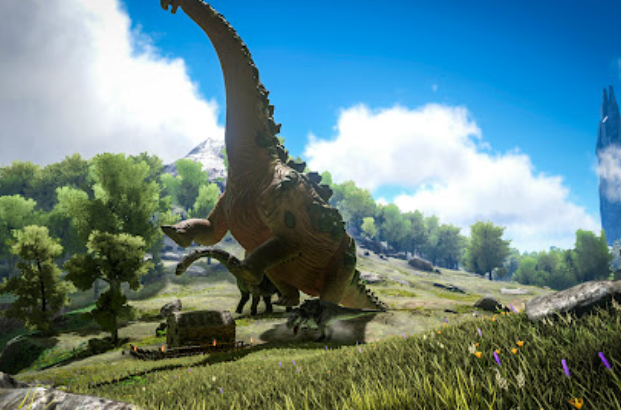
The roar of a Tyrannosaurus Rex, the rhythmic pulse of an alien obelisk, and the desperate scramble for berries on a sun-drenched beach—these are the formative memories of millions who have stepped onto the Island. ARK: Survival Evolved did more than just launch a game; it birthed a new sub-genre of “dino-survival” that blended prehistoric biology with high-concept science fiction. While the primary loop of taming and building is well-understood, the history of its development is a saga of high-stakes legal drama, technical miracles, and a narrative depth that most players barely scratch the surface of.
To truly understand the “ARK,” one must look at the foundation laid by Studio Wildcard. It was a project born out of a desire to create a “living, breathing ecosystem” where the player was not the protagonist of the world, but merely a participant in a much larger, darker experiment. From the rapid-fire development cycle that brought the game to market in record time to the complex lore hidden within thousands of digital notes, the history of this franchise is a testament to the power of community-driven design. This guide serves as a comprehensive overview of the technical, creative, and historical pillars that support one of the most ambitious survival experiences ever created.
1. The Blitz-Development: From Concept to Early Access
The creation of the Island was not a slow, multi-year crawl typical of most “Triple-A” titles. Instead, it was an incredibly focused sprint. Development began in late autumn, and the game was playable for the public in a robust “Early Access” state by the following summer. This seven-to-eight-month development window is almost unheard of for a game of this scale, especially one featuring complex AI, high-fidelity graphics, and a massive open world. The small, agile team at Studio Wildcard utilized the burgeoning capabilities of Unreal Engine 4 to build a foundation that felt “next-gen” even in its earliest iterations. This rapid speed allowed the team to capture the market’s attention before competitors could react, setting a pace of updates and content drops that defined the “ARK experience” for years. This “blitz” philosophy forced the developers to prioritize player interaction and core loops—like the iconic taming system—ensuring that the heart of the game was solid before they even started on the narrative polish.
2. A Revolution in the Early Access Model
At the time of its initial release, the “Early Access” model was often viewed with skepticism by the gaming community, frequently associated with abandoned projects and “vaporware.” This game, however, became the poster child for how the model should work. The developers maintained a transparent, almost frantic communication style with their player base, often releasing patches and content updates multiple times a week. They leaned into the “meta-game,” allowing the community to dictate which prehistoric creatures were added next through public polls and feedback threads. This created a sense of “co-authorship” between the developers and the survivors. By the time the game reached its official “1.0” status, it had already lived through dozens of “mini-eras,” with its mechanics polished by millions of hours of real-world stress testing. This approach turned a technical gamble into a cultural phenomenon, proving that a dedicated community can act as the most effective QA department in the industry.
3. Taming the Impossible: Unreal Engine 4 Hurdles
The technical ambition of the project pushed the limits of its engine in ways the original software architects likely never anticipated. Specifically, the game had to manage hundreds of independent AI entities—ranging from tiny Dodos to massive Brontosaurs—each with their own sensory ranges, hunger levels, and pathfinding logic. Balancing this against a destructible environment and a complex lighting system meant that the early years of development were a constant battle for optimization. The “murkiness” of the jungle and the scale of the creatures required revolutionary “level-of-detail” (LOD) transitions to prevent the hardware from buckling. Many of the “quirks” players remember—like dinosaurs occasionally clipping through the terrain or the specific way shadows played across the beach—were the result of the developers finding creative ways to trick the hardware into rendering more than it was technically capable of handling. This tension between high-end visual fidelity and the sheer density of a “living” world became the engine’s defining challenge.
4. The Narrative Breadcrumbs: The Lore of Explorer Notes
For the first several months of its public life, many players believed the game was a “sandbox” with no story—simply a playground for dinosaur enthusiasts. However, the developers had actually hidden a deep, millennia-spanning narrative within “Explorer Notes.” These digital artifacts, scattered across the maps, tell the stories of past survivors like Helena Walker and Sir Edmund Rockwell. This “breadcrumb” style of storytelling allowed the lore to exist as an optional layer for those interested in the why of the world without interrupting the survival gameplay for those who just wanted to build bases. The notes revealed a shocking truth: the “Island” wasn’t a prehistoric Earth, but a sophisticated space-borne station designed to “test” humanity’s resilience. This shift from “dino-sim” to “high-concept sci-fi” was one of the greatest tonal pivots in gaming, transforming every obelisk and mysterious ruin from a background prop into a central mystery of the universe.
5. The Science of the “Element” War
The deep lore of the franchise is anchored in a fictional substance known as “Element.” Within the history of the game’s universe, Element was a highly advanced, sentient material that catalyzed a global war between two superpowers: the United Republic of Earth and the Terran Federation. This conflict eventually led to the destruction of Earth’s ecosystem, forcing the remnants of humanity to launch the “ARKs” into orbit. These stations were meant to serve as genetic lifeboats, preserving the DNA of Earth’s flora and fauna while searching for a way to purge the Element-based corruption from the planet. This backstory explains why players see anachronistic mixtures of creatures—like Woolly Mammoths living near tropical raptors—as the ARKs were artificial environments designed for data collection and testing rather than historical accuracy. Understanding the “Element War” provides the context for the “Tek Tier” technology players unlock late in the game, bridging the gap between primitive stone tools and futuristic energy weapons.
6. Orchestrating the Apocalypse: The Music of Gareth Coker
The sonic identity of the franchise was crafted by composer Gareth Coker, who approached the score with the intent of making the environment feel “primordial yet alien.” The main theme, with its driving percussion and soaring brass, is designed to evoke both the majesty of a prehistoric world and the cold, mechanical precision of the space stations. Unlike many games that use ambient noise exclusively, the music here is “reactive,” signaling to the player when they have entered a dangerous territory or when a successful tame has been completed. The use of traditional orchestral instruments mixed with synthetic, digital textures mirrors the game’s central conflict: nature versus technology. This soundtrack became so integral to the player experience that it is often cited as a key factor in the game’s “immersion,” providing a sense of cinematic scale to the everyday struggle of surviving on the beach.
7. The Community-Driven Map Evolution
One of the most unique aspects of the game’s history is how several of its official maps began as “fan-made” mods. Maps like The Center, Ragnarok, and Valguero were originally created by talented members of the community using the game’s public development kit. Recognizing the quality and popularity of these projects, the developers made the unprecedented move to bring these creators into the official fold, incorporating their maps as free, official expansions. This “official mod” program changed the relationship between the studio and its fans, proving that the most creative ideas for world-building often come from the people playing the game. It allowed the franchise to expand its geographical variety—adding Norse-inspired mountains and massive underground cavern systems—without the developer having to start from scratch every time, ensuring a constant stream of high-quality content that kept the community engaged for thousands of hours.
8. The Balancing Act of Prehistoric Realism
The design of the creatures was a delicate balance between “scientific accuracy” and “gameplay utility.” While the team conducted extensive research into the fossil record, they intentionally took “creative license” to make the creatures more interesting for players. For instance, the “Dilophosaurus” in the game is famously small and features a venom-spitting mechanic inspired by popular cinema rather than paleontology. Similarly, the “raptors” were given feathers to align with modern scientific theories, but their intelligence and pack-hunting behaviors were tuned to provide a specific “threat level” for players. This “hybrid” approach to design—where a creature looks real but acts like a game mechanic—is what allowed the taming system to feel so rewarding. Every creature was designed with a “job” in mind: some were better at gathering wood, others were the ultimate scouts, and some served as walking fortresses for tribal warfare.
9. The Shadow of the Legal Battle
Behind the scenes of the game’s early success, a massive legal battle was taking place that nearly halted production entirely. Shortly after launch, a lawsuit was filed by a separate development studio involving one of the lead creators. The legal dispute centered on “non-compete” clauses and intellectual property, with the potential for the game to be removed from digital storefronts altogether. The resolution of this case required a significant multi-million dollar settlement, a staggering sum for a relatively new indie studio. This period of “behind-the-scenes” tension is a fascinating, if stressful, part of the lore; the developers had to maintain a brave face for the community and keep the updates rolling while the very existence of their studio was being contested in a courtroom. The fact that the game survived and thrived following this settlement is a testament to the sheer momentum and profitability of the “ARK” brand.
10. Bridging the Gap: The Console and Mobile Expansion
While the game was born on the PC, its transition to consoles and mobile devices represented a major milestone in technical porting. Bringing a game that famously “melted” high-end computer processors to the more limited hardware of a gaming console required a complete overhaul of the rendering pipeline. The developers had to implement “dynamic resolution scaling” and aggressive memory management to ensure that players could still experience massive 70-player battles without the system crashing. The later transition to mobile devices was even more radical, involving a “re-build” of the game’s assets to fit into a pocket-sized form factor. This expansion ensured that “dino-survival” was accessible to a global audience, regardless of their hardware, and solidified the franchise’s place as a cornerstone of modern gaming history. It proved that the “dream” of a living prehistoric world was powerful enough to overcome even the steepest technical barriers.
Further Reading
- The Art of ARK: Survival Evolved by Studio Wildcard
- Prehistoric Life: The Definitive Visual History of Life on Earth by DK Publishing
- Blood, Sweat, and Pixels: The Triumphant, Turbulent Stories Behind How Video Games Are Made by Jason Schreier
- The Rise and Fall of the Dinosaurs: A New History of a Lost World by Steve Brusatte
- 10 Things You Should Know About The Making Of And History Of The Video Game – Diablo II
- 10 Things You Should Know About The Making Of And History Of The Video Game – God of War (2018)
- 10 Things You Should Know About The Making Of And History Of The Video Game – The Legend of Zelda: Ocarina of Time
- 10 Things You Should Know About The Making Of And History Of The Video Game – Portal 2
- 10 Essential Facts About Assassin’s Creed (2007) – Video Game Facts
- 10 Essential Facts About Mortal Kombat 2 – Video Game (1993)
- 10 Essential Facts About the Making and History of ARK: Survival Evolved – Video Game Lore
- 10 Essential Facts About the Making and History of Tomb Raider (1996) – Video Game Lore
- 10 Essential Facts About the Making and History of Mario Kart – Video Game Lore
- 10 Things You Should Know About Skyrim – Video Game



