
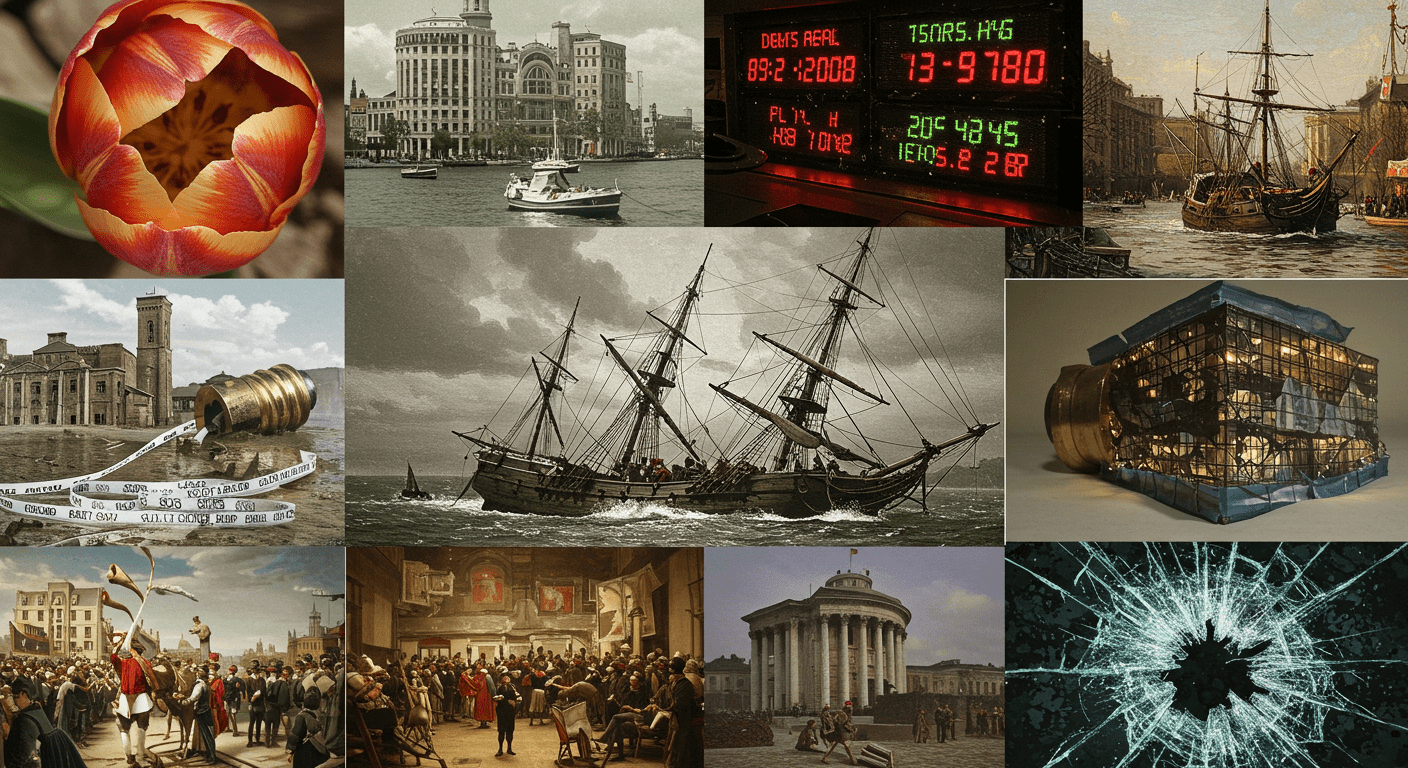
Have you ever heard the saying, “Those who do not learn history are doomed to repeat it”? Well, that’s especially true when it comes to money! Throughout time, even the smartest people have made some big mistakes with their finances, leading to huge problems that affected entire countries and even the whole world. But here’s the cool part: every one of these “financial fails” taught us important lessons that help us build a more stable and fair financial world today.
Think of it like this: imagine building a magnificent sandcastle on the beach. If you don’t know about the tides, your castle might get washed away! These financial fails were like unexpected high tides that came crashing down, but each time, we learned how to build stronger walls and better foundations. So, grab your magnifying glass, because we’re about to become financial detectives, uncovering the secrets of ten incredible moments where money went wrong, and how those mistakes made us smarter.
1. The South Sea Bubble (1720): A Tidal Wave of Speculation
Imagine a time when people got so excited about a company that they threw all their money at it, hoping to get super rich super fast. That’s exactly what happened with the South Sea Bubble in 1720. This company promised amazing riches from trading with faraway lands in South America, even though no one really knew how they would do it. It was like a huge rumour started that if you bought a special magic bean, you’d instantly have a beanstalk reaching to the sky with gold at the top! Everyone wanted those “magic beans” – from regular folks to super-smart people like Isaac Newton, who was a famous scientist.
The price of shares in the South Sea Company shot up incredibly high, not because the company was actually making tons of money, but because everyone believed it would. This is called a speculative bubble, where prices go up just because people think they will keep going up. But just like a bubble blown with soap, it eventually has to pop. When people realized the company wasn’t actually doing much, panic set in, and the prices crashed. Lots of people lost everything they had invested. What we learned from this financial disaster is that it’s dangerous to get carried away by hype and to invest without really understanding what you’re putting your money into. It also showed us how easily markets can go wild without proper rules.
2. The Tulip Mania (1637): When Flowers Ruled the Market
Believe it or not, there was a time in Holland when a simple flower bulb became more valuable than gold! This was the Tulip Mania in the 1630s. Tulips were new and exciting, and people started paying more and more for them. It was like collecting the rarest, coolest Pokémon cards, but instead of cards, it was just a flower bulb! Soon, people weren’t buying tulips to plant them and enjoy their beauty; they were buying them just to sell them to someone else for an even higher price.
At its peak, a single tulip bulb could cost as much as a fancy house or a whole farm! This was another classic speculative bubble, similar to the South Sea Company, but with flowers. People were so caught up in the excitement that they forgot about the actual value of a tulip. When some people started to sell, others panicked, and the prices plummeted. Many people who had borrowed money to buy expensive bulbs were left completely broke. The big lesson from the Tulip Mania is that things only have value if someone is willing to pay for them, and when that belief disappears, prices can crash. It also teaches us about the dangers of irrational exuberance, which is a fancy way of saying people getting overly excited and making silly financial decisions.
3. The Mississippi Bubble (1719-1720): A River of Ruin
Across the English Channel from the South Sea Bubble, France was having its own financial adventure with something called the Mississippi Bubble. This was the grand plan of a clever Scottish financier named John Law. He convinced the French government that his Mississippi Company, which was supposed to trade with the vast and mysterious Louisiana territory in America, would make everyone rich. It was like promising that a brand-new video game company would instantly become bigger than all the existing ones combined, just because they said they would!
The French people, desperate for some good economic news after a lot of wars, eagerly bought shares in Law’s company. Just like the other bubbles, the share prices soared to incredible heights, fueled by excitement and big promises. But the company wasn’t actually making much money, and like all bubbles, it eventually burst. The crash of the Mississippi Company left France in a huge financial mess, with lots of angry and ruined investors. What we learned from this economic crisis is that even governments can get tricked by grand, unrealistic plans. It also showed the dangers of having too much government control over financial markets and the importance of having solid businesses behind the promises being made. This French financial disaster was a harsh lesson in believing in dreams rather than facts.
4. The Wall Street Crash of 1929: A Global Economic Earthquake
Imagine a game of Jenga where everyone keeps pulling out blocks, hoping the tower won’t fall. For much of the 1920s, the American stock market was a bit like that. People were borrowing a lot of money to buy stocks, hoping they would get rich quickly. This was happening on Wall Street, the famous financial district in New York City. Then, on October 29, 1929, known as Black Tuesday, the Jenga tower crashed down. The stock market suddenly plunged, and everyone panicked.
This wasn’t just a small dip; it was a huge stock market crash that sent shockwaves around the world. Because banks had lent so much money for stock purchases, they started to fail when people couldn’t pay back their loans. Businesses couldn’t get loans, so they closed down, and millions of people lost their jobs. This was the start of the Great Depression, a terrible time of hardship that lasted for many years. The Wall Street Crash taught the world many crucial lessons: we learned how important it is to have rules for banks and stock markets (called financial regulation), how dangerous it is when people borrow too much money (known as excessive credit), and how connected all the world’s economies are. It was a painful but vital lesson in keeping financial systems stable.
5. The Latin American Debt Crisis (1980s): A Decade of Debt
Think about if you borrowed a lot of money to buy something really big, like a new house, but then your income suddenly dropped, and the interest on your loan went sky-high. That’s kind of what happened to many countries in Latin America in the 1980s, leading to the Latin American Debt Crisis. During the 1970s, these countries had borrowed huge amounts of money from international banks, often for big projects. They thought their economies would grow fast enough to pay it all back.
However, in the early 1980s, global interest rates went up a lot, and the prices of goods these countries sold (like oil or coffee) went down. Suddenly, they couldn’t afford to pay back their loans. This led to what’s called hyperinflation, where prices for everyday things like bread and milk would double or triple in a single day, making money almost worthless. It caused huge economic problems and hardship for millions of people. The debt crisis showed us the big risks of countries borrowing too much, especially from other countries, and the importance of managing money carefully (responsible fiscal policies). It also highlighted how economic problems in one part of the world can affect others, especially when countries owe money to international banks.
6. The Japanese Asset Price Bubble (1980s-1990s): A Lost Decade
Imagine if the price of your house or your favorite video game console kept going up and up, not because it was getting better, but just because everyone believed it would keep getting more expensive. That’s similar to what happened in Japan during the late 1980s with the Japanese Asset Price Bubble. Japan’s economy was booming, and people felt very rich. So, they started investing huge amounts of money in real estate (land and buildings) and stocks. Prices for houses and company shares reached incredible, almost unbelievable, levels.
People were buying tiny apartments for millions of dollars, and the stock market was soaring higher than ever before. But just like any balloon that’s blown up too much, this bubble had to burst. When it did, in the early 1990s, prices for houses and stocks crashed dramatically. This led to Japan entering what became known as a “Lost Decade” of very slow economic growth and financial struggles. The Japanese bubble taught us that even strong economies can fall victim to excessive speculation and asset price bubbles. It showed that unsustainable growth, where prices go up too fast without real reasons, can lead to long-term problems. This economic downturn served as a major lesson in the dangers of inflated markets.
7. The Russian Financial Crisis (1998): A Ruble Rumble
Imagine a country that’s just getting used to being a free market after many years of a different system. That was Russia in the 1990s. In 1998, Russia faced a huge problem called the Russian Financial Crisis. It was like a double whammy: the price of oil, which Russia sells a lot of, suddenly dropped, and the Russian government had borrowed a lot of money that it couldn’t pay back. This combination created a perfect storm.
When the crisis hit, the Russian government made a shocking decision: they devalued their currency, the ruble, meaning it suddenly became worth a lot less. And even more surprisingly, they defaulted on their government bonds, which means they told the people and countries they borrowed money from that they couldn’t pay them back. This caused chaos and uncertainty, both inside Russia and for investors around the world. The Russian crisis taught us how vulnerable new or “emerging” economies can be to sudden changes in global markets, like oil prices. It also showed how incredibly important it is for governments to manage their money carefully and honestly. This economic shock highlighted the need for strong financial management to prevent future crises.
8. The Dot-Com Bubble (2000-2001): When Tech Dreams Turned to Dust
Do you remember a time when everyone was talking about the internet and how it was going to change everything? In the late 1990s, there was a huge excitement about new internet companies, leading to the Dot-Com Bubble. It was like everyone believed that any company with “.com” in its name was going to be super successful, even if they didn’t have a solid business plan or were actually making any money. Investors were pouring tons of cash into these tech startups, hoping they would become the next big thing.
Companies that just had an idea, but no profits, were suddenly worth billions of dollars! It was a time of immense optimism and a belief that the rules of traditional business no longer applied. But just like all bubbles, this one eventually popped. In 2000 and 2001, many of these internet companies ran out of money or failed to deliver on their promises, and their stock prices crashed. Lots of investors, big and small, lost huge amounts of money. The Dot-Com Bubble taught us a valuable lesson: investing should be based on real company value and potential for profit, not just on hype and exciting new technology. It reminded us that even in the age of rapid innovation, fundamentals still matter.
9. The Global Financial Crisis (2008): A Subprime Meltdown
Imagine a house built on shaky foundations. It might look fine on the outside, but one strong gust of wind could bring it all down. That’s a bit like what happened leading up to the Global Financial Crisis of 2008. This crisis started in the United States with something called “subprime mortgages.” These were home loans given to people who might not have been able to afford them, often with tricky terms. Banks then packaged these risky loans together and sold them to other banks and investors all over the world, making it seem like they were safe investments.
When many homeowners couldn’t pay back their loans, the value of these mortgage packages plummeted. This caused huge problems for banks that had invested in them, leading to some of the biggest banks collapsing or needing massive government bailouts. The crisis quickly spread around the world, causing a deep global recession, where businesses closed, and millions lost their jobs. This financial meltdown taught us about the dangers of complex and hidden financial products, the risks of banks taking on too much debt (excessive leverage), and the desperate need for better rules and monitoring of the financial system (financial regulation). It emphasized that the financial system needs to be transparent and accountable to everyone.
10. The Enron Scandal (2001): Corporate Corruption Exposed
Imagine if a company told everyone it was super successful and making tons of money, but secretly, it was hiding huge debts and making up its profits. That’s exactly what happened with Enron, a giant energy trading company, in 2001. Enron was once seen as a brilliant and innovative company on Wall Street, but underneath the shiny exterior, there was massive fraud and dishonesty.
Enron’s executives used complicated accounting tricks to make the company seem profitable when it was actually losing money. When the truth finally came out, Enron collapsed incredibly quickly, leaving thousands of employees jobless and wiping out billions of dollars for investors. It was a shocking reminder that even big, respected companies can be led astray by greed. The Enron scandal was a huge wake-up call. It highlighted the critical importance of good corporate governance (how a company is run), honest leadership (ethical leadership), and independent auditors who check a company’s books to make sure everything is true and fair. It showed how easily trust can be broken and how devastating the consequences of corporate greed and financial fraud can be, reinforcing the need for strong oversight.
Further Reading
- The Little Book of Common Sense Investing by John C. Bogle
- The Richest Man in Babylon by George S. Clason
- Rich Dad Poor Dad by Robert T. Kiyosaki
- A Random Walk Down Wall Street by Burton G. Malkiel
- Think and Grow Rich by Napoleon Hill




Leave a Reply