
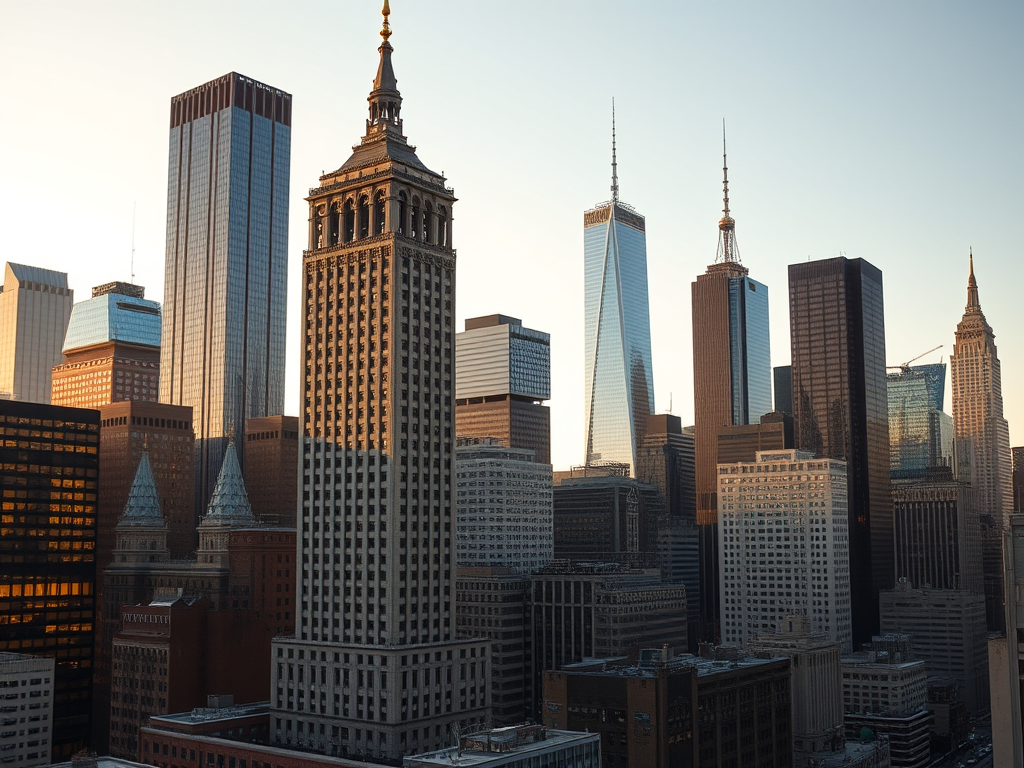
The New York City skyline is one of the most iconic and instantly recognizable vistas on Earth. It’s a vertical testament to human ambition, architectural innovation, and economic power, a forest of steel and glass that has been shaped and reshaped over more than a century. This incredible cityscape didn’t just appear; it grew, floor by floor, in a fascinating story of technological breakthroughs, fierce rivalries, and evolving aesthetic visions. From the very first building to dare to “scrape the sky” to the latest generation of impossibly slender supertalls, every structure is a chapter in the city’s dynamic history.
The evolution of the skyscraper is the story of New York itself. It’s a tale driven by the relentless pressure of a crowded island, the invention of the elevator and the steel frame, the creative genius of architects, and the immense wealth of a global financial hub. Understanding how this skyline came to be is to understand the forces that have made New York the city it is today. This list will take you on a journey through time, exploring ten fascinating facts that reveal how the New York skyline was built, from its humble beginnings to its breathtaking present.
1. The Frail Firstcomer: The Tower Building
While Chicago’s Home Insurance Building (1885) is often credited as the world’s first true skyscraper due to its full steel frame, New York’s own journey into the sky began with a more modest, almost hesitant step. The Tower Building, completed in 1889 at 50 Broadway, is widely considered New York’s first skyscraper. Designed by architect Bradford Gilbert, it faced a unique challenge: a very narrow plot of land. A traditional, thick-walled masonry construction would have left virtually no usable interior space. Gilbert’s ingenious solution was to use a hybrid system—a concealed internal frame of cast iron columns and wrought iron beams to support the weight of the upper floors.
This “cage” construction allowed the building to rise to a dizzying 11 stories (39 meters) without needing impossibly thick walls at its base. However, the public was deeply sceptical. Many New Yorkers, accustomed to solid stone structures, were terrified that this spindly-looking building would simply blow over in a strong wind. To prove his design’s stability, Gilbert famously took a top-floor office for himself and, during a hurricane, stood at the window with an instrument to show that the building was not swaying. Despite its groundbreaking role, the Tower Building’s reign was short. It was demolished in 1914, a testament to the rapid pace of change it had helped to unleash.
2. The Essential Inventions: The Elevator and the Steel Frame
Skyscrapers could not exist without two transformative 19th-century inventions: the safety elevator and the mass-produced steel frame. Before the elevator, a building’s height was limited by how many flights of stairs people were willing to climb, typically capping buildings at around six stories. The invention of the first passenger safety elevator by Elisha Otis in 1853, which included a mechanism to prevent the car from falling if the cable broke, was a game-changer. His dramatic public demonstration at the 1854 New York World’s Fair, where he stood on an elevated platform and had the rope cut, assured a nervous public that vertical travel could be safe, paving the way for taller buildings.
Equally important was the development of the steel frame. For centuries, a building’s walls supported its weight, meaning the higher the building, the thicker the walls at the base had to be, limiting practical height. The innovation of a rigid steel skeleton, perfected in Chicago in the 1880s, shifted the load-bearing function from the exterior walls to the internal frame. This meant the outer walls were merely “curtains” to keep the weather out and could be made of much lighter materials like glass or terracotta. This revolutionary concept, combined with the safety elevator, unshackled architects from the constraints of height and weight, providing the fundamental toolkit for the skyscraper age.
3. The Law That Shaped the Skyline: The 1916 Zoning Resolution
As early skyscrapers like the Equitable Building (1915) began to rise straight up from their property lines, they created vast, dark urban canyons, casting permanent shadows that blocked light and air from the streets and smaller buildings below. Public outcry over these “unruly” giants led to a landmark piece of urban planning: the 1916 Zoning Resolution. This was the first city-wide zoning code in the United States, and it fundamentally reshaped the appearance of New York skyscrapers for decades.
The law mandated that as a building rose, it had to be “set back” from the street at specific heights, following a complex formula. The goal was to ensure that light and air could still reach the street level. This simple rule had a profound architectural impact, forcing architects to design buildings in a tiered, “wedding cake” style. The iconic, stepped silhouettes of classics like the Empire State Building and the Chrysler Building are direct results of this legislation. The law also contained a provision allowing for a tower of unlimited height, as long as it occupied no more than 25% of the lot size. This incentive is what gave rise to the slender, soaring towers that defined the city’s pre-war skyline.
4. The “Race for the Sky”: Chrysler vs. 40 Wall Street
The late 1920s saw a frantic and dramatic “Race for the Sky,” a fierce competition to build the world’s tallest building. The two main contenders were William Van Alen’s Art Deco masterpiece, the Chrysler Building, and H. Craig Severance’s neo-Gothic skyscraper at 40 Wall Street (then the Bank of Manhattan Trust Building). The rivalry was personal, as Van Alen and Severance had once been partners and were now bitter competitors. Throughout 1929, the two buildings rose at a breathtaking pace, with each side trying to outdo the other, often announcing revised, taller heights to the press.
40 Wall Street appeared to have won the race when it topped out at 927 feet. However, Van Alen had a secret weapon. He had been secretly constructing a 185-foot-long steel spire, the “Vertex,” inside the Chrysler Building’s fire shaft. On October 23, 1929, in a stunning theatrical move, the spire was hoisted through the roof and secured in just 90 minutes, bringing the Chrysler Building’s total height to 1,046 feet and snatching the title. This victory was a moment of immense public pride and a perfect embodiment of the Roaring Twenties’ exuberance, even as the stock market crash unfolded just days later.
5. The Empty State Building: A Symbol of Hope in a Time of Despair
The Chrysler Building’s reign as the world’s tallest was famously short-lived. The Empire State Building, a project conceived at the height of the 1920s boom, was constructed in a stunning feat of speed and efficiency. Despite its immense scale, the 1,250-foot-tall skyscraper was completed in just one year and 45 days, an astonishing pace driven by military-precision logistics and the grim availability of labour during the Great Depression. However, its timing was its curse. It opened in 1931, in the depths of the economic crisis.
With businesses failing and office space demand at an all-time low, the magnificent new building struggled to attract tenants. It became derisively known as the “Empty State Building,” with less than 25% of its office space occupied in its early years. Its owners relied heavily on revenue from the observation deck, which became an instant tourist sensation, to stay afloat. Despite its financial struggles, the Empire State Building became a powerful symbol of hope and resilience for a nation in crisis. Its iconic image, immortalized in films like King Kong, represented American ambition and the enduring belief in a brighter future.
6. A New Look for a New Era: The International Style
After World War II, the ornate, decorative styles of Art Deco and neo-Gothic fell out of fashion, replaced by the clean lines and minimalist aesthetic of the International Style. This architectural movement, which had its roots in Europe’s Bauhaus school, emphasized function, simplicity, and a lack of ornamentation. The motto was “less is more.” In New York, the definitive example of this new style was the Seagram Building, completed in 1958. Designed by Ludwig Mies van der Rohe with Philip Johnson, it was a radical departure from its predecessors.
The Seagram Building is a sleek, bronze-and-glass box set back from Park Avenue in a grand public plaza. This creation of open space was a revolutionary concept in corporate architecture, prioritizing civic grace over maximum rentable floor area. Its construction was meticulous, using expensive materials and featuring non-structural bronze I-beams on the facade to articulate the building’s underlying frame—a key tenet of the style. The Seagram Building’s elegant, austere modernism became the new gold standard for corporate headquarters, and its “glass box” design was replicated, with varying degrees of success, by countless other skyscrapers across the city and the world, defining the look of the post-war skyline.
7. Reaching for the Clouds: The Twin Towers of the World Trade Center
The construction of the World Trade Center’s Twin Towers, completed in 1973, marked a monumental shift in the scale of skyscraper design. Conceived by the Port Authority of New York and New Jersey and designed by Minoru Yamasaki, the goal was to create a staggering 10 million square feet of office space. Rather than building a cluster of smaller buildings, the design team opted for a bold “superblock” concept featuring two colossal towers. At 1,368 and 1,362 feet, they briefly surpassed the Empire State Building to become the world’s tallest buildings.
Their design was a triumph of engineering. To create vast, open-plan office floors without obstructive internal columns, the towers used an innovative “tube” structural system. The closely spaced steel columns of the exterior facade, combined with the central core, created a rigid, hollow tube that effectively resisted wind loads. For many, the towers were initially criticized for their stark, monolithic design and the destruction of the historic neighbourhood they replaced. Over time, however, they became beloved and unmistakable symbols of New York’s financial power and a defining feature of the Lower Manhattan skyline until their tragic destruction on September 11, 2001.
8. The Rise of the Supertalls: Billionaires’ Row
The 21st-century New York skyline has been redefined by a new breed of skyscraper: the supertall. Generally defined as a building over 984 feet (300 meters), these new towers are most notable for their extreme slenderness. This trend is most dramatically seen along Manhattan’s 57th Street and Central Park South, an area now nicknamed “Billionaires’ Row.” Buildings like 432 Park Avenue, Central Park Tower, and the Steinway Tower (111 West 57th Street) have pushed engineering to its limits. The Steinway Tower, for instance, has a height-to-width ratio of approximately 24:1, making it the most slender skyscraper in the world—essentially a “pencil tower.”
This new typology is a direct result of modern engineering, advanced materials, and a loophole in zoning laws that allows developers to purchase the “air rights” from neighboring, smaller buildings. By acquiring the unused development potential of adjacent plots, developers can combine it to build a much taller tower on a small footprint. These super-slender buildings are primarily luxury residential towers, offering panoramic views and unprecedented exclusivity, catering to a global elite and fundamentally altering the classic silhouette of the Midtown skyline.
9. Taming the Wind: The Engineering of Modern Giants
Building a super-slender skyscraper like those on Billionaires’ Row presents an immense engineering challenge, with the primary adversary being the wind. A tall, thin structure is highly susceptible to swaying, which can cause discomfort for occupants and even structural fatigue over time. To counteract this, engineers employ sophisticated damping systems. The most common of these is the tuned mass damper (TMD). A TMD is a massive, passive pendulum or block of concrete and steel, often weighing hundreds of tons, located near the top of the building.
This giant weight is suspended on cables and hydraulics and is “tuned” to the building’s natural resonant frequency. When the wind pushes the building in one direction, the TMD swings out of phase in the opposite direction, effectively absorbing the vibrational energy and cancelling out the sway. The damper in 432 Park Avenue, for example, is a 1,300-ton concrete block. Without these incredible feats of counter-intuitive engineering, which act as a giant shock absorber, the construction of today’s impossibly thin skyscrapers would simply not be possible.
10. Rebuilding with Meaning: One World Trade Center
In the wake of the September 11th attacks, the rebuilding of the World Trade Center site became a project of immense national and emotional significance. The centerpiece of the new complex is One World Trade Center. Designed by architect David Childs of Skidmore, Owings & Merrill, the tower is a powerful symbol of resilience and remembrance. Its design is laden with meaning. The tower’s main structure has the same footprint as the original Twin Towers, and it rises to a symbolic height of 1,776 feet, a direct reference to the year the United States Declaration of Independence was signed.
Completed in 2014, One WTC is the tallest building in the Western Hemisphere. Its design incorporates cutting-edge safety features, born from the lessons of 9/11, including a robust concrete core and extra-wide pressurized stairwells. The tapering, crystalline form of the building creates a shimmering, elegant profile that changes its appearance from different viewpoints—from some angles appearing like a classic tapering obelisk, and from others, referencing the form of the original towers. It stands not only as a beacon on the Lower Manhattan skyline but as a solemn and defiant monument to the city’s ability to rebuild and remember.
Further Reading
- The Rise of the New York Skyscraper, 1865-1913 by Sarah Bradford Landau and Carl W. Condit
- Higher: A Historic Race to the Sky and the Making of a City by Neal Bascomb
- The Skyscraper and the City: The Woolworth Building and the Making of Modern New York by Gail Fenske
- Seven Days in May: The Speed and Spectacle of the Building of the Empire State Building by Kevin Bubriski
Here at Zentara.blog, our mission is to take those tricky subjects and unlock them, making knowledge exciting and easy to gresp for everyone. But the adventure doesn’t stop on this page! We’re constantly exploring new frontiers and sharing discoveries across the digital universe. Want to dive deeper into more mind-bending Top 10s and keep expanding your world? Come join us on our other platforms – we’ve got unique experiences waiting for you on each one!
Get inspired by visual wonders and bite-sized facts: See the world through Zentara’s eyes on Pinterest!
Pin our fascinating facts and stunning visuals to your own boards. Explore Pins on Pinterest: https://uk.pinterest.com/zentarablog/
Discover quick insights and behind-the-scenes peeks: Hop over to Tumblr for snippets, quotes, and unique content you won’t find anywhere else. It’s a different flavour of discovery! Follow the Fun on Tumblr: https://www.tumblr.com/zentarablog
Ready for deep dives you can listen to or watch? We’re bringing our accessible approach to video and potentially audio! Subscribe to our YouTube channel and tune into future projects that make learning pop! Subscribe on YouTube: https://www.youtube.com/@ZentaraUK
Seeking even more knowledge in one place? We’ve compiled some of our most popular topic deep dives into fantastic ebooks! Find them on Amazon and keep the learning journey going anytime, anywhere. Find Our Ebooks on Amazon: https://www.amazon.co.uk/s?k=Zentara+UK&ref=nb_sb_noss
Connect with us and fellow knowledge seekers: Join the conversation on BlueSky! We’re sharing updates, thoughts, and maybe even asking you what wonders we should explore next. Chat with Us on BlueSky: https://bsky.app/profile/zentarablog.bsky.social
Perfect for learning on the move! We post multiple 10-minute podcasts per day on Spotify. Pop on your headphones and fill your day with fascinating facts while you’re out and about! Listen on Spotify: https://open.spotify.com/show/3dmHbKeDufRx95xPYIqKhJFollow us on Instagram for bytesize knowledge! We post multiple posts per day on our official Instagram account. https://www.instagram.com/zentarablog/ Every click helps us keep bringing honest, accessible knowledge to everyone. Thanks for exploring with us today – see you out there in the world of discovery!



Leave a Reply