
Table of Contents
He is the Man of Steel, the Last Son of Krypton, and the archetype for every superhero who followed in his red-booted wake. Since his debut in 1938, Superman has become a global icon representing truth, justice, and the American Way. Most people know the basics: he was born on a dying planet, raised by farmers in Kansas, and works as a mild-mannered reporter named Clark Kent. But after over 80 years of continuous publication, his history is filled with bizarre twists, forgotten powers, and behind-the-scenes dramas that are far stranger than fiction.
The Superman we know today is a polished product of decades of evolution. He didn’t start out flying, he wasn’t always a “boy scout,” and some of his most famous lore didn’t even originate in the comic books. His history mirrors the evolution of the American comic book industry itself—from the gritty, rough-hewn Golden Age to the psychedelic Silver Age, and finally to the modern era of blockbuster events.
Prepare to enter the Fortress of Solitude and unlock the archives. Here are 10 facts about the comic book history of Superman that will change the way you see the Man of Tomorrow.
1. He Originally Started as a Bald Villain
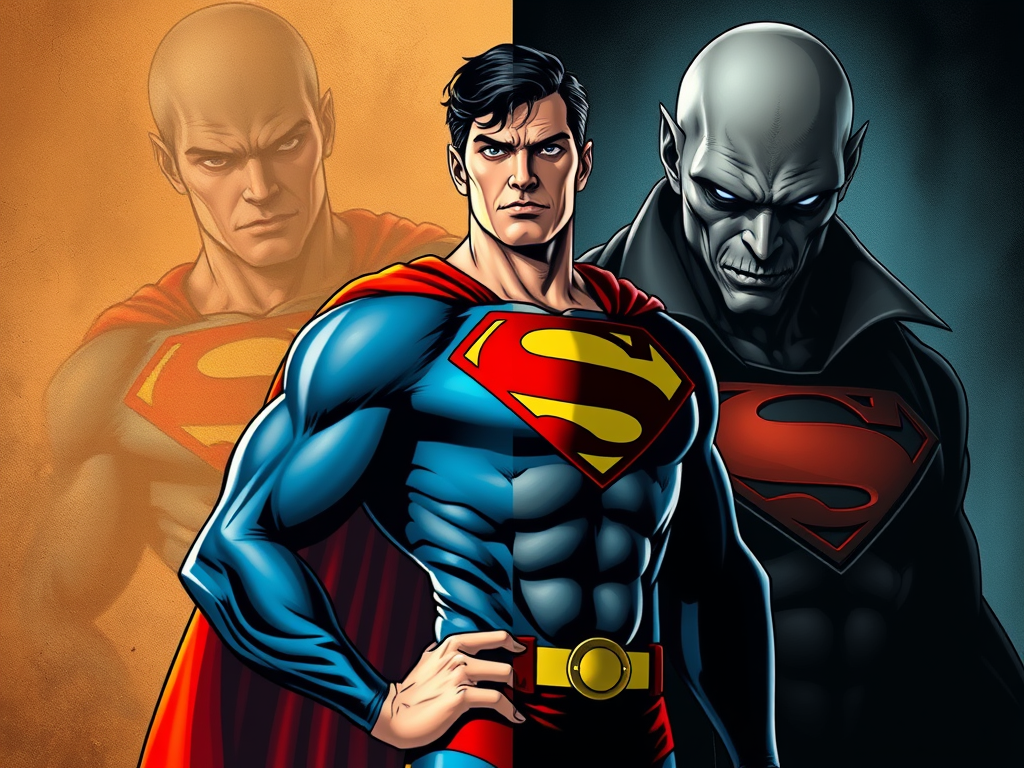
Before he was the hero of Metropolis, the character named “Superman” was a menace to society. In 1933, five years before Action Comics #1, creators Jerry Siegel and Joe Shuster self-published a short story titled “The Reign of the Super-Man.” In this early draft, the titular character was not a handsome alien savior, but a bald, telepathic vagrant named Bill Dunn. Dunn was granted mental powers by an evil scientist and used them to manipulate the stock market and racehorses for personal gain, eventually becoming a villain bent on world domination.
This version of the character was a reflection of the Great Depression era’s fear of unchecked power and the concept of the “Übermensch” gone wrong. Fortunately for pop culture history, Siegel and Shuster reimagined the concept. They shifted the “super” aspect from mental abilities to physical ones and flipped his morality from a conqueror to a protector. The bald, power-hungry archetype wasn’t completely discarded, however; it was eventually recycled to create Superman’s arch-nemesis, Lex Luthor.
2. He Could Not Originally Fly
“Look! Up in the sky! It’s a bird! It’s a plane!” Today, we finish that sentence with “It’s Superman!” implying flight. However, in his original 1938 incarnation, Superman was strictly ground-bound. As the intro to the old Superman TV show stated, he was “able to leap tall buildings in a single bound.” This wasn’t a figure of speech; his power was simply immense leg strength, allowing him to jump about an eighth of a mile at a time, much like a grasshopper or the Hulk.
The power of flight was not added until the early 1940s, and it was born out of production necessity rather than creative inspiration. When the Fleischer Studios began animating the Superman theatrical cartoons, they found that animating a character constantly bending his knees and jumping looked silly and was time-consuming to draw. They requested permission from DC Comics (then National Comics) to just have him fly through the air. DC agreed, the change was retroactively applied to the comics, and the Man of Steel has been defying gravity ever since.
3. Kryptonite Was Invented for Radio, Not Comics
Kryptonite is arguably the most famous plot device in fiction, a shorthand for any hero’s fatal weakness. Yet, for the first decade of his existence, Superman was effectively invincible. The glowing green rock did not appear in the comics until 1949. Its true origin lies in the The Adventures of Superman radio serial, which began airing in 1940.
The most persistent (and amusing) legend regarding Kryptonite is that it was created to give the voice actor, Bud Collyer, a vacation. By introducing a substance that made Superman sick and incapacitated, the writers could have the character groan in a closet for a week while a substitute voice actor filled in (or the character simply remained silent), allowing Collyer to take time off. Additionally, the radio show is responsible for introducing other key elements of the mythos, including copy boy Jimmy Olsen and Editor-in-Chief Perry White, proving that the radio waves were just as influential as the printed page in shaping the Superman legend.
4. The Tragic $130 Rights Deal
The story of Superman’s creation is one of the greatest successes in American literature, but the story of his creators is one of its greatest tragedies. In 1938, young creators Jerry Siegel and Joe Shuster were desperate to get their character published after years of rejection. When Detective Comics (DC) finally accepted the pitch for Action Comics #1, the duo signed a standard work-for-hire contract. They sold the complete rights to Superman for a check of $130 (roughly $2,800 in today’s money).
This decision haunted them for the rest of their lives. While Superman went on to generate billions of dollars in comics, merchandise, movies, and TV shows, Siegel and Shuster saw almost none of it. They spent decades in legal battles fighting for recognition and fair compensation. It wasn’t until the late 1970s, with the first Superman movie on the horizon and facing a public relations nightmare, that DC Comics finally agreed to give the creators a yearly pension and—crucially—the credit “Created by Jerry Siegel and Joe Shuster” that now appears on every piece of Superman media.
5. The Golden Age Social Crusader
If you read the earliest Action Comics issues, you won’t find Superman fighting alien warlords or interdimensional demons. Instead, you will find him dropping a slumlord off a roof to force him to renovate his crumbling buildings. The “Golden Age” Superman was a champion of the oppressed working class, a social justice warrior who used his powers to fight corruption, domestic abusers, and war profiteers.
This version of Superman was rougher, angrier, and significantly more violent. He was known to destroy the cars of reckless drivers and terrify corrupt lobbyists into submission. He didn’t care about “the law” as written; he cared about moral justice. This “social crusader” aspect was toned down during World War II when the character became more of a patriotic figure, and eventually, he evolved into the “friend to all” authority figure we recognize today. However, those early years remain a fascinating glimpse into the character’s roots as a power fantasy for the powerless.
6. The “Electric Blue” Era
In the 1990s, DC Comics was willing to take massive risks to revitalize their characters. In 1997, they launched a storyline that completely rewrote Superman’s biology. He lost his traditional physical powers (strength, heat vision, flight) and transformed into a being of pure energy. To maintain his cohesion, he had to wear a blue and white “containment suit,” leading fans to dub him “Electric Blue Superman.”
This wasn’t just a costume change; it fundamentally altered how he fought. He could turn tangible or intangible, shoot lightning bolts, and manipulate computers. The weirdness peaked when he was split into two separate beings: Superman Red (angry and decisive) and Superman Blue (calm and cerebral), a nod to a classic 1960s imaginary story. While the change was temporary and eventually reverted in time for the character’s 60th anniversary, it remains a controversial and unforgettable chapter that highlights the extreme experimentation of 90s comics.
7. The Death That Changed the Industry
While characters die in comics all the time today, in 1992, the “Death of Superman” was a cultural phenomenon. The story arc, simply titled The Death of Superman, saw the Man of Steel beaten to death by the unstoppable monster Doomsday in a brawl that destroyed half of Metropolis. The issue where he died, Superman #75, sold over six million copies, with people lining up around blocks to buy what they thought was a collector’s item that would fund their retirement.
The real significance of this event was not the death itself (he came back less than a year later), but the narrative structure that followed. The “Reign of the Supermen” storyline introduced four replacement heroes—Steel, Superboy, the Cyborg Superman, and the Eradicator—each claiming to fill the void. This arc proved that you could remove the main character from his own book and still tell compelling stories. It set a precedent for “event comics” where major status quo changes became the primary driver of sales, a strategy that dominates the comic book industry to this day.
8. He Boxed Muhammad Ali (And Lost)
In 1978, DC Comics published Superman vs. Muhammad Ali, an oversized special that remains one of the most beloved oddities in comic history. The plot involves an alien race called the Scrubb who demand to fight Earth’s greatest champion. Superman steps up, but Muhammad Ali argues that Superman isn’t technically from Earth. To settle the dispute, the aliens transport both of them to a planet orbiting a red sun, which temporarily strips Superman of his powers, forcing them to box fair and square to decide who will represent humanity.
In the ring, without his super-strength, Superman gets absolutely pummeled by Ali. The People’s Champion knocks out the Man of Steel (technically a TKO) and goes on to fight the alien champion himself. The comic is famous not just for its wild premise, but for the stunning artwork by Neal Adams and the fact that it treats both figures with immense respect. It stands as a testament to Ali’s real-world superhero status that he was written as the one man who could beat Superman in a fair fight.
9. The “Hypno-Glasses” Explanation
The oldest joke in pop culture is that Clark Kent’s disguise is just a pair of glasses. How could anyone be fooled by that? While modern explanations often rely on Superman acting clumsy or slouching to change his silhouette, the Silver Age of comics (roughly 1956-1970) offered a far more “comic book” explanation: super-hypnosis.
In various stories (and solidified in 1978’s Superman #330), it was revealed that Clark’s glasses were made of Kryptonian plexiglass from his rocket ship. These lenses amplified a low-level subconscious hypnosis that Superman naturally projected. When people looked at Clark Kent, the glasses influenced their minds to see him as frailer, older, and completely different from Superman. While this explanation has been largely retconned in modern eras in favor of “people just don’t expect a god to walk among them,” the Hypno-Glasses remain a hilarious example of the writers trying to use sci-fi logic to explain a simple suspension of disbelief.
10. The Pink Kryptonite Incident
Every fan knows Green Kryptonite kills him and Red Kryptonite causes unpredictable mutations. However, the comic archives contain some truly bizarre color variations, the most infamous being Pink Kryptonite. This mineral appeared in a single panel in a 2003 Supergirl story (post-Crisis) as a satire of the goofy Silver Age transformations.
In the scene, Superman is exposed to Pink Kryptonite and immediately begins to exhibit stereotypical campy behavior, complimenting Jimmy Olsen on his window treatments and fashion sense. The implication was that Pink Kryptonite temporarily turned Superman gay. While intended as a lighthearted jab at the arbitrary nature of Kryptonite colors in the past, it has since become a viral internet meme. It serves as a reminder of the tonal shifts in comics, where a character can go from being a gritty depression-era brawler to the subject of a campy social satire in the span of a few decades.
Further Reading
To explore the Man of Steel’s history beyond the cape and tights, check out these essential books:
- “Superman: The High-Flying History of America’s Most Enduring Hero” by Larry Tye – A comprehensive biography of the character, detailing his creation, cultural impact, and the lives of Siegel and Shuster.
- “Super Boys: The Amazing Adventures of Jerry Siegel and Joe Shuster” by Brad Ricca – A deep dive into the personal lives and legal struggles of the two young men from Cleveland who created a legend.
- “All-Star Superman” by Grant Morrison and Frank Quitely – Widely considered the greatest Superman story ever told, perfectly capturing the Silver Age imagination with modern emotional depth.
- “Superman: Red Son” by Mark Millar – A fascinating “Elseworlds” graphic novel that asks the question: What if Superman’s rocket had landed in the Soviet Union instead of Kansas?
Here at Zentara.blog, our mission is to take those tricky subjects and unlock them, making knowledge exciting and easy to grasp for everyone. But the adventure doesn’t stop on this page! We’re constantly exploring new frontiers and sharing discoveries across the digital universe. Want to dive deeper into more mind-bending Top 10s and keep expanding your world? Come join us on our other platforms – we’ve got unique experiences waiting for you on each one!
Get inspired by visual wonders and bite-sized facts: See the world through Zentara’s eyes on Pinterest!
Pin our fascinating facts and stunning visuals to your own boards. Explore Pins on Pinterest: https://uk.pinterest.com/zentarablog/
Discover quick insights and behind-the-scenes peeks: Hop over to Tumblr for snippets, quotes, and unique content you won’t find anywhere else. It’s a different flavour of discovery! Follow the Fun on Tumblr: https://www.tumblr.com/zentarablog
Ready for deep dives you can listen to or watch? We’re bringing our accessible approach to video and potentially audio! Subscribe to our YouTube channel and tune into future projects that make learning pop! Subscribe on YouTube: https://www.youtube.com/@ZentaraUK
Seeking even more knowledge in one place? We’ve compiled some of our most popular topic deep dives into fantastic ebooks! Find them on Amazon and keep the learning journey going anytime, anywhere. Find Our Ebooks on Amazon: https://www.amazon.co.uk/s?k=Zentara+UK&ref=nb_sb_noss
Connect with us and fellow knowledge seekers: Join the conversation on BlueSky! We’re sharing updates, thoughts, and maybe even asking you what wonders we should explore next. Chat with Us on BlueSky: https://bsky.app/profile/zentarablog.bsky.social
Perfect for learning on the move! We post multiple 10-minute podcasts per day on Spotify. Pop on your headphones and fill your day with fascinating facts while you’re out and about! Listen on Spotify: https://open.spotify.com/show/3dmHbKeDufRx95xPYIqKhJFollow us on Instagram for bytesize knowledge! We post multiple posts per day on our official Instagram account. https://www.instagram.com/zentarablog/ Every click helps us keep bringing honest, accessible knowledge to everyone. Thanks for exploring with us today – see you out there in the world of discovery!



Leave a Reply