
Table of Contents
World War II was not just fought with tanks, airplanes, and atomic bombs; it was fought with words, images, and radio waves. It was the first “Total War,” meaning every aspect of society was mobilized for the effort, and that required total psychological control. To keep soldiers fighting and civilians working, governments on both sides developed sophisticated machines of manipulation.
While we often look back at vintage war posters with a sense of nostalgia—admiring the art style of “Rosie the Riveter” or the stoicism of “Keep Calm and Carry On”—the reality of WWII propaganda was far darker. It was a calculated science of the mind, designed to bypass logic and trigger primal instincts: fear, hatred, lust, and tribalism. The “Ministers of Information” in Berlin, London, Washington, and Tokyo didn’t just want to inform their citizens; they wanted to rewire them.
From creating fake radio stations that broadcast pornography to demoralize the enemy, to rewriting math textbooks to teach children about ballistics, the psychological warfare of the 1940s laid the groundwork for modern fake news and information warfare. Here are the top 10 most disturbing propaganda tricks used during World War II that reveal just how fragile the human mind can be.
1. Dehumanization: The “Vermin” Narrative
Turning the Enemy into Monsters to Make Killing Easier
The most effective way to get a soldier to kill another human being is to convince him that the target isn’t human at all. Dehumanization was the cornerstone of Axis and Allied propaganda alike. It wasn’t enough to say the enemy was wrong; the enemy had to be portrayed as a biological threat to civilization itself.
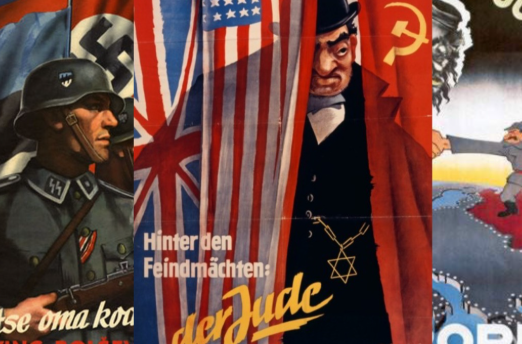
Nazi propaganda famously depicted Jewish people not as humans with a different religion, but as rats, lice, or parasites feeding on the healthy body of the German nation. This wasn’t just an insult; it was a psychological trigger designed to evoke disgust rather than empathy. If the enemy is a “disease,” then killing them becomes a medical necessity—a form of hygiene.
The Allies were not immune to this. American propaganda frequently portrayed the Japanese not as soldiers, but as buck-toothed, sub-human beasts or monkeys. This racial caricature was far more vicious than the imagery used against the Germans, contributing to the brutality of the Pacific theater. By stripping the enemy of their humanity in cartoons, posters, and films, propagandists removed the moral barrier to violence, allowing average citizens to cheer for the extermination of the “other.”
2. The “Big Lie” Technique
If You Lie Huge, People Will Believe It
Adolf Hitler and his Propaganda Minister, Joseph Goebbels, operated on a chillingly effective principle known as the Große Lüge or “Big Lie.” The theory was simple but counterintuitive: people are suspicious of small lies, but they are defenseless against colossal ones. The average person might lie about being late to work, but they cannot imagine a government fabricating an entire history or reality.
Goebbels utilized this to frame the war not as German aggression, but as a necessary defense against a global conspiracy of “Jewish-Bolshevism” encircling Germany. They repeated this narrative across every medium—newspapers, radio, cinema, and rallies—until it became the ambient truth of the Third Reich. The trick relies on “frequency of exposure.” If you hear a lie often enough, from enough authoritative sources, your brain eventually categorizes it as a fact to save cognitive energy. This technique didn’t just deceive the German public; it insulated them from reality, making them fight to the bitter end even when the war was clearly lost.
3. Black Propaganda and Fake Radio Stations
Pretending to Be the Enemy to Destroy Them from Within
Most propaganda is “White Propaganda,” where the source is known (e.g., the BBC broadcasting news). But the most disturbing trick was “Black Propaganda,” where the source was disguised to look like it was coming from the enemy’s own side. The British Political Warfare Executive (PWE), led by the genius Sefton Delmer, mastered this dark art.
Delmer created Soldatensender Calais, a radio station that posed as a German military station. It played the latest German pop music and featured a host who sounded like a loyal, patriotic Nazi. However, sandwiched between the hits were subtle, demoralizing lies. They would broadcast reports that Nazi party officials were sleeping with soldiers’ wives while the men were freezing on the Eastern Front, or spread rumors about disease outbreaks in German cities.
Because the station sounded “German,” soldiers trusted it more than the BBC. The British used this trust to spread confusion, lower morale, and sow distrust between the German army (Wehrmacht) and the Nazi Party leadership. It was psychological gaslighting on an industrial scale.
4. Weaponizing Sexual Insecurity
“While You’re Away, Someone Else is in Your Bed”

Shutterstock
War takes men away from their families for years, creating a deep well of insecurity about fidelity. Propagandists ruthlessly exploited this fear. Both Axis and Allied forces dropped millions of leaflets over enemy lines that had nothing to do with politics and everything to do with sex.
German leaflets dropped on American troops featured erotic drawings of beautiful women and captions insinuating that “Jody” (the slang term for the man back home who steals your girl) was having a great time while the soldier was dying in a muddy foxhole. The goal was to distract the soldier, fill him with jealousy and depression, and make him question why he was fighting.
Japan’s “Tokyo Rose” and Germany’s “Axis Sally” were radio personalities who used sultry, seductive voices to broadcast to Allied troops. They played great American jazz but interspersed it with taunts about their wives’ infidelity and the futility of the war. It was a psychological attack on the soldier’s masculinity and emotional stability, aimed at breaking his will to fight by breaking his heart.
5. Indoctrination of Children
Rewriting Textbooks to Breed Future Soldiers
The most long-term and disturbing propaganda trick was the targeting of children. The Nazi regime understood that if you control the youth, you control the future. They didn’t just use posters; they altered the school curriculum to normalize war and racial hatred.
Math textbooks in the Third Reich included word problems that asked students to calculate how much money the state would save if they stopped caring for the mentally ill, or to calculate the blast radius of bombs dropping on “inferior” cities. This wasn’t just teaching math; it was desensitizing children to eugenics and violence.
Fairy tales were rewritten to feature Aryan heroes fighting Semitic villains. Toy stores sold board games where the objective was to maneuver U-boats to sink Allied shipping or to clear “invaders” from the map. By gamifying war and embedding ideology into education, the regime created a generation of “Hitler Youth” who were fanatically loyal and intellectually inoculated against empathy for their enemies.
6. The “Terror of the Spy” (Paranoia Induction)
Making Citizens Fear Their Neighbors
“Loose Lips Sink Ships” is a catchy slogan, but the campaign behind it was designed to induce a state of constant, low-level paranoia. Governments needed to ensure operational security, but they often achieved this by making citizens terrified of one another.
Propaganda posters depicted average-looking citizens—a barman, a girl on a park bench, a grandmother knitting—as potential spies. The message was clear: Trust no one. This effectively weaponized the population against itself. In totalitarian regimes like the Soviet Union and Nazi Germany, this was ramped up to terrify citizens into denouncing their neighbors to the secret police (Gestapo or NKVD) to avoid being denounced themselves.
This atmosphere of suspicion destroyed social cohesion. It made people afraid to voice any dissent or criticism of the war effort, effectively silencing the population through self-censorship. The propaganda didn’t just say “be quiet”; it said “someone is listening,” turning every living room into a potential interrogation cell.
7. The “Wonder Weapon” (Wunderwaffe) Myth
Selling False Hope to Prolong Suffering
As the war turned against Germany, the propaganda machine shifted from tales of conquest to promises of technological salvation. Goebbels began promoting the idea of Wunderwaffen or “Wonder Weapons”—super-advanced technology that would turn the tide of the war at the last minute.
While weapons like the V-2 rocket and jet fighters were real, the propaganda exaggerated their capabilities and quantity to a mythical degree. This was a psychological trick to keep the German population fighting long after the war was lost. It exploited the “Sunk Cost Fallacy,” convincing soldiers and civilians that if they just held on for a few more weeks, a miracle would save them.
This was arguably one of the most cruel propaganda tricks, as it prolonged the war by months, leading to hundreds of thousands of unnecessary deaths in 1945. It transformed the delusions of leadership into a national suicide pact.
8. Atrocity Propaganda
Exaggerating Cruelty to incite Rage
To keep the war machine churning, nations needed to maintain a high level of public anger. Atrocity propaganda involved highlighting, exaggerating, or outright fabricating crimes committed by the enemy.
While real atrocities were plentiful (the Holocaust, the Rape of Nanking), propaganda often focused on specific, visceral stories designed to trigger a protective rage. For example, stories circulated that Germans were cutting off the hands of Belgian children (a recycled story from WWI) or that the Japanese were engaging in specific, grotesque forms of torture on pilots.
Conversely, the Nazis broadcasted the discovery of the Katyn Massacre (where Soviets executed thousands of Polish officers) not out of care for the Poles, but to split the Allied alliance. This selective use of truth and fiction turned human suffering into a tactical asset, manipulating the moral outrage of the public to justify total war tactics like firebombing cities.
9. The “Safe Conduct” Trap
Psychological Warfare on the Front Lines
Not all propaganda was for civilians. On the battlefield, planes dropped millions of “Safe Conduct Passes.” These looked like official banknotes or government documents and promised the finder good food, medical treatment, and safety if they surrendered.
While the Allies generally treated POWs according to the Geneva Convention, on the Eastern Front, this was a deadly trap. Soviet propaganda dropped leaflets on German troops promising warm food and a return home, while German propaganda did the same for the Soviets. In reality, surrender on the Eastern Front often meant slave labor, starvation, or summary execution.
The disturbing aspect was the exploitation of physical misery. These leaflets were dropped on starving, freezing men, dangling the basic biological needs of food and warmth to bait them into captivity. It weaponized the soldier’s survival instinct against his duty.
10. The Appeal to Motherhood
Guilt-Tripping the Matriarchs
Propagandists knew that women were the emotional anchors of the home front. Consequently, a specific genre of propaganda was developed to manipulate mothers. In the US and UK, this often took the form of guilt: “What did YOU do to help win the war?” or posters showing children in danger with the implication that buying war bonds would protect them.
In Germany, the Mutterkreuz (Cross of Honor of the German Mother) was awarded to women who bore four or more children for the Reich. Propaganda elevated women to the status of “breeding machines” for the state, tying their self-worth directly to their biological output.
This trick played on the deepest human instinct—the drive to protect offspring. By framing the war as a direct threat to their children, or by framing childbirth as a military service, governments manipulated the unconditional love of mothers to fuel the machinery of death.
Further Reading
To dig deeper into the manipulation of the mind during wartime, consider these insightful books:
- “Propaganda” by Edward Bernays – Written by the “father of public relations” (and nephew of Sigmund Freud), this 1928 classic outlines the mechanics of manipulating public opinion that were heavily studied by Goebbels.
- “The Black Game: British Subversive Operations Against the Germans During the Second World War” by Ellic Howe – A fascinating, detailed look at the British executive that created fake radio stations and rumors.
- “Munitions of the Mind: A History of Propaganda from the Ancient World to the Present Era” by Philip M. Taylor – This provides excellent context, showing how WWII tactics fit into the broader history of psychological warfare.
- “Hitler’s Willing Executioners” by Daniel Jonah Goldhagen – A controversial but compelling look at how propaganda contributed to the ordinary German citizen’s complicity in the Holocaust.
[Begin Outro Text]
Keep the Discovery Going!
Here at Zentara, our mission is to take tricky subjects and unlock them, making knowledge exciting and easy to grasp. But the adventure doesn’t stop at the bottom of this page. We are constantly creating new ways for you to learn, watch, and listen every single day.
📺 Watch & Learn on YouTube
Visual learner? We publish 4 new videos every day, plus breaking news shorts to keep you smarter than the headlines. From deep dives to quick facts, our channel is your daily visual dose of wonder.
Click here to Subscribe to Zentara on YouTube
🎧 Listen on the Go on Spotify
Prefer to learn while you move? Tune into the Zentara Podcast! We drop a new episode daily, perfect for your commute, workout, or coffee break. Pop on your headphones and fill your day with fascinating facts.
Click here to Listen on Spotify
Every click, view, and listen helps us keep bringing honest knowledge to everyone. Thanks for exploring with us today—see you out there in the world of discovery!



Leave a Reply