
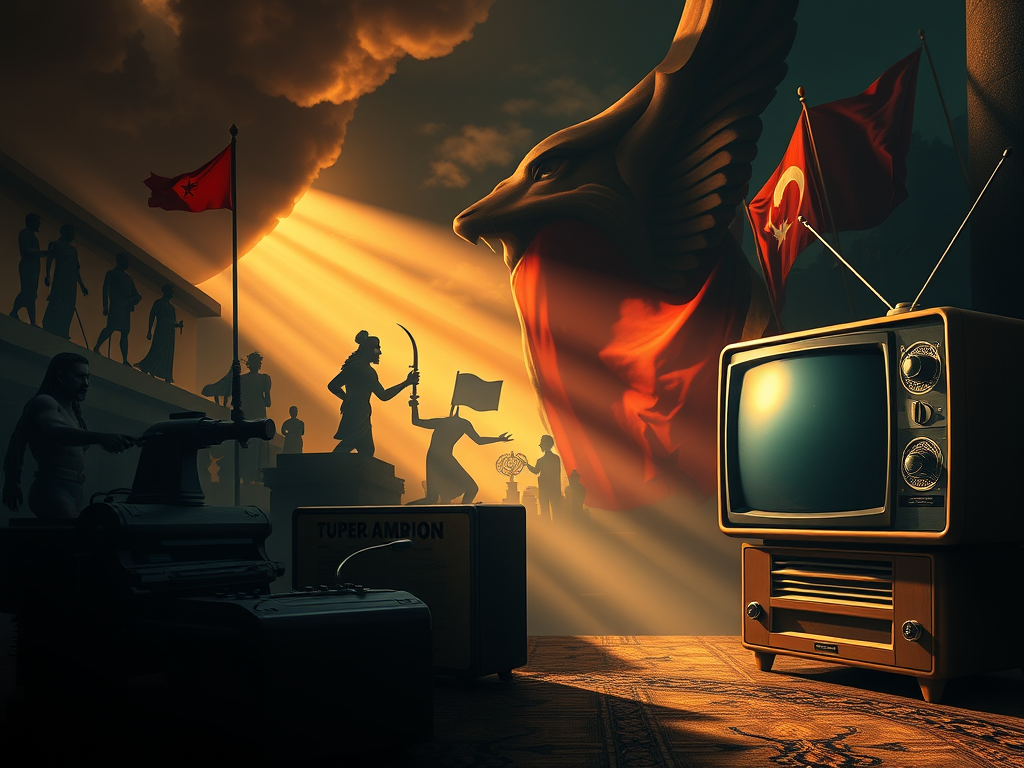
Propaganda is often viewed as a modern “dirty word,” associated with misinformation and authoritarian regimes. However, the history of propaganda is as old as civilization itself. Derived from the Latin propaganda, meaning “things to be spread,” the term originally had a neutral, even religious, connotation. At its core, propaganda is the systematic effort to manipulate people’s beliefs, attitudes, or actions through symbols, images, and words.
As we navigate the information-dense landscape of late 2025, understanding how to spot manipulation in media is a vital skill. From the carved monuments of ancient pharaohs to the algorithm-driven “deepfakes” of the digital age, the tools have changed, but the psychological manipulation techniques remain remarkably consistent. Propaganda thrives by bypassing our logical centers and targeting our primal emotions—fear, pride, and the desire to belong.
In this guide, we will explore ten pivotal facts about the evolution of persuasion. By examining war propaganda, the role of the printing press, and the rise of mass media, we can better protect our own perspective from the subtle influence of those who seek to shape our reality.
1. The Ancient Origins: Propaganda Before Paper
Long before the invention of the television or the internet, leaders used architecture and art as tools for subtle manipulation. In ancient Egypt, Pharaoh Ramses II used temple walls to depict himself winning battles that were, in reality, stalemates. By carving his “victory” in stone, he ensured that future generations would view him as an invincible god-king. This is one of the earliest signs of manipulation on a state level.
These ancient methods relied on “monumental propaganda.” If a king builds a statue fifty feet tall, the message is clear: I am powerful, and you are small. The Greeks and Romans refined this by minting coins with the Emperor’s face, ensuring that every person in the empire held a piece of propaganda in their pocket. This established a sense of “omnipresence,” making the leader feel like an unavoidable part of daily life. It was the first step toward the manipulative personality cults we see in modern history.
2. The Vatican and the Birth of the Word
The word “propaganda” actually has its roots in the Catholic Church. In 1622, Pope Gregory XV established the Sacra Congregatio de Propaganda Fide (the Sacred Congregation for the Propagation of the Faith). Its mission was to spread Christianity to the “New World” and defend the faith against the Protestant Reformation. At the time, the term was not considered negative; it simply meant “the spreading of ideas.”
This period represents a major shift in interpersonal communication. For the first time, an organization had a dedicated department for managing its global image and message. It recognized that ideas are a form of power that must be “propagated” like seeds in a field. This religious origin reminds us that propaganda is not always about lies; it is often about the aggressive promotion of a specific “truth” to ensure institutional survival and growth.
3. The Printing Press: Information as a Weapon
Before Johannes Gutenberg invented the printing press in the mid-15th century, ideas moved at the speed of a walking horse. The press changed the world by allowing for the mass production of pamphlets and posters. This technology was the “social media” of its day, enabling activists like Martin Luther to spread revolutionary ideas faster than the authorities could suppress them.
However, the press was also a tool for psychological manipulation. During the European wars of religion, both sides used woodcut illustrations—the “infographics” of the 1500s—to depict their enemies as monsters or demons. Since many people were illiterate, these vivid, terrifying images were highly effective at inciting fear and violence. This marked the beginning of “mass persuasion,” where a single person with a machine could influence the minds of thousands without ever meeting them.
4. Napoleon and the Press: Controlling the Narrative
Napoleon Bonaparte was a master of military leadership, but he was perhaps an even better propagandist. He famously said, “Four hostile newspapers are more to be feared than a thousand bayonets.” Napoleon understood that his power depended on public opinion, so he exerted strict control over the French press, ensuring that only glowing reports of his victories reached the citizens of Paris.
He also utilized “The Bulletins of the Grand Army,” which were read aloud to soldiers and civilians alike. These bulletins used vivid examples and flowery language to turn every skirmish into a legendary feat. This created a “hero myth” that lasted long after his eventual defeat. Napoleon’s tactics show us that propaganda is often about “editing” reality—highlighting the glorious bits while using selective memory to erase the failures.
5. World War I: The Factory of Hate
World War I was the first “Total War,” and it required the total mobilization of the civilian mind. Governments on both sides created official propaganda bureaus, such as the British “Wellington House” and the American “Committee on Public Information.” Their goal was to turn a complex geopolitical conflict into a simple story of good versus evil.
This era introduced the concept of “Atrocity Propaganda.” This involved spreading stories (often exaggerated or completely fabricated) about the enemy’s cruelty toward women and children. By dehumanizing the opponent, the government made it easier for young men to go to the front lines and for civilians to accept the hardships of war. This remains one of the most effective war propaganda techniques: making the “Other” seem so monstrous that any violence against them feels justified.
6. The Rise of Radio: The Voice in the Living Room
The invention of the radio in the 1920s changed the interpersonal communication landscape forever. Suddenly, a leader’s voice could enter a person’s private home. This created a sense of intimacy and trust that written words could never match. Dictators of the 1930s, such as Adolf Hitler and Joseph Stalin, used the radio to create a direct emotional bond with the masses.
This was the era of the “Big Lie.” Propagandists realized that if you tell a lie that is big enough, and repeat it frequently enough, people will eventually believe it because they cannot imagine someone would have the impudence to distort the truth so significantly. Radio allowed for this repetition to happen 24/7. It turned the citizen’s living room into a theater of psychological manipulation, where the leader’s voice became the only voice that mattered.
7. The Cold War: The Battle for Hearts and Minds
During the Cold War, propaganda moved beyond posters and speeches and into the realm of cultural history. The U.S. and the Soviet Union competed to prove that their “way of life” was superior. This meant that everything—from Hollywood movies and jazz music to kitchen appliances and the Space Race—was used as a form of “soft power” propaganda.
This was a more subtle manipulation than the “hate-mongering” of the World Wars. It was about “lifestyle propaganda.” The U.S. wanted the world to see a vision of suburban comfort and freedom, while the USSR promoted a vision of communal equality and scientific progress. This era proved that propaganda isn’t just about what you are against; it’s about the “dream” you are trying to sell. The goal was to make the other side’s citizens feel “FOMO” (Fear Of Missing Out) on a better life.
8. Television and the “Image” Era
With the rise of television in the 1950s and 60s, propaganda became more about the “image” than the argument. The 1960 televised debate between John F. Kennedy and Richard Nixon is a classic science fact in political history: those who listened on the radio thought Nixon won, but those who watched on TV thought the young, tan, and confident Kennedy won.
TV allowed for the “Seven Techniques of Propaganda” to be used with high-frequency visuals:
- Glittering Generalities: Using “virtue words” like Freedom or Family.
- Transfer: Linking a leader to a respected symbol (like a flag).
- Testimonial: Using celebrities to endorse an idea.
- Plain Folks: Pretending the leader is “just like you.”
- Card Stacking: Only showing the positive facts.
- Bandwagon: Making you feel like “everyone is doing it.”
- Name Calling: Labeling the opponent with a negative term.
9. Cognitive Dissonance: Why Propaganda Works
One of the most fascinating behavioral psychology aspects of propaganda is its reliance on cognitive dissonance. This is the mental discomfort we feel when we hold two conflicting beliefs at the same time. To resolve this discomfort, we often choose the “easiest” truth—the one provided by the propaganda.
If a person identifies deeply with a specific political group, and that group’s leader says something that contradicts the facts, the person faces a choice: accept they were wrong (painful) or believe the leader’s lie (easier). Propaganda is designed to give you “permission” to ignore the truth in favor of your identity. Understanding this psychological manipulation is the key to protecting yourself; it’s not about how smart you are, but how aware you are of your own emotional biases.
10. The Digital Age: Algorithms and Deepfakes
In the 2020s, propaganda has entered its most dangerous phase: the era of “Micro-targeting.” Through social media, data scientists can identify your specific fears and insecurities and send you personalized propaganda that never appears on your neighbor’s feed. This creates a “filter bubble” where your reality is different from everyone else’s.
Furthermore, “Deepfakes”—AI-generated videos of people saying things they never said—make it nearly impossible to believe our own eyes. This is the ultimate form of unconscious manipulation. It is no longer about making you believe a lie; it’s about making you stop believing in any truth. When the public is so confused that they give up on the facts, the propagandists have won. The modern world requires a new kind of “digital literacy” to navigate these hidden agendas.
Further Reading
To learn more about the history of influence and how to guard your mind, check out these accessible resources:
- “Propaganda” by Edward Bernays (The “father” of modern PR)
- “Influence: The Psychology of Persuasion” by Robert B. Cialdini
- “How Propaganda Works” by Jason Stanley
- “The Age of Propaganda: The Everyday Use and Abuse of Persuasion” by Anthony Pratkanis and Elliot Aronson
Keep the Discovery Going!
Here at Zentara, our mission is to take tricky subjects and unlock them, making knowledge exciting and easy to grasp. But the adventure doesn’t stop at the bottom of this page. We are constantly creating new ways for you to learn, watch, and listen every single day.
📺 Watch & Learn on YouTube
Visual learner? We publish 4 new videos every day, plus breaking news shorts to keep you smarter than the headlines. From deep dives to quick facts, our channel is your daily visual dose of wonder.
Click here to Subscribe to Zentara on YouTube
🎧 Listen on the Go on Spotify
Prefer to learn while you move? Tune into the Zentara Podcast! We drop a new episode daily, perfect for your commute, workout, or coffee break. Pop on your headphones and fill your day with fascinating facts.
Click here to Listen on Spotify
Every click, view, and listen helps us keep bringing honest knowledge to everyone. Thanks for exploring with us today—see you out there in the world of discovery!




Leave a Reply