
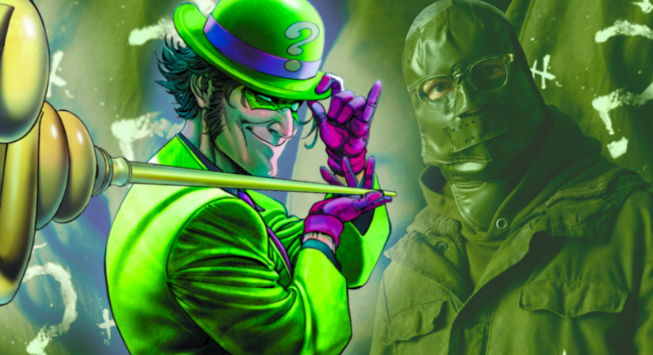
In the neon-lit, rain-soaked streets of Gotham City, the battle between good and evil is often fought with fists, gadgets, and sheer willpower. But while the Joker brings chaos and the Penguin brings greed, one man brings a challenge that cannot be solved with a Batarang or a smoke pellet. Edward Nygma—the man known as the Riddler—is a villain who views crime as the ultimate game of chess. He doesn’t just want to win; he wants to prove he is the smartest person in the room, even if that room is shared with the World’s Greatest Detective.
For over half a century, the Riddler has evolved from a campy trickster in a question-mark-covered unitard to a chilling, psychological mastermind capable of bringing entire cities to their knees. He is a character defined by paradoxes: a man who craves secrecy yet leaves a trail of clues for the police to follow; a criminal who seeks power through knowledge but is often undone by his own overinflated ego. To understand the Riddler is to understand the fragile line between brilliance and madness. This guide explores the foundational layers of Gotham’s Prince of Puzzles, revealing why he remains one of the most enduring figures in the DC Universe.
1. The Many Names of a Mastermind: From Nashton to Nigma
The identity of the Riddler is as much a puzzle as the crimes he commits. While most fans recognize him as Edward Nigma (a clever play on the word “enigma”), his actual birth name in many comic continuities is Edward Nashton. Born into a household where truth was a weapon used against him, young Edward felt like a “cipher”—a zero in the eyes of his peers and his abusive father. Changing his name to Nigma was his first act of self-creation, a way to turn himself into a mystery that no one else could solve.
This name change represents more than just a pun; it is a declaration of war against his own unremarkable past. By adopting the persona of “E. Nigma,” he claimed ownership of his intelligence and transformed his insecurity into a brand. In the lore of DC Comics, this shift highlights the character’s core motivation: he isn’t just a thief or a murderer; he is a man building a legend. Whether he is operating under his birth name or his chosen alias, the man behind the question mark is always trying to rewrite his own story to be more complex than the world gave him credit for.
2. A Tragic Origin Rooted in Intellectual Insecurity
Unlike many of Batman’s foes who are born from chemical accidents or cosmic events, the Riddler’s origin is deeply human and psychological. As a child, Edward was desperate for approval and validation. The defining moment of his youth occurred when his teacher announced a puzzle-solving contest. Edward, desperate to win at any cost, broke into the school at night and practiced the puzzle until he could solve it in seconds. He won the contest, but instead of the praise he craved, his father accused him of cheating and beat him for “lying.”
This trauma created a permanent scar on Edward’s psyche. It instilled in him a pathological need to prove his intelligence while simultaneously forcing him to stay “honest” through his clues. He became obsessed with the idea that if he could solve the hardest puzzles, he would finally be untouchable. His turn to crime wasn’t about the money—though he enjoys the finer things—but about finding a stage large enough for his genius. He views the world as a series of tests, and every heist is simply another way to scream to the world that he is the smartest man alive.
3. The Psychological Compulsion: Why He Leaves Clues
One of the most frequent questions asked by casual fans is: “If the Riddler is so smart, why does he leave clues that help Batman catch him?” The answer lies in a deep-seated psychological compulsion. The Riddler does not just want to leave clues; he must. In several iconic stories, Edward has tried to commit “clean” crimes without any riddles, only to find himself leaving subconscious hints—like a specific arrangement of objects or a cryptic note—without even realizing it.
Psychiatrists in the DC Universe often diagnose him with a form of obsessive-compulsive disorder. For Edward, a crime without a riddle is “incomplete” and “artless.” He views himself as a teacher and Batman as his only worthy student. If he simply stole a diamond and disappeared, he would be no better than a common street thug. By leaving a riddle, he turns the crime into a duel of wits. He wants to be caught, but only if Batman is smart enough to “earn” the victory. It is a self-sabotaging cycle that ensures he will always end up back in Arkham Asylum, yet he is unable to break the habit because his ego demands the challenge.
4. Solving the Greatest Riddle: Knowing Batman’s Identity
For decades, the Riddler’s ultimate goal was the answer to the greatest mystery in Gotham: “Who is Batman?” In the landmark storyline Hush, Edward finally achieved the impossible. Through a series of brilliant deductions and by utilizing a Lazarus Pit to restore his health and clarity, he pieced together the clues to realize that Bruce Wayne is the man behind the cowl. This was his crowning achievement, the moment he finally “won” the game.
However, the way he handled this information is a testament to his complex nature. When he confronted Batman with the truth, Bruce countered with a riddle of his own: “What is a riddle that everyone knows the answer to, but no one tells?” The answer is “A secret.” Batman pointed out that if the Riddler revealed Batman’s identity to the world, the mystery would be gone, and the “riddle” would lose all its value. A secret that everyone knows is worthless. Faced with the prospect of losing his greatest intellectual game, the Riddler chose to keep the secret, proving that for him, the “solve” is more important than the power it brings.
5. The Dark Transformation of Zero Year
While the Riddler was once seen as a somewhat campy villain, modern interpretations have recast him as a terrifying, high-stakes threat. In the Zero Year saga, which reimagines Batman’s early days, the Riddler manages to do what few villains ever have: he actually conquers Gotham. By shutting down the city’s power grid and flooding the streets, he turns Gotham into a post-apocalyptic “Savage City” where the citizens must solve his riddles daily just to survive.
This version of the character is far from a joke. He is depicted as a cold, calculating strategist who uses his knowledge of engineering, computer hacking, and social manipulation to hold millions of lives hostage. Zero Year serves as the definitive proof that the Riddler is an “A-list” threat. He doesn’t need super-strength or cosmic rays; he just needs a laptop and a plan. It elevated him from a nuisance who leaves notes at bank robberies to a master of urban warfare, showing that his mind is the most dangerous weapon in Gotham.
6. The Reformed Detective: E. Nigma, Consulting Detective
In one of the most unique character arcs in comic book history, the Riddler actually “went straight” for a period. After recovering from a head injury that seemingly cured his criminal compulsions, Edward Nygma opened his own private investigation firm. Operating as “E. Nigma, Consulting Detective,” he spent years solving crimes that baffled the GCPD and even occasionally assisted Batman.
This era of the character is fascinating because it proves that Edward’s skills are legitimately top-tier. He wasn’t just a good criminal; he was a brilliant detective. During this time, he and Batman developed a begrudging respect for one another. They were two sides of the same coin: both men were obsessed with the truth, both were masters of deduction, and both were social outcasts. Though he eventually returned to his villainous roots, this “heroic” era added a layer of tragedy to the character. It showed that he could have been a force for good if his ego and mental instability hadn’t pulled him back into the shadows.
7. The War of Jokes and Riddles
One of the most significant events in the Riddler’s history is his all-out war with the Joker. Set in the early years of Batman’s career, this conflict arose when the two villains disagreed over who had the “right” to kill the Batman. The Riddler believed that a death by his hand would be a triumph of logic, while the Joker viewed it as the ultimate punchline. The result was a bloody gang war that split Gotham’s underworld in half.
This storyline highlights the Riddler’s leadership and tactical brilliance. He successfully recruited an army of villains—including Poison Ivy and Scarecrow—and fought the Joker to a bloody standstill. More importantly, it showed the terrifying coldness of Edward’s intellect. He was willing to sacrifice countless lives and orchestrate horrific tragedies just to prove a point to a clown. While the Joker is chaotic and unpredictable, the Riddler is precise and intentional. Seeing the two of them clash reminds readers that as dangerous as the Joker’s madness is, the Riddler’s calculated cruelty is just as lethal.
8. An Arsenal of the Mind: Gadgets and Lethal Traps
The Riddler may not be a physical powerhouse like Bane or Killer Croc, but he is a skilled engineer and inventor. His signature weapon is his “Question Mark Cane,” which often conceals a variety of high-tech gadgets, including stun tasers, holographic projectors, and computer hacking interfaces. He is also a master of “Rube Goldberg” style traps—elaborate, multi-stage puzzles that require the victim to solve a series of logic problems to avoid a lethal outcome.
His traps are designed to exploit human psychology. He knows that in a moment of panic, most people lose their ability to think clearly. By forcing his victims (and Batman) to think under extreme pressure, he asserts his dominance. Whether it’s a giant crossword puzzle where the wrong letter triggers a trapdoor or a digital maze that requires high-level coding to escape, his “weapons” are always extensions of his intellect. He doesn’t just want to kill his enemies; he wants to prove that they died because they weren’t smart enough to live.
9. Team Affiliations and the Secret Society
Though he is often a loner who believes no one else is smart enough to keep up with him, the Riddler has been a key player in several major supervillain teams. He has been a member of the Secret Society of Super Villains, the Legion of Doom, and even a reluctant member of the Secret Six. In these groups, he usually serves as the “strategist” or the “intellect,” providing the blueprints for complex heists that require more than just brute force.
However, his arrogance often makes him a difficult teammate. He cannot help but point out the flaws in his allies’ plans, and he frequently views himself as the “true” leader, even when someone like Lex Luthor or Vandal Savage is in charge. His history with these teams shows that his influence extends far beyond Gotham. He has matched wits with the Justice League and the Flash, proving that his riddles are a universal threat that can challenge the greatest heroes of the DC Universe.
10. The Legacy of the Question Mark: Enigma and Beyond
The Riddler’s influence on the DC Universe has also manifested in his legacy. He has a daughter, known as Enigma, who took up her father’s mantle for a time. Much like her father, she is brilliant, obsessed with puzzles, and deeply conflicted about her relationship with the man who raised her. Her presence explores the “nature vs. nurture” aspect of the character—is the obsession with riddles a genetic trait or a learned behavior born from trauma?
Beyond his literal offspring, the Riddler has inspired a specific type of “cerebral” villain in comic book media. He is the archetype for the antagonist who challenges the hero’s mind rather than their muscles. As long as there are mysteries to be solved and detectives to solve them, the Riddler will remain a vital part of the mythos. He is the eternal question mark at the end of every sentence, the shadow of doubt that forces Batman to be more than just a vigilante—he forces him to be a genius.
Further Reading
To truly grasp the genius and the madness of the Prince of Puzzles, these essential volumes are the perfect place to start:
- Batman: Zero Year by Scott Snyder and Greg Capullo
- Batman: Hush by Jeph Loeb and Jim Lee
- The War of Jokes and Riddles by Tom King and Mikel Janín
- Batman: One Bad Day – The Riddler by Tom King and Mitch Gerads
- Batman: Dark Knight, Dark City by Peter Milligan and Kieron Dwyer




Leave a Reply