
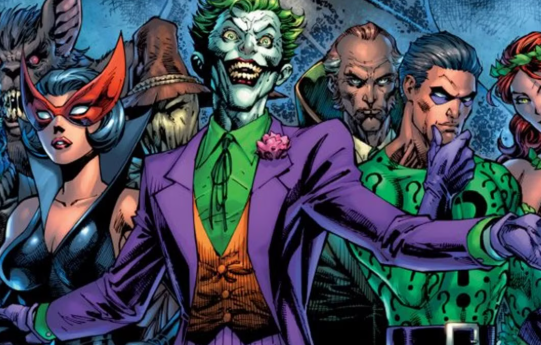
In the fog-drenched streets of Gotham City, the shadows don’t just hide secrets—they hide monsters. While every superhero has a list of adversaries, Batman’s “Rogues Gallery” is widely considered the most complex, terrifying, and psychologically deep collection of villains in literary history. These are not merely bank robbers or world-conquering aliens; they are fractured mirrors of the Dark Knight himself.
To understand Batman, one must understand the people he fights. Each villain represents a specific fear, a psychological trauma, or a societal failure that Bruce Wayne has sworn to combat. From the chaotic laughter of the Joker to the cold, calculating intellect of the Riddler, these characters provide the friction that allows Batman’s heroism to shine. This guide explores the most significant threats to Gotham City, analyzing their origins, their methods, and the deep-seated reasons why they continue to fascinate audiences across the globe.
1. The Psychology of Evil: Why Batman Has Such Strong Villains
The primary reason Batman’s villains are so enduring is that they are rarely “evil for the sake of being evil.” Instead, they are defined by their psychological depth. While many superheroes fight enemies with cosmic powers, Batman’s foes are often rooted in human frailty and mental illness. They aren’t just trying to punch the hero; they are trying to prove a point about the human condition.
Most of Batman’s enemies are “themed” criminals who suffer from obsessive-compulsive tendencies or deep-seated traumas that mirror Bruce Wayne’s own origin. This creates a narrative where every battle is as much a debate as it is a fistfight. The strength of this gallery lies in its diversity; whether the threat is a biochemical fear toxin, a complex riddle, or a brute-force physical assault, the villains force Batman to use every tool in his utility belt—and every ounce of his detective brain. They are the “final exams” for the World’s Greatest Detective, testing his morality, his sanity, and his vow never to kill.
2. The Chaos Manifest: A Joker Overview
If Gotham is a machine of order, the Joker is the wrench thrown into the gears. He is Batman’s ultimate opposite: the colorful to Batman’s monochrome, the laughter to his silence, and the chaos to his control. The Joker has no definitive origin story, which makes him a terrifying “force of nature” rather than a man with a motive. He doesn’t want to rule the city or get rich; he simply wants to show the world that everything is a joke.
The Joker’s danger lies in his unpredictability. He uses weaponized “comedy”—lethal joy buzzers, acidic lapel flowers, and the infamous Joker Gas—to turn the concept of joy into a nightmare. His relationship with Batman is deeply symbiotic; he views the Dark Knight as his only true peer and his favorite plaything. He doesn’t want to win; he wants the game to go on forever, constantly pushing Batman to the edge of his “no-kill” rule to prove that beneath the mask, the hero is just as twisted as the villain.
3. The Intellectual Obsession: A Riddler Overview
Edward Nygma, known as the Riddler, represents the dark side of Batman’s detective skills. While Batman uses his intellect to solve crimes and help people, the Riddler uses his to feed his own ego. He is pathologically incapable of committing a crime without leaving a clue, a riddle, or a puzzle for the police and Batman to solve. For Nygma, a successful crime isn’t about the money—it’s about proving he is the smartest person in the room.
The Riddler’s threat is rarely physical. Instead, he traps Batman in elaborate “death traps” that require lateral thinking and high-pressure problem-solving to escape. He views life as a giant game of wits, and he is obsessed with the one person who has the capacity to play it on his level. This creates a fascinating dynamic where Batman must play along with the villain’s games to save innocent lives, making the Riddler a constant reminder that being a hero requires more than just muscle; it requires a mind that can navigate the most convoluted mazes.
4. The Tragedy of Duality: A Two-Face Overview
Once Gotham City’s “White Knight,” District Attorney Harvey Dent was a symbol of hope and justice. However, after a courtroom accident left half of his face horribly scarred, his psyche fractured along with his skin. He became Two-Face, a villain obsessed with duality and the concept of “chance.” He makes every decision—from whether to rob a bank to whether to kill a hostage—by flipping a double-headed silver dollar with one scarred side.
Two-Face is one of Batman’s most tragic enemies because he represents Bruce Wayne’s greatest failure. Bruce didn’t just lose a colleague; he lost a friend. Two-Face embodies the idea that justice is blind and that even the best people can be broken by a single stroke of bad luck. He is a constant reminder that the line between a hero and a villain is razor-thin. For Batman, every encounter with Two-Face is a struggle to find the man who was once Harvey Dent beneath the coin-obsessed monster he has become.
5. The Gentleman of Crime: A Penguin Overview
Oswald Cobblepot, the Penguin, is unique among Batman’s villains because he is often more of a “traditional” criminal than a costumed lunatic. Often portrayed as a high-society aristocrat with a deformed physical appearance, he runs the Iceberg Lounge, a nightclub that serves as a neutral ground for Gotham’s underworld. The Penguin doesn’t care about philosophical points or proving Batman wrong; he cares about power, influence, and the prestige that his family name once held.
The Penguin acts as a dark reflection of Bruce Wayne’s social status. Both come from old money, but while Bruce uses his wealth for philanthropy, Oswald uses his to fund an empire of smuggling and information brokering. He uses specialized umbrellas—equipped with guns, knives, and even flight capabilities—to defend his territory. Because he often operates under the guise of a “legitimate” businessman, he is a difficult enemy for Batman to take down legally, representing the systemic corruption that keeps Gotham’s elite above the law.
6. The Man Who Broke the Bat: A Bane Overview
Many people mistake Bane for a simple “muscle-bound” brute, but he is actually one of the few villains who matches Batman in both physical strength and tactical brilliance. Born and raised in a brutal prison, Bane spent his life honing his body and his mind. He is fueled by “Venom,” a super-steroid that grants him immense physical power, but his true weapon is his ability to study his enemies and strike at their weakest point.
Bane is most famous for the “Knightfall” event, where he orchestrated a massive breakout at Arkham Asylum to exhaust Batman before confronting him and literally “breaking his back.” Unlike the Joker, who wants to play a game, Bane wants to conquer. He views himself as the ultimate apex predator and sees Batman as the only obstacle to his complete dominance over Gotham. He is the ultimate physical challenge, forcing Batman to prove that willpower and training can overcome a force of nature fueled by chemical enhancement.
7. The Blurred Line: Catwoman’s Role as an Anti-Hero
Selina Kyle, known as Catwoman, is rarely a “villain” in the traditional sense. She is a world-class cat burglar who operates in the grey areas of Gotham’s morality. Driven by a desire for independence and a penchant for the finer things in life, she steals from the corrupt and the wealthy. While she has frequently stood on the opposite side of the law from Batman, she has also been his most frequent ally and romantic interest.
Catwoman represents the temptation of a “normal” life for Bruce Wayne. She challenges his rigid moral code, arguing that the world isn’t as black-and-white as he believes. Her presence in his life forces him to humanize his mission. Because she has a conscience and often helps the downtrodden in her own way, Batman struggles to treat her like his other enemies. She is the wild card of Gotham—sometimes a thief, sometimes a protector, but always a reminder that justice isn’t always found in a police report.
8. The Master of Phobias: Scarecrow and Fear as a Weapon
Dr. Jonathan Crane, the Scarecrow, is perhaps the villain who understands Batman’s methods best. Batman uses fear as a tool to intimidate criminals; Scarecrow uses “Fear Toxin” as a chemical weapon to drive people into fits of hallucinogenic terror. A former professor of psychology, Crane is obsessed with the physiology of fear, viewing Gotham as his laboratory and its citizens as his lab rats.
When exposed to Scarecrow’s gas, victims see their worst nightmares come to life. For Batman, this often means reliving the night his parents died or seeing his failures as a hero magnified. Scarecrow is a terrifying opponent because he attacks the mind directly, bypassing Batman’s armor and gadgets. By forcing the Dark Knight to face his internal demons, Scarecrow serves as a dark mirror to Batman’s own “creature of the night” persona, questioning whether there is a difference between a hero who uses fear for good and a villain who uses it for his own twisted curiosity.
9. The Mirror Effect: How Villains Reflect Parts of Batman
A recurring theme in Gotham is that every major villain is a distorted version of a trait found within Batman himself. This “Mirror Effect” is why the rogues gallery is so compelling. The Joker is Batman’s internal chaos. The Riddler is his intellectual drive taken to an arrogant extreme. Two-Face is the duality of his secret identity. The Penguin is the dark side of his billionaire status, and Bane is the shadow of his physical discipline.
By fighting these villains, Batman is essentially fighting the worst versions of himself. This thematic depth elevates the stories from simple “good vs. evil” narratives into a complex character study. If Batman were to lose his moral compass, he could easily become any one of these monsters. His villains don’t just threaten the city; they threaten his soul. Their existence forces him to constantly redefine his boundaries and reinforces his commitment to his mission, proving that his greatest power is not his wealth or his gadgets, but his refusal to succumb to the darkness that consumed them.
10. The Breeding Ground: Why Gotham Creates Such Villains
It is often asked: Does Batman create his villains, or does Gotham? This concept of “escalation” is a central part of the lore. When Batman appeared with his high-tech gear and theatrical mask, the criminal element responded in kind. Traditional mobsters were replaced by costumed “freaks” who could match Batman’s theatricality and specialized tactics.
However, Gotham City itself plays a massive role. Its gothic architecture, pervasive corruption, and deep socio-economic inequality create a pressure cooker environment where people are pushed to the edge. The city’s history of “curses” and secret societies suggests that the land itself might be tainted. Whether it is the chemical plants that created the Joker or the crumbling legal system that broke Harvey Dent, Gotham provides the ingredients for madness. In this light, Batman is the city’s response to its own illness—a white blood cell fighting off a massive infection. As long as Gotham remains a place of shadows and suffering, it will continue to produce the colorful nightmares that Batman is destined to fight.
Further Reading
- Batman: The Long Halloween by Jeph Loeb and Tim Sale
- Arkham Asylum: A Serious House on Serious Earth by Grant Morrison and Dave McKean
- Batman: Hush by Jeph Loeb and Jim Lee
- Batman: Year One by Frank Miller and David Mazzucchelli




2 responses to “The Gallery of Rogues: 10 Iconic Batman Villains and Why They Haunt Gotham”
[…] The Gallery of Rogues: 10 Iconic Batman Villains and Why They Haunt Gotham […]
[…] relationship between Batman and Catwoman is the most iconic “will-they-won’t-they” in comic book history, often referred […]