
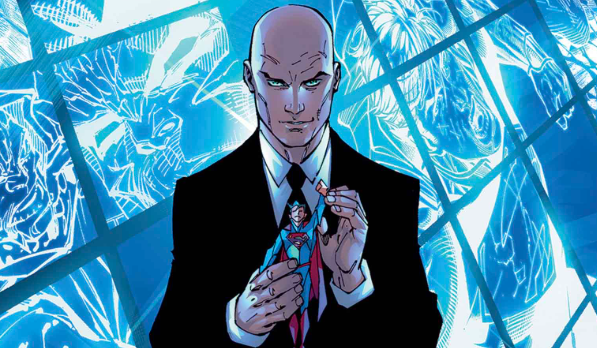
In a world populated by gods who can move planets and speedsters who can outrun time, one man stands as the ultimate testament to the power of the human will—and the darkness of the human ego. Lex Luthor is not just a villain; he is the “Apex Human.” While other antagonists rely on alien physiology or magical artifacts, Luthor’s primary weapons are his staggering intelligence, his bottomless bank account, and an unshakable belief that he is the rightful savior of the human race.
To the public eye in Metropolis, he is the visionary philanthropist and industrialist who built a city of tomorrow. To Superman, he is a sociopathic mastermind who would gladly see the world burn if it meant he could rule the ashes. Understanding Lex Luthor is key to understanding the central conflict of the DC Universe: the struggle between the selfless inspiration of a “Superman” and the selfish ambition of a man who refuses to live in anyone’s shadow.
1. The Self-Made Myth and the Cult of Meritocracy
The core of Lex Luthor’s identity is his status as a “self-made” man. In almost every iteration of his history, Lex did not inherit his billions; he earned them through a combination of ruthless business tactics and unparalleled scientific genius. Often depicted as coming from a troubled or impoverished background—sometimes in the gritty streets of Suicide Slum—Lex viewed his ascent to power as a victory of human intellect over circumstance.
This background fuels his intense hatred for Superman. In Lex’s eyes, Superman is a “cheater.” The Man of Steel didn’t work for his powers; he was born with them under a yellow sun. Lex believes that by existing, Superman devalues human achievement. Why should a human scientist spend decades curing a disease when a god can simply fly in and save the day with a wave of his hand? This perspective allows Lex to cast himself as the hero of his own story—the defender of humanity’s potential against an alien “interloper” who makes mankind weak and dependent.
2. From Mad Scientist to Corporate Titan
The character of Lex Luthor has undergone one of the most significant evolutions in comic book history. In his earliest appearances, he was the prototypical “mad scientist”—a man with a full head of red hair who operated from secret laboratories and dirigibles, plotting to take over the world with ray guns and giant robots. However, as the world moved into an era of corporate dominance, the character was reimagined into something much more grounded and terrifying: the billionaire industrialist.
This shift transformed Lex from a cackling recluse into a public figure. He became the CEO of LexCorp, a multi-billion dollar conglomerate that owns nearly every aspect of Metropolis. This version of Lex is far more dangerous because he hides in plain sight. He uses his wealth to buy influence, manipulate the media, and frame his illegal activities as “research and development.” He doesn’t just want to destroy Superman; he wants to be more popular than him. This corporate persona makes him a critique of unchecked capitalism and the “great man” theory, showing how brilliance without a moral compass can lead to a sophisticated form of tyranny.
3. LexCorp: The Infrastructure of a Shadow Empire
LexCorp is not just a company; it is the physical manifestation of Lex Luthor’s ego. Headquartered in the iconic, L-shaped skyscraper that looms over the Metropolis skyline, LexCorp provides everything from medical supplies and aerospace technology to news media and private security. For the average citizen of Metropolis, LexCorp is the provider of jobs and progress. For the heroes of the Justice League, it is a fortress of secrets.
Luthor uses LexCorp as a legal shield for his vendetta against Superman. Many of his most dangerous inventions—including his combat armor and specialized Kryptonite weapons—are developed under the guise of “national defense” or “space exploration.” The company also serves as a massive intelligence network, allowing Lex to keep tabs on his rivals and potential threats. By controlling the city’s infrastructure, Lex ensures that even if he is arrested, the city’s economy would collapse without him, making him “too big to fail” in the most literal sense possible.
4. The Philosophical Paradox of Humanism
One of the most complex aspects of Lex Luthor is his “pro-human” philosophy. Lex often argues that Superman is a “stunted” evolution for humanity because he prevents people from solving their own problems. He claims that if Superman were to leave, humanity would be forced to innovate and ascend to the stars on its own merits. He views himself as the ultimate champion of human excellence, arguing that a human’s greatest achievement is worth more than a god’s miracle.
However, this philosophy is almost always a mask for his own insecurity. Lex doesn’t actually want humanity to succeed; he wants Lex Luthor to succeed. He has frequently held back technological breakthroughs—such as a cure for cancer or infinite energy sources—simply because he couldn’t find a way to use them to destroy Superman or ensure his own total control. His “humanism” is a thin veil for a massive inferiority complex. He cannot stand that there is something in the universe more powerful than him, and he projects that personal envy onto the rest of the human race.
5. The Fatal Attraction to Green Kryptonite
Lex Luthor’s greatest weapon is also his greatest obsession: Kryptonite. As a master of chemistry and geology, Lex was one of the first to realize that the radioactive remains of the planet Krypton were lethal to Superman. Over the decades, he has spent untold millions acquiring every fragment of the green ore he can find, fashioning it into rings, daggers, and power sources for his machinery.
However, this obsession came with a heavy price. For a long period in his history, Lex wore a ring with a Kryptonite setting as a constant deterrent against Superman. He believed that since the radiation was only lethal to Kryptonians, he was perfectly safe. He was wrong. The long-term exposure to the radiation eventually caused Lex to develop terminal cancer, leading to the loss of his hand and, eventually, a desperate plot to transplant his brain into a younger, cloned body. This arc serves as a perfect metaphor for the character: his hatred for Superman is so toxic that it literally eats him alive from the inside out.
6. Political Ambition and the Presidency
Perhaps the most chilling display of Lex Luthor’s power occurred when he decided to trade his lab coat and armor for a business suit and a campaign trail. Leveraging a period of national crisis and a “tough on crime” platform, Lex Luthor successfully ran for and won the Presidency of the United States. This wasn’t achieved through mind control or cosmic cubes, but through high-level manipulation of the public’s fears and desires.
As President, Luthor was arguably more dangerous than ever. He had the full might of the U.S. military and intelligence agencies at his disposal. He used his position to alienate Superman from the public, branding the Man of Steel as a rogue vigilante who refused to answer to the government. His presidency showed that Lex’s greatest skill is not science, but the ability to read the “pulse” of the people and give them exactly what they want to hear. Even though he was eventually removed from office following a scandal involving a Kryptonite asteroid, the fact that he won remains a haunting reminder of how easily a master manipulator can weaponize democracy.
7. The Apex Predator and the War Suit
While Lex prefers to lead from the boardroom, he is not afraid of physical confrontation. Recognizing that a human body is no match for a Kryptonian, Lex designed a high-tech War Suit. Usually colored in his signature green and purple, this armor is one of the most advanced pieces of technology in the DC Universe. It incorporates stolen alien tech, LexCorp’s best engineering, and a variety of Kryptonite-based weaponry.
The suit allows Lex to fly, grants him superhuman strength, and provides him with energy shields capable of withstanding a direct punch from Superman. More importantly, the suit is a psychological tool. When Lex puts on the armor, he is telling the world that he is an “Apex Predator”—a being who has used his mind to bridge the gap between mortal and god. In recent storylines, this suit has even been modified with Mother Box technology and other cosmic artifacts, allowing Lex to hold his own against threats that would crush entire civilizations.
8. The Smallville Connection: A Shared Past
In many versions of the mythos, the rivalry between Lex and Clark Kent didn’t begin in Metropolis, but in the small town of Smallville. In these iterations, a young Lex Luthor was sent to live in the rural town by his father to oversee a local LexCorp facility. There, he met a young Clark Kent, and the two briefly became close friends. Lex saw in Clark a kindred spirit—someone who felt isolated by their gifts.
The tragedy of their friendship is often tied to the incident that caused Lex’s hair loss. In the Silver Age of comics, a laboratory accident caused by Superboy resulted in Lex losing his hair, which Lex viewed as a betrayal. In more modern takes, the friendship crumbles as Lex’s ambition and paranoia grow, while Clark’s inherent goodness becomes a mirror that Lex cannot bear to look into. This shared history adds a layer of personal tragedy to their feud; they are not just enemies, but former friends who represent two different paths humanity can take when faced with power.
9. Leadership of the Injustice League and Legion of Doom
Lex Luthor is not a team player by nature, but he is a pragmatist. He understands that while he is brilliant, he cannot take on the Justice League alone. This has led him to form and lead various incarnations of the Injustice League and the Legion of Doom. In these groups, Lex acts as the “Chairman of Evil,” providing the funding, the headquarters, and the overarching strategy for the world’s greatest villains.
His leadership style is based on fear and mutual interest. He often recruits “heavy hitters” like Bizarro or Black Manta to do the physical work, while he remains the architect of the grand plan. However, Lex is notorious for his “exit strategies.” He rarely cares about the well-being of his teammates and is always prepared to sacrifice them to ensure his own survival. His role in these organizations proves that he is the undisputed “villain’s villain”—the one person that even the most chaotic monsters in the DC Universe are willing to follow, if only out of respect for his sheer intellect.
10. The Ambiguous Path to Redemption
Perhaps the most surprising fact about Lex Luthor is that he has, on several occasions, tried to be a “hero.” Following the disappearance of Superman during a multiversal crisis, Lex actually took up the mantle of the “S” shield, wearing a new suit of armor and joining the Justice League. He claimed that he wanted to honor the legacy of his fallen rival and prove that he could be the hero the world needed.
During this period, Lex struggled with his own ego. He saved the world multiple times and even worked alongside Batman and Wonder Woman. However, the question always remained: was he doing it for the right reasons, or was he just addicted to the praise? This “Hero Lex” era highlighted the character’s complexity. It suggested that under different circumstances, Lex could have been the world’s greatest savior. Ultimately, his inability to truly let go of his pride and his need for total control usually draws him back to the side of the antagonist, making him one of the most tragic “could-have-beens” in fiction.
Further Reading
If you want to delve into the mind of DC’s greatest mastermind, these books offer the most insightful looks into Lex Luthor’s psyche:
- Lex Luthor: Man of Steel by Brian Azzarello and Lee Bermejo
- Superman: Secret Origin by Geoff Johns and Gary Frank
- All-Star Superman by Grant Morrison and Frank Quitely
- President Luthor: New Gotham by various authors




Leave a Reply