
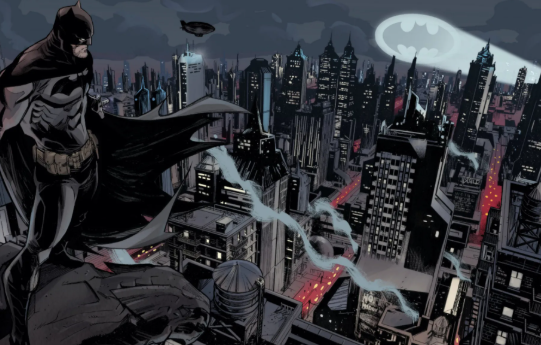
If cities had souls, Gotham’s would be a labyrinth of stained glass, cold iron, and whispered secrets. It is a place where the sun rarely seems to crest the horizon, and when it does, it struggles to pierce a canopy of smog and towering gargoyles. Gotham City is not merely a backdrop for the adventures of the Caped Crusader; it is the heartbeat of the story. It is a living, breathing entity that challenges its inhabitants to either succumb to its darkness or rise above it.
To understand Batman, one must first understand the concrete jungle that forged him. Gotham is a city of impossible contrasts—of staggering wealth and crushing poverty, of brilliant scientific advancement and primitive, superstitious fear. It is the “Character 0” in every Batman tale, providing the atmosphere, the conflict, and the motivation for everything that occurs within its borders. This guide explores the geography, the history, and the haunting identity of the world’s most iconic fictional city.
1. The Living Nightmare: Defining Gotham City
Gotham City is often described as a “noir” hellscape, a metropolis that feels as though it was built by a mad architect with a penchant for Gothic Revival and Art Deco. Located on the Eastern Seaboard, it is a sprawling urban center defined by its jagged skyline and narrow, rain-slicked alleys. Unlike its brighter counterpart, Metropolis, Gotham is a city that feels perpetually stuck in the middle of a cold, autumn night.
What truly defines Gotham is its density. It is a pressure cooker of humanity, where millions of people live stacked on top of one another, separated only by the thin walls of tenements or the reinforced glass of penthouses. The city is divided into various districts—the Narrows, Old Gotham, the Diamond District—each with its own flavor of peril or prestige. Gotham is a place where the environment itself feels hostile; the wind howls through the skyscrapers like a banshee, and the very gargoyles atop the buildings seem to watch the citizens with judgmental eyes. It is a city that demands resilience from anyone brave enough to call it home.
2. Concrete Origins: Real-World Inspirations for the City
While Gotham is fictional, its roots are firmly planted in the reality of the American urban experience. Writers and artists have long cited New York City as the primary blueprint—specifically “New York at night” or “New York in the 1930s.” In fact, the name “Gotham” was a nickname for New York long before Batman ever graced a page. However, Gotham also draws heavy inspiration from the industrial grit of Chicago and the decaying grandeur of cities like Detroit and Newark.
The city serves as a cautionary tale of what happens when urban development outpaces social welfare. It captures the frantic energy of the “Big Apple” but strips away the glamour, leaving behind the soot and the struggle. Architects of the Batman mythos often describe Gotham as “Manhattan below 14th Street at 3:00 AM, in the dead of winter.” By blending the verticality of New York with the midwestern industrial decay of the Rust Belt, creators have crafted a location that feels uncomfortably real, tapping into universal fears about crime, overcrowding, and the loss of the individual within a massive, uncaring machine.
3. The Rot Within: Systemic Crime and Corruption
Gotham’s greatest threat isn’t just a man in a colorful costume; it is the systemic corruption that flows through its veins like a poison. Long before the “freaks” appeared, Gotham was ruled by the “Five Families”—organized crime syndicates like the Falcones and the Maronis. These families controlled the docks, the labor unions, and the distribution of illicit goods, turning the city into a personal playground for the mob.
This crime is not an anomaly; it is part of the city’s foundation. In Gotham, crime is often the only viable economy for those in the lower districts. The corruption extends from the street-level pusher all the way to the judge’s chambers and the mayor’s office. This creates a cycle of hopelessness where the law is a suggestion and justice is a commodity bought by the highest bidder. When the traditional mob was eventually challenged by costumed criminals, the city didn’t get safer; it simply became more chaotic. The transition from “organized” crime to “theatrical” crime reflects a city that has lost its mind, moving from calculated greed to senseless, colorful violence.
4. A Badge in the Dark: The Failure of Law Enforcement
The Gotham City Police Department (GCPD) is historically one of the most ineffective and compromised organizations in fiction. For years, the department was little more than a subsidiary of the mob, with high-ranking officials taking bribes to look the other way. This failure of law enforcement is the primary reason vigilantes exist in Gotham. When the people tasked with protecting you are the ones selling you out, the social contract is broken.
There are, however, “islands of integrity” within the GCPD, most notably Commissioner James Gordon. Gordon represents the “honest cop” struggling against a tide of filth. Even with honest leadership, the GCPD is often outgunned and outmaneuvered by the unique threats the city produces. How can a standard police officer handle a man who uses fear-inducing chemicals or a botanical terrorist who can control the city’s greenery? This inadequacy creates a power vacuum that Batman fills. The relationship between the GCPD and Batman is a delicate dance of necessity; the police need him to do what the law won’t allow, while Batman needs the police to provide a framework of legitimacy for his crusade.
5. The Silent Guardian: Why Gotham Needs Batman
The question is often asked: Does Batman attract the villains, or does Gotham produce them? Regardless of the answer, the city needs Batman because he is the only force capable of bridging the gap between the law and the lawless. Batman is a symbol of accountability in a city that had none. He represents the idea that no matter how rich or powerful you are, there is someone in the shadows who can touch you.
Batman provides Gotham with a psychological anchor. For the criminals, he is the embodiment of the “fear of God.” For the innocent, he is the “Bat-Signal”—a literal light in the dark. In a city where the institutions have failed, Batman acts as a one-man infrastructure. He is the detective the police can’t afford, the scientist the city lacks, and the warrior the people need. He doesn’t just fight crime; he fights the despair of Gotham. By refusing to give up on a city that many have written off as a lost cause, Batman gives the citizens a reason to keep fighting for their own homes.
6. The Revolving Door: Arkham Asylum and Its Role
Located on the outskirts of the city, the Elizabeth Arkham Asylum for the Criminally Insane is perhaps the most famous—and least effective—psychiatric hospital in history. Originally the home of the Arkham family, the mansion was converted into a facility to house Gotham’s most dangerous and mentally unstable offenders. It is a place of gothic horror, filled with padded cells and secret histories that are often as dark as the inmates themselves.
Arkham serves as a microcosm of Gotham’s failures. It is intended to be a place of healing, yet it rarely rehabilitates anyone. Instead, it becomes a “think tank” for madness, where villains like the Joker, the Riddler, and Two-Face wait for their inevitable escape. The facility’s architectural gloom and history of occult rumors suggest that it is more of a prison for the soul than a hospital for the mind. Its presence highlights the unique nature of Gotham’s crime; these aren’t people you can simply put in a regular jail. They require a specific kind of containment that Arkham provides, albeit poorly, standing as a monument to the city’s ongoing struggle with its own sanity.
7. Where the Legend Began: Crime Alley and the Past
Every city has a dark corner, but in Gotham, that corner is Park Row—famously known as “Crime Alley.” This is the site where Thomas and Martha Wayne were murdered in front of their young son, Bruce. This single location is the geographic center of the Batman mythos. What was once a prestigious theater district has since decayed into a slum, mirroring the downward trajectory of the city itself following the death of its most prominent philanthropists.
Crime Alley is a place of pilgrimage for Batman. It represents the “Ground Zero” of his trauma and the birthplace of his mission. The fact that the area has remained a den of crime for decades, despite Bruce Wayne’s best efforts to revitalize it, serves as a sobering reminder of the uphill battle he faces. It is a place where the past and the present collide. In the narrative of Gotham, Crime Alley is the wound that refuses to heal, a permanent scar on the city’s map that dictates the movements of its greatest protector.
8. The Engine of the City: Wayne Enterprises
While the Batman operates in the shadows, Wayne Enterprises dominates the skyline. As one of the world’s largest multinational conglomerates, it is the economic backbone of Gotham. The company is involved in everything from aerospace and biotech to shipping and construction. Under the leadership of Bruce Wayne (and his trusted allies like Lucius Fox), the corporation serves as the “legitimate” side of Batman’s war.
Wayne Enterprises is how Bruce Wayne attempts to “fix” Gotham through systemic change. The Wayne Foundation funds free clinics, orphanages, and schools, attempting to alleviate the poverty that breeds crime. However, the company is also a double-edged sword. Its vast resources are often the target of corporate espionage or hostile takeovers by villains. Furthermore, the high-tech research conducted in its labs often inadvertently provides the “super-science” that villains weaponize. The towers of Wayne Enterprises represent the pinnacle of Gotham’s potential—a shining example of what the city could be if the shadows were finally chased away.
9. A Masterclass in Atmosphere: Gothic Identity
Gotham’s identity is forged in its atmosphere. It is the world’s premier example of “Gothic Noir.” The architecture is designed to make the human inhabitant feel small and insignificant. Buildings are adorned with fierce protectors—gargoyles, griffins, and stone angels—that look more like predators than guardians. The use of heavy stone, wrought iron, and dark woods creates a sense of timelessness; Gotham feels like a city from the 1940s that has been forced to integrate modern technology.
The weather is a key component of this identity. It is almost always raining, snowing, or shrouded in a thick, yellow fog. This constant dampness gives the city a “slick” look, reflecting the neon lights of the Diamond District and the muzzle flashes of Crime Alley. The soundscape is equally important: the distant wail of sirens, the rumble of the elevated train (the “L”), and the flutter of bat wings. This atmosphere isn’t just for show; it dictates the tone of the stories. It creates a world where a man dressed as a bat doesn’t seem ridiculous—he seems like the only thing that makes sense.
10. The Symbiotic Mission: How Gotham Shapes Batman
Ultimately, Batman and Gotham are inseparable. Batman is not a hero who could exist in a vacuum; he is a specific response to a specific environment. The city’s darkness necessitated a dark protector. Its theatrical villains required a theatrical hero. Its complex, layered corruption required a detective who could see through the grime. Gotham is the anvil upon which Batman was hammered into shape.
However, the relationship is reciprocal. Just as the city shaped the man, the man has begun to shape the city. Batman’s presence has forced Gotham to choose what kind of future it wants. The “escalation” caused by his arrival has brought the city’s hidden rot to the surface, making it impossible to ignore. Every night that Batman patrols the rooftops, he is making a statement: This city is worth saving. His mission is a perpetual labor of Sisyphus—pushing the boulder of justice up a hill of corruption—but in doing so, he gives the city a soul. Gotham is a dark world, yes, but as long as the Bat-Signal shines, it is a world that still has a chance.
Further Reading
- Batman: No Man’s Land by Various Authors
- Batman: The Long Halloween by Jeph Loeb and Tim Sale
- Gotham Central by Ed Brubaker and Greg Rucka
- Batman: Gates of Gotham by Scott Snyder and Kyle Higgins
- Batman: Year One by Frank Miller and David Mazzucchelli




5 responses to “Beyond the Shadows: A Deep Dive into Gotham City—The World’s Most Dangerous Metropolis”
[…] the rain-slicked theater of Gotham City, two figures stand at the center of a perpetual storm. One is a creature of the night, draped in […]
[…] the world sees a thief, the residents of Gotham’s East End see a guardian. One of the most significant aspects of Catwoman’s character is her localized […]
[…] Beyond the Shadows: A Deep Dive into Gotham City—The World’s Most Dangerous Metropolis […]
[…] the neon-lit rain of Gotham City, where shadows stretch long and secrets are buried deep, one sound strikes more terror into the […]
[…] the fog-drenched streets of Gotham City, the shadows don’t just hide secrets—they hide monsters. While every superhero has a list of […]