
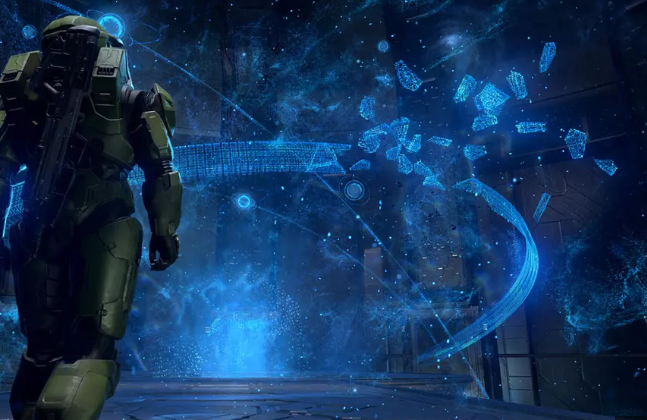
Stepping into the world of Halo for the first time can feel like walking into the middle of a galactic opera that has been playing for billions of years. To the casual observer, it is a game about a green-armored super-soldier shooting purple aliens. But beneath the surface of the visor lies one of the most complex, expansive, and emotionally resonant science fiction mythologies ever conceived. It is a story that spans eons, involving ancient gods, parasitic nightmares, and a desperate struggle for the survival of life itself.
Think of the Halo universe as a massive, cosmic clock. Every gear, from the smallest human colony to the largest artificial ringworld, is interconnected by a history of sacrifice and destiny. Understanding this lore isn’t just about memorizing names and dates; it’s about grasping the “why” behind the war. Why do the rings exist? Why is humanity special? And what exactly is the “Great Journey”? This guide breaks down the massive scale of the Halo mythos into digestible, simple pillars, providing a “go-to” resource for anyone ready to explore the stars.
1. The Precursors and the Mantle of Responsibility
Before the stars were young, there were the Precursors. These weren’t just aliens; they were trans-dimensional architects who traveled between galaxies, shaping life and reality itself. They lived by a philosophy known as the Mantle of Responsibility, a belief that the most advanced race in the galaxy must protect and nurture all life. In their eyes, the Mantle was a sacred duty, a burden passed from one supreme race to the next. They were the original “gardeners” of the universe, and their legacy is the foundation upon which every other conflict in the Halo saga is built.
However, the Precursors weren’t just benevolent creators; they were also judges. When they decided that their chosen successors, the Forerunners, were unworthy of the Mantle, they planned to pass it to a rising race called humanity. This led to a cosmic tragedy: the Forerunners, consumed by jealousy and a sense of entitlement, rose up and wiped out their creators. But you cannot kill a god so easily. The dust of the destroyed Precursors eventually mutated and corrupted, transforming into the parasitic nightmare we now know as the Flood. Thus, the greatest threat to the galaxy was born from the wreckage of its creators.
2. The Forerunner-Flood War: A Galaxy in Flames
Millions of years ago, the Forerunners stood at the absolute peak of technological perfection. They built artificial planets, manipulated the fabric of space-time, and lived in a golden age of peace. This peace was shattered when the Flood returned from the void. Unlike a typical army, the Flood was a “cosmic wildfire”—a hive-mind parasite that didn’t just kill its enemies, but assimilated their knowledge, their memories, and their very souls. As the Flood grew, it consumed entire solar systems, turning the Forerunners’ own wisdom against them.
The war lasted for centuries, and it was a slow, agonizing defeat for the Forerunners. They realized that conventional weapons were useless against a foe that grew stronger with every casualty. This desperation led to a divide in Forerunner society: some wanted to build the Promethean knights to fight the infection, while others looked for a more “final” solution. Eventually, the Forerunners came to a harrowing conclusion: to save life in the long run, they had to destroy it in the short term. This realization led to the creation of the most terrifying weapons in existence: the Halo Array.
3. The Design and Purpose of the Halo Array
The Halo rings are the most iconic structures in science fiction, but their purpose is often misunderstood. A Halo ring is not a traditional weapon that “shoots” the Flood. Instead, think of it as a massive, galactic-scale reset button. The Flood requires sentient life (hosts with a specific neural capacity) to survive and evolve. The Halos were designed to fire a burst of cross-phase super-massive neutrinos that target the nervous systems of all sentient life across the entire galaxy.
By activating the rings, the Forerunners weren’t killing the Flood directly; they were “starving the fire” by removing all of its fuel. It was an act of ultimate sacrifice. The Forerunners knew that by firing the rings, they would also be committing suicide. The seven rings in the array were positioned strategically so that their pulse would overlap, ensuring that not a single sentient being would be left behind. It is a haunting irony that the galaxy’s most beautiful structures are also its most efficient graveyards, built by a race that loved life so much they felt compelled to end it.
4. The Great Re-seeding and the Forerunner Extinction
Firing the Halos was only the first half of the plan. Before the pulse was sent, the Forerunners tasked an AI known as the Librarian with a mission called the “Conservation Measure.” She traveled across the galaxy, collecting DNA samples and live specimens of every sentient race—including ancient humans—and stored them safely on a massive, extra-galactic forge known as The Ark. This facility was located outside the range of the Halo pulse, serving as a biological lifeboat for the future of the universe.
Once the rings were fired and the galaxy was silenced, the automatons left on the Ark began the process of “re-seeding.” They returned the stored species to their original home planets, allowing life to start over from scratch. The Forerunners, however, chose not to return. They believed that their failure to uphold the Mantle and their creation of the Halos meant they had no place in the new world. They disappeared into the shadows of history, leaving behind only their technology and a directive that humanity—the “Reclaimers”—would one day inherit their legacy.
5. The Rise of the Covenant and the “Great Journey”
Thousands of years after life began anew, a collective of alien races known as the Covenant discovered the ruins of Forerunner technology. Led by a trio of High Prophets, the Covenant misinterpreted the purpose of the Halo rings. They didn’t see them as weapons of mass destruction; they saw them as “divine wind” that would propel all who followed the Prophets’ faith into a state of godhood. They called this religious ascension the Great Journey.
The Covenant was a complex hierarchy built on religious zealotry. The San’Shyuum (Prophets) provided the spiritual leadership, while the Sangheili (Elites) served as the military backbone. Other races, like the Jackals, Grunts, and Brutes, were absorbed into the fold through force or the promise of salvation. For centuries, the Covenant searched the galaxy for the “Holy Rings,” unaware that finding them would lead to their total annihilation. Their entire civilization was built on a lie, and the discovery of humanity—a race that could interact with Forerunner tech in ways they couldn’t—threatened to expose the truth.
6. Humanity and the UNSC: Expansion and Insurrection
While the Covenant was growing in the shadows, humanity was reaching for the stars in its own way. Under the banner of the United Nations Space Command (UNSC), humans colonized hundreds of worlds across the Orion Arm of the Milky Way. This expansion wasn’t always peaceful; as colonies grew further from Earth, tensions rose, leading to a period of civil unrest known as the Insurrection. Many “Outer Colonies” felt neglected by the central government, sparking a series of brutal rebellions and terrorist attacks.
The UNSC was a military machine designed to keep order. To combat the Insurrection, they authorized shadowy programs to create a more efficient type of soldier. This was the era of the “Titan,” where humanity used its limited resources to fortify its borders. At this point in history, humans had no idea that aliens existed. They were too busy fighting themselves to notice that a much larger threat was observing them from the dark. This internal conflict is what paved the way for the creation of the Spartan programs, originally intended to fight human rebels, but ultimately destined to save the species from extinction.
7. The Spartan-II Program: Humanity’s Last Hope
When the Covenant eventually declared war on humanity, the UNSC was hopelessly outmatched. Human ships were smaller, their weapons were primitive compared to plasma technology, and their losses were catastrophic. The only thing that stood a chance against the alien tide was the SPARTAN-II program, led by the brilliant and controversial Dr. Catherine Halsey. She believed that humanity needed a new breed of warrior—one that was faster, stronger, and more tactically brilliant than any baseline human.
The Spartans were children drafted into a life of intense military training and biological augmentation. They were outfitted with Mjolnir Powered Assault Armor, a suit that turned them into “walking tanks.” The most famous of these was John-117, the Master Chief. The Spartans became the legends of the war; while the regular marines were the heart of the UNSC, the Spartans were its fist. They performed the impossible, turning the tide of ground battles even when the space above them was lost. They were the only thing the Covenant truly feared, earning them the nickname “Demons.”
8. The Human-Covenant War: A Struggle for Survival
The war between humanity and the Covenant was not a war of territory; it was a war of genocide. The Covenant believed that humans were “vermin” who desecrated the artifacts of their gods. For nearly thirty years, the Covenant systematically moved from one human world to the next, “glassing” them—using plasma bombardment to turn the surface of planets into scorched glass. Humanity was losing, planet by planet, until the fallback to the inner colonies became a desperate final stand.
The conflict reached its peak during the Fall of Reach, humanity’s greatest military stronghold outside of Earth. When Reach fell, it seemed like the end was near. However, a single ship, the Pillar of Autumn, escaped the carnage and made a blind jump into slipspace, stumbling upon the first Halo ring (Installation 04). This discovery changed the nature of the war. It forced the Covenant and humanity into a three-way struggle involving the dormant Flood and the ring’s AI caretaker, setting the stage for the collapse of the Covenant empire and the revelation of humanity’s true destiny as Reclaimers.
9. The Parasitic Threat: Understanding the Flood Hive Mind
The Flood is often mistaken for space-faring zombies, but they are far more dangerous. They are a single, unified consciousness. When the Flood consumes enough biomass, it creates a Gravemind—a massive, sentient brain that coordinates the entire infection. The Gravemind is not just smart; it possesses the collective memories of everyone it has ever consumed. It can speak, it can philosophize, and it can strategize with a level of cruelty that is difficult to fathom.
The Flood’s goal is “total peace” through the elimination of free will. If every living thing is part of the Flood, there can be no war, no hunger, and no pain. It is a perversion of the Mantle of Responsibility. The Flood is the ultimate test for any civilization; it challenges not just their military strength, but their moral fiber. To defeat the Flood, one must be willing to sacrifice everything, because the parasite only needs a single “spore” to start the cycle of infection all over again. It is the shadow that hangs over every story in the Halo universe, a reminder that the galaxy is a very fragile place.
10. The Reclaimer Saga and the Legacy of the Forerunners
In the aftermath of the Great War, the Halo universe entered a new era. The Covenant was shattered, with many Elites forming an alliance with humanity, while others clung to the old ways. Humanity, now wielding Forerunner-influenced technology, began to take its place as the dominant power in the galaxy. However, being a Reclaimer is not just a title; it is a burden. The Forerunners left behind many secrets, including “Shield Worlds” and ancient AIs that aren’t necessarily happy to see their creators’ chosen successors.
The modern lore focuses on the “Return of the Forerunners” and the rise of new threats like the Banished—a mercenary splinter group that defies both the Covenant and the UNSC. Master Chief continues to be the central figure in this saga, navigating a universe where the lines between friend and foe are increasingly blurred. The story of Halo is ultimately a cycle: a story about how we deal with the ghosts of the past and whether we are strong enough to inherit a legacy built on the ruins of gods. It is a universe that is constantly expanding, proving that while the war might change, the fight for the Mantle never truly ends.
Further Reading
- Halo: The Fall of Reach by Eric Nylund
- Halo: Cryptum (The Forerunner Saga) by Greg Bear
- Halo: The Flood by William C. Dietz
- Halo: Mythos: A Guide to the Story of Halo by various contributors
- 10 Things You Should Know About the Covenant – Halo Lore
- 10 Things You Should Know About Red vs Blue – Halo
- 10 Things You Should Know About The Halo TV Show (2022)
- 10 Things You Should Know About Master Chief John-117 Halo Lore
- The Halo Universe Explained in Simple Terms – Halo Lore



