
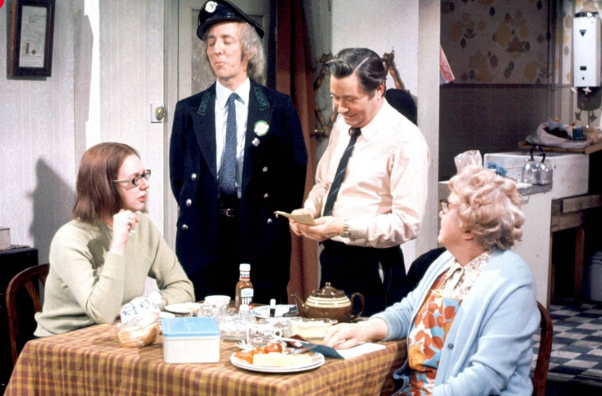
Mind the Doors: 10 Untold Truths and Hilarious Secrets of the British Classic On the Buses
The roar of a Bristol Lodekka engine, the sharp whistle of a conductor’s signal, and the immortal, exasperated cry of “I ‘ate you, Butler!” define a very specific, golden era of British television. On the Buses is not merely a sitcom; it is a cultural artifact of the working-class British experience. First broadcast in 1969, the show centers on the escapades of Stan Butler, a bus driver for the Luxton and District Traction Company, and his lecherous conductor pal, Jack Harper. Together, they navigate the trials of the depot, the overbearing authority of Inspector “Blakey” Blake, and the domestic chaos of Stan’s multi-generational family home.
While high-brow critics of the time often dismissed the show as “bawdy” or “low-rent,” the public disagreed with staggering fervor. At its peak, the show commanded audiences of over 15 million viewers—a feat that modern streaming services can only dream of. The success was built on a foundation of relatable, if exaggerated, archetypes: the bumbling bachelor, the strict boss, the nagging mother, and the “ugly duckling” sister. It captured the cheekiness of the “Carry On” era but transplanted it into the everyday grind of the public transport system.
To truly understand the phenomenon of On the Buses, one has to look beneath the grease and the oil. The production was a whirlwind of unlikely success stories, surprising casting choices, and a level of popularity that briefly made its stars the biggest celebrities in the United Kingdom. From the technical challenges of filming on a moving double-decker to the bizarre real-life records held by its lead actor, the history of the show is as winding as a Luxton bus route. Here are ten secrets from behind the depot doors.
1. Reg Varney: The 50-Year-Old “Youthful” Bachelor
One of the most surprising aspects of the show’s casting was the actual age of its lead star, Reg Varney. On screen, Stan Butler is portrayed as a young-at-heart, somewhat immature bachelor living at home with his mother and sister, desperately trying to save money for his own place while chasing “clippies” (female conductors). Given the character’s energy and his role as the “boy” of the house, audiences generally assumed Stan was in his late 20s or early 30s.
In reality, Reg Varney was 53 years old when the first episode aired. This meant there was a significantly small age gap between him and Doris Hare, the actress who played his mother (who was only 11 years older than him). Varney’s background in music halls and his naturally youthful, energetic face allowed him to pull off the deception flawlessly. His ability to perform physical comedy, including leaping onto moving buses and engaging in slapstick with Jack, masked the fact that he was technically old enough to be a grandfather. This casting choice is a testament to Varney’s charisma; he managed to embody the “lad” persona so convincingly that the age gap never became a distraction for the millions of viewers tuning in weekly.
2. The ATM Connection: A Global First for Reg Varney
While Reg Varney will always be remembered as Stan Butler, he holds a place in world history that has nothing to do with the Luxton and District Traction Company. In a bizarre twist of fate, the man who played Britain’s most famous bus driver was the first person in the world to use a robotic cash machine (ATM). On June 27, 1967, at a Barclays Bank branch in Enfield, Varney was chosen to perform the inaugural transaction to generate publicity for the new technology.
The bank chose Varney because he was a household name and a “man of the people,” symbolizing that this new-fangled technology was for everyone, not just the elite. At the time, the machine worked using special paper vouchers rather than plastic cards. This piece of trivia often shocks fans; while Stan Butler was constantly complaining about being broke and asking his Mum for “ten bob,” the actor himself was the face of the future of global banking. It remains one of the most successful celebrity endorsements in history, as Varney’s relatable image helped demystify a technology that many people were initially suspicious of.
3. Beating James Bond at the Box Office
It is a common misconception that On the Buses was “just” a TV show. In the early 1970s, the franchise transitioned to the big screen with three feature films: On the Buses, Mutiny on the Buses, and Holiday on the Buses. While television spin-offs were common, no one predicted the sheer scale of their success. The first film, released in 1971, was a gargantuan hit, becoming the highest-grossing film in the British box office for that year.
To put this in perspective, the humble bus crew managed to out-earn the suave superspy James Bond. The film On the Buses actually beat the Sean Connery-led Bond film Diamonds Are Forever in total UK ticket sales. It was a stunning victory for working-class comedy over high-budget glamour. The films took the bawdy humor of the show and dialed it up, utilizing larger locations and more elaborate stunts. The fact that a sitcom about a drafty bus depot could outperform a global action franchise is a powerful reminder of how deeply the British public identified with Stan, Jack, and the gang during that era.
4. The “Olive” Transformation of Anna Karen
The character of Olive Rudge—Stan’s sister—is one of the most recognizable figures in British comedy. Portrayed as “homely,” dowdy, and constantly the butt of jokes regarding her appearance and her failing marriage to the lazy Arthur, Olive was the show’s ultimate underdog. However, the actress behind the glasses and the messy hair, Anna Karen, was the complete opposite of her character. In real life, Karen was a stunning former model and dancer who had to undergo a radical transformation for the role.
The makeup department worked hard to hide Karen’s natural beauty, using heavy-rimmed glasses, flat hairstyles, and unflattering padding. Karen’s performance was so convincing that many fans were genuinely startled when they saw her in person or in other roles. Interestingly, she was close friends with Carry On star Barbara Windsor, and her comedic timing was sharp enough to make Olive more than just a caricature. She brought a pathos to the role that made the audience root for her, even while laughing at her domestic misfortunes. Her ability to completely vanish into such a “un-glamorous” role is often cited as one of the best examples of character acting in sitcom history.
5. The Real-Life Inspiration for Inspector “Blakey” Blake
Stephen Lewis, who played the terrifying, moustache-twitching Inspector Cyril “Blakey” Blake, created one of the most iconic “villains” in TV history. With his rigid posture and his catchphrase “I ‘ate you, Butler!”, Blakey was the personification of petty bureaucracy. Stephen Lewis didn’t have to look far for inspiration; he based the character’s mannerisms and distinct look on his own experiences with trade union officials and minor authority figures he had encountered in his youth.
The famous “hitleresque” moustache and the sharp, staccato way of speaking were deliberate choices to make Blakey seem like a man who took his very small amount of power far too seriously. Despite being the antagonist, Blakey became so popular that he eventually starred in his own spin-off series, Don’t Drink the Water, which followed the character into retirement in Spain. Lewis’s portrayal was so effective that real-life bus inspectors across the UK reported being teased with his catchphrases for years. The brilliance of the character was that while he was a foil to Stan and Jack’s laziness, he was also a tragic figure—a man whose life revolved entirely around the bus timetable.
6. The “Mum” Dilemma: Why the First Mother Disappeared
When On the Buses first filmed its pilot episode and the very beginning of the first series, the role of Stan’s mother was played by a different actress. The legendary Cicely Courtneidge, a star of the musical hall and theater, was the original “Mum.” Courtneidge was a formidable performer, but her interpretation of the character was seen as a bit too “grand” for the gritty, working-class setting of the Butler household. She played the mother with a certain theatrical flair that didn’t quite mesh with the “kitchen sink” realism the writers wanted.
After the first few episodes, the role was taken over by Doris Hare, and the show found its true rhythm. Hare brought a more “homely,” fussing, and grounded energy to the role, perfectly capturing the matriarch who was both the glue holding the family together and the source of constant nagged-at frustration for Stan. Doris Hare became the definitive Mum, and her chemistry with Reg Varney and Michael Robbins (Arthur) was a cornerstone of the show’s success. The switch is a classic piece of TV trivia, as the early episodes featuring Courtneidge are rarely seen in standard repeat cycles.
7. The Tragedy of Bob Grant (Jack Harper)
On screen, Bob Grant played Jack Harper, the cheeky, girl-chasing conductor with a permanent grin and a mischievous glint in his eye. Jack was the ultimate “partner in crime,” always ready with a scheme to avoid work or chat up the female staff. However, the life of the actor behind Jack was unfortunately marred by a long and difficult struggle with depression and the pitfalls of being “typecast” by such a famous role.
After On the Buses ended, Bob Grant found it incredibly difficult to secure serious acting work. He was so associated with the randy conductor Jack Harper that producers struggled to see him as anyone else. This led to a period of professional decline and personal despair. Despite the joy he brought to millions, Grant’s later years were marked by several disappearances and tragic mental health battles. His story is a poignant reminder of the “tears of a clown” trope, where those who provide the most laughter often struggle with the quietest pains. Fans today remember him for the incredible warmth and comedic energy he brought to the screen, which remains his enduring legacy.
8. The “Lotsa Luck” American Remake
The popularity of On the Buses wasn’t confined to the British Isles. The concept was so strong that it crossed the Atlantic, resulting in an American remake titled Lotsa Luck. This version, which aired in the mid-1970s, starred the famous comedic actor Dom DeLuise as Stanley Belmont (the Stan Butler equivalent). The setting was shifted from a bus depot to a lost-and-found department at a bus station in New York, but the core dynamics remained the same: a frustrated bachelor living with his mother, sister, and lazy brother-in-law.
While Lotsa Luck only lasted for one season, it is a fascinating example of how the “Butler family” dynamic was seen as a universal comedic template. The show struggled to capture the specific “British-ness” of the original—the rainy bus stops, the specific class tensions, and the “naughty postcard” humor—but it maintained a cult following. The existence of the American version proves that the frustrations of a man trapped between a demanding job and a chaotic home life are themes that resonate across any border.
9. The Bus Depot was a Real Working Location
To give the show its authentic feel, the production didn’t rely solely on studio sets. While the interior of the Butler house was a set at London Weekend Television, the “Luxton and District” bus depot was filmed at a real, functioning bus garage. Most of the exterior depot scenes were filmed at the Wood Green bus garage in North London, and later at the Eastern National bus garage in Basildon, Essex.
Filming in a real garage presented unique challenges. The actors had to work around the schedules of actual buses and real-life drivers. In many shots, you can see genuine Luxton-area buses (actually Eastern National vehicles) pulling in and out of the bays. This “location” feel helped ground the slapstick in reality. When Stan and Jack were seen cleaning the buses or arguing with Blakey on the forecourt, they were standing on real grease-stained concrete. This commitment to location filming was relatively rare for sitcoms of that era and contributed significantly to the “working-class” atmosphere that fans loved.
10. The Scientific Success of the Catchphrases
The success of On the Buses can be analyzed through the sheer density of its catchphrases. In the world of comedy writing, a catchphrase is a “hook” that provides the audience with a sense of familiarity and belonging. On the Buses mastered this better than almost any other show of its time. Phrases like “I ‘ate you, Butler!”, “Get that bus out!”, and “Ooh, you are a one, Stan!” became part of the national lexicon.
Psychologically, these catchphrases acted as “comedic anchors.” Whenever Blakey would appear and start twitching his moustache, the audience was already primed to laugh because they knew the inevitable “I ‘ate you, Butler!” was coming. It created a rhythmic, almost musical quality to the scripts. While some critics called it repetitive, the repetition was the point; it turned the show into a shared ritual for families. The show’s ability to create lasting linguistic trends is one of the reasons it remains an “evergreen” favorite in repeats; even decades later, the mere mention of a “bus out” triggers a nostalgic response in the viewer.
Further Reading
- On the Buses: The Complete Story by Craig Walker
- The On the Buses Encyclopedia by Kevin Snelgrove
- I ‘Ate You, Butler! The Reg Varney Story by Reg Varney (Autobiography)
- Classic British Sitcoms by various authors (BBC Publications)
- 10 Things You Should Know About Foghorn Leghorn – Looney Tunes
- 10 Futurama TV SHOW Facts That Still Hold Up
- 10 Things You Should Know About Speedy Gonzales – Looney Tunes
- 10 Things You Should Know About Yosemite Sam – Looney Tunes
- 10 Things You Should Know About The Looney Tunes
- 10 Things You Should Know About Road Runner – Looney Tunes
- 10 Things You Should Know About Wile E. Coyote – Looney Tunes
- 10 Things You Should Know About Tweety Pie – Looney Tunes
- 10 Things You Should Know About Sylvester The Cat – Looney Tunes
- 10 Things You Should Know About Porky Pig – Looney Tunes



