
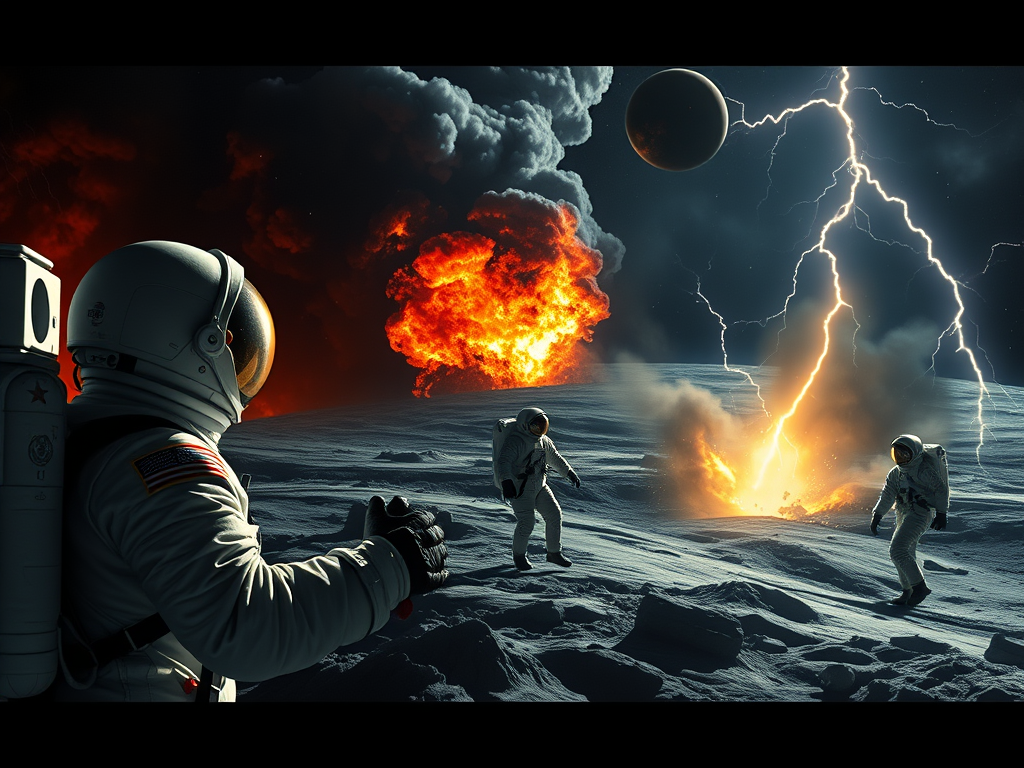
The journey to the Moon was never a routine flight; it was a series of controlled explosions pushed to the absolute limit of human engineering. While we often remember the Apollo program through the lens of triumph and grainy footage of astronauts leaping in low gravity, the reality was a high-wire act performed over a vacuum. Between 1961 and 1972, NASA pushed the boundaries of what was survivable, often coming within seconds—or inches—of total catastrophe.
The Apollo missions were characterized by a philosophy of “redundancy,” but even the best backups can fail when faced with the unforgiving environment of deep space. From electrical fires in pure oxygen environments to lightning strikes during liftoff, the men of the Apollo era were essentially test pilots in a laboratory that spanned 238,000 miles. Understanding these moments isn’t just about revisiting space history; it’s about appreciating the razor-thin margin between becoming a pioneer and becoming a permanent resident of the cosmos. Here are the top 10 most dangerous moments when the Apollo program almost ended in tragedy.
1. The Apollo 1 Fire: A Tragic Lesson in Engineering
The most dangerous moment in the program occurred before a single Saturn V ever left the pad. On January 27, 1967, during a routine “plugs-out” test, a spark ignited in the pure oxygen atmosphere of the Apollo 1 Command Module. Within seconds, the interior became a furnace. Astronauts Gus Grissom, Ed White, and Roger Chaffee were trapped inside because the complex, multi-part hatch was designed to stay sealed under pressure and took at least 90 seconds to open.
This disaster was a “perfect storm” of poor design choices. The cabin was filled with flammable Velcro and nylon, and the high-pressure oxygen environment turned a tiny electrical short into a blowtorch. It was a sobering reminder that NASA safety protocols needed a total overhaul. The fire resulted in a complete redesign of the spacecraft, including a new quick-release hatch and a mixed-gas atmosphere on the ground. While it was a heartbreaking loss, many historians argue that without the lessons learned from the Apollo 1 disaster, a later mission would likely have suffered a fatal failure in deep space where no rescue was possible.
2. The Apollo 13 Oxygen Tank Explosion: “Houston, We’ve Had a Problem”
Perhaps the most famous crisis in space exploration, the Apollo 13 mission transformed from a lunar landing into a desperate survival story on April 13, 1970. While the crew was 200,000 miles from Earth, an oxygen tank in the Service Module exploded after a routine fan “stir.” The explosion crippled the Command Module, Odyssey, stripping it of power, water, and oxygen.
The crew—Jim Lovell, Jack Swigert, and Fred Haise—had to use the Lunar Module Aquarius as a “lifeboat.” This was an improvisation of the highest order; the lander was designed to support two people for two days, not three people for four days. The danger was multi-faceted: they faced freezing temperatures, a build-up of toxic carbon dioxide, and the terrifying uncertainty of whether their heat shield had been cracked by the explosion. The world watched as engineers on the ground used “cardboard, plastic bags, and duct tape” to build a CO2 filter. The Apollo 13 survival remains the ultimate example of human ingenuity under the most extreme pressure imaginable.
3. The Apollo 12 Lightning Strike: A Bolt from the Blue
On November 14, 1969, just 36 seconds after the launch of Apollo 12, the massive Saturn V rocket became the world’s tallest lightning rod. A bolt of lightning traveled down the ionized exhaust plume and struck the rocket, followed by a second strike 16 seconds later. Inside the cockpit, Pete Conrad, Richard Gordon, and Alan Bean saw their instrument panels light up like a Christmas tree before the entire electrical system went offline.
The mission was seconds away from a mandatory abort, which would have seen the Command Module ripped away from the rocket during the most violent phase of flight. However, a young flight controller in Houston named John Aaron remembered a similar pattern from a test years prior. He made the legendary call: “Try SCE to Aux.” Most people, including the Flight Director, had no idea what that meant, but Alan Bean found the obscure switch. Flipping it restored the telemetry, allowing the crew to reset the fuel cells and continue the mission. It was a high-stakes gamble that saved the Apollo 12 mission from a premature and potentially disastrous end.
4. The Apollo 11 “1202” Alarms: The Digital Brink
As Neil Armstrong and Buzz Aldrin were descending toward the lunar surface in the Lunar Module Eagle, their guidance computer began to fail. It wasn’t a mechanical break, but a “buffer overflow.” The computer was being overwhelmed by data from the rendezvous radar (which was left on by mistake) and couldn’t process the landing data fast enough. It triggered a “1202” alarm, followed by a “1201” alarm—codes the astronauts had never seen in training.
In the cockpit of a descending spacecraft, an unknown alarm is usually a signal to abort. If the computer crashed, they would lose control of the descent and likely crash into the Moon. However, in Mission Control, Steve Bales—guided by 24-year-old Jack Garman—realized the computer was simply rebooting and prioritizing the most critical tasks. They gave the “Go” to continue. This moment represents the terrifying intersection of Apollo 11 technology and human intuition, where a single “stop” command from Earth would have ended the dream of the first moonwalk.
5. Apollo 11 Fuel Depletion: Flying on Fumes
Immediately following the computer alarms, the Apollo 11 crew faced a physical crisis: they were running out of gas. Because they had overshot their landing site due to the computer issues, Armstrong had to manually fly the Lunar Module over a field of boulders. He hovered the spacecraft like a helicopter, searching for a clear patch of dirt while the fuel gauges dropped toward zero.
The tension in Mission Control was palpable. The “Low Fuel” light came on, indicating they had only 60 seconds of “usable” fuel left. If they didn’t touch down within that window, they would have to initiate an emergency abort—blasting the top half of the lander away from the bottom—or risk falling the final 50 feet to the surface. When Armstrong finally called out “Contact light,” NASA estimates suggest he had roughly 25 seconds of fuel remaining. This Moon landing fuel crisis is a testament to Armstrong’s nerves of steel, as he chose to ignore the ticking clock to ensure the safety of the landing gear.
6. The Apollo 10 “Wild Ride”: A Loss of Control in Lunar Orbit
Apollo 10 was the “dress rehearsal” for the landing, where Tom Stafford and Gene Cernan took the Lunar Module “Snoopy” down to within 50,000 feet of the lunar surface. However, just as they were preparing to jettison the descent stage and head back to the Command Module, the spacecraft began to spin violently. Cernan was heard shouting “Son of a bitch!” over the open radio as the Moon and stars whipped past the windows.
The cause was a simple human error: a switch for the abort guidance system had been left in the wrong position, causing the computer to fight against the astronauts’ manual inputs. For about 15 seconds, the Lunar Module was in a “death spiral.” If they hadn’t regained control, the spacecraft would have exceeded its structural limits or crashed into the lunar mountains. This Apollo 10 anomaly remains one of the most hair-raising moments of the program, proving that even a rehearsal can turn deadly in the blink of an eye.
7. Apollo 14’s “Ghost” Abort Signal: The Solder Ball Scare
Before Alan Shepard could become the fifth man to walk on the Moon, his mission almost ended before the descent began. While in lunar orbit, the Apollo 14 crew noticed that the computer was receiving a “dead-man” abort signal. If they started the engine to land, the computer would think an emergency had occurred and immediately blast them back into orbit.
The culprit was a tiny, microscopic ball of solder that had broken loose inside the switch and was rattling around, creating a “short” that mimicked an abort command. To fix it, NASA programmers had to rewrite the spacecraft’s landing software in real-time. They dictated a long string of code to the astronauts, who had to manually type it into the computer to tell it to ignore the abort switch during the burn. It was a masterclass in NASA problem solving, bypassing a mechanical failure with digital creativity just hours before the landing was scheduled.
8. Apollo 16’s Gimbals: The Near-Abort at the Moon
In April 1972, Ken Mattingly, John Young, and Charlie Duke arrived at the Moon, but a technical glitch in the Command Module’s engine almost sent them straight home. After the Lunar Module separated, Mattingly noticed a violent vibration in the backup steering system for the main engine. According to mission rules, if the backup steering was broken, the landing had to be aborted immediately.
For six hours, the crew orbited the Moon in separate ships, waiting for Earth to decide their fate. If the engine failed during the burn to get home, they would be stranded in lunar orbit forever. After exhaustive testing in simulators on Earth, engineers decided the vibration was manageable. They gave the “Go,” but the delay meant the Apollo 16 mission had to be shortened. This moment highlights the “go/no-go” pressure that defined every second of these missions, where a single vibrating motor could cancel a billion-dollar expedition.
9. Apollo 15’s Parachute Failure: A Hard Landing
The danger didn’t end once the astronauts left the Moon. During the return of Apollo 15 in 1971, the crew experienced a terrifying malfunction during the final two miles of their descent. One of the three massive orange-and-white parachutes failed to inflate properly and collapsed.
The Command Module was designed to land on two chutes in an emergency, but the descent speed increased significantly. The astronauts watched through the windows as the ocean rushed up toward them much faster than planned. The impact was significantly harder than usual, jarring the crew and potentially risking the structural integrity of the capsule. Fortunately, the “Endeavour” stayed upright and didn’t take on water, but it was a chilling reminder that the splashdown recovery was just as risky as the launch.
10. The Apollo-Soyuz Gas Leak: The Last Near-Fatal Breath
Technically the final flight of the Apollo hardware, the Apollo-Soyuz Test Project in 1975 nearly ended in the deaths of the three American astronauts during splashdown. Due to a checklist error, the “RCS” (Reaction Control System) was left on during the final descent. As the capsule vented air to equalize pressure, it sucked in highly toxic nitrogen tetroxide fumes from the thrusters.
The cabin filled with yellow, acrid smoke. Astronaut Vance Brand lost consciousness, and the crew struggled to put on their oxygen masks while gasping for air. They survived, but were hospitalized for two weeks with chemical-induced pneumonia. It was a final, ironic twist in NASA’s history: after surviving the Moon and the vacuum of space, the program’s last crew was nearly killed by their own spacecraft just minutes before being rescued by the Navy.
Further Reading
- Apollo: The Race to the Moon by Charles Murray and Catherine Bly Cox – A phenomenal look at the engineers and mission controllers who managed these crises from the ground.
- Failure Is Not an Option by Gene Kranz – The memoir of the legendary Flight Director who led Mission Control through the Apollo 13 and Apollo 11 scares.
- Lost Moon (later titled Apollo 13) by Jim Lovell and Jeffrey Kluger – The definitive first-hand account of the most famous survival story in space history.
- Thirteen: The Incredible Flight of Apollo 13 by Henry S.F. Cooper Jr. – A concise and gripping journalistic account of the rescue mission that remains a classic.
Keep the Discovery Going!
Here at Zentara, our mission is to take tricky subjects and unlock them, making knowledge exciting and easy to grasp. But the adventure doesn’t stop at the bottom of this page. We are constantly creating new ways for you to learn, watch, and listen every single day.
Watch & Learn on YouTube
Visual learner? We publish 4 new videos every day, plus breaking news shorts to keep you smarter than the headlines. From deep dives to quick facts, our channel is your daily visual dose of wonder.
Click here to Subscribe to Zentara on YouTube
Listen on the Go on Spotify
Prefer to learn while you move? Tune into the Zentara Podcast! We drop a new episode daily, perfect for your commute, workout, or coffee break. Pop on your headphones and fill your day with fascinating facts.
Click here to Listen on Spotify
Every click, view, and listen helps us keep bringing honest knowledge to everyone. Thanks for exploring with us today—see you out there in the world of discovery!




Leave a Reply