
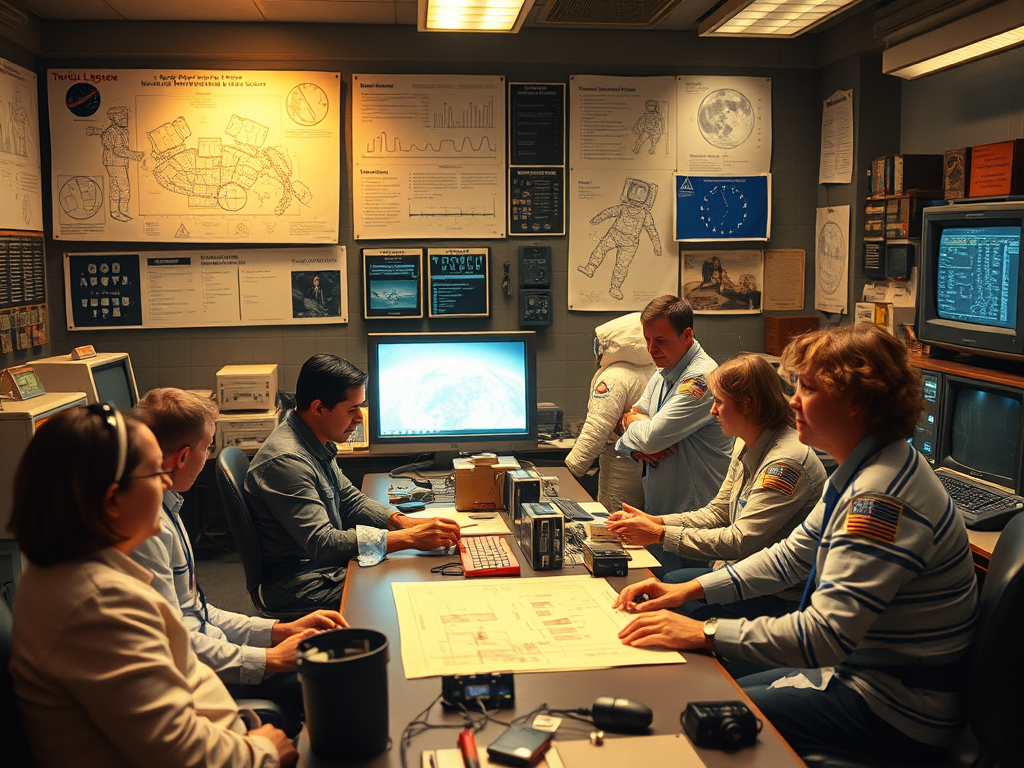
When we think of the Apollo 11 moon landing, the names Neil Armstrong and Buzz Aldrin immediately spring to mind. We envision the heroic astronauts perched atop a Saturn V rocket, venturing into the great unknown. However, the mission to the Moon was not the work of three men alone. It was a monumental achievement fueled by the labor of over 400,000 engineers, mathematicians, seamstresses, and technicians. Behind the scenes, a “hidden army” worked in windowless rooms and high-tech labs to solve problems that had never even been defined.
These unsung heroes of the moon landing were the ones who ensured the computers didn’t crash, the spacesuits didn’t leak, and the trajectory didn’t miss the target by a thousand miles. They operated in an era of slide rules and room-sized computers, often facing immense social barriers along the way. To truly understand how humanity reached the lunar surface, we must look past the grainy television footage and into the stories of the individuals who made the “impossible” possible. Here are the top 10 unsung heroes who put humans on the Moon.
1. Margaret Hamilton: The Architect of Apollo Flight Software
Long before “software engineering” was a recognized profession, Margaret Hamilton was leading the team at MIT that developed the on-board flight software for the Apollo missions. In an era when hardware was king, Hamilton recognized that the code was the “brains” of the operation. She is famously pictured standing next to a stack of printed code as tall as she is—a visual testament to the complexity of the Apollo 11 technology.
Hamilton’s most critical contribution was “priority scheduling.” During the final descent of the Eagle, the computer began to suffer from a buffer overflow, triggering the infamous 1202 alarms. While others might have panicked, Hamilton’s software was designed to recognize that the landing was more important than the background radar tasks. It pushed the less critical data aside, allowing the computer to focus on the landing. Think of her work like a digital air traffic controller; when the runway got busy, she ensured the most important plane landed first. Without her foresight in software pioneer techniques, the first moonwalk might have ended in an abort—or a crash.
2. John Houbolt: The Maverick Who Saved the Mission Strategy
In the early 1960s, NASA was divided on how to get to the Moon. The leading theory was “Direct Ascent”—blasting a massive rocket straight to the lunar surface and back. John Houbolt, an engineer at Langley Research Center, knew this was a logistical nightmare. He championed a radical, “risky” alternative: Lunar Orbit Rendezvous (LOR). This involved sending a small lander down to the surface while a command module stayed in orbit.
Houbolt was initially ignored and even called “crazy” by his superiors. However, he risked his career by circumventing the chain of command, writing a passionate letter to NASA leadership. He argued that LOR was the only way to save weight and meet President Kennedy’s deadline. His persistence eventually won over Wernher von Braun. To visualize this, imagine trying to take your entire house on a camping trip (Direct Ascent) versus driving a car to the site and using a small tent (LOR). Houbolt’s space mission strategy was the “tent” that made the Moon reachable with the technology of the 1960s.
3. JoAnn Morgan: The Lone Woman in the Launch Room
If you look at the photos of the Apollo 11 launch control room, you see a sea of white shirts and dark ties. But if you look closely at the third row, you’ll see one woman: JoAnn Morgan. As the only female engineer in the room for the historic liftoff, Morgan served as the Instrumentation Controller. She was responsible for monitoring the ground support equipment and the “health” of the rocket before it left the pad.
Morgan had to overcome significant institutional hurdles, including a lack of ladies’ restrooms near the control center. Her presence was a breakthrough in NASA gender diversity, proving that technical excellence knows no gender. She was the one watching the “vitals” of the Saturn V, ensuring that every sensor and pressure gauge was green. Her story is a reminder that the NASA workforce was beginning to change, even as it propelled men toward the stars. She stood as a silent pioneer, opening the door for generations of women in aerospace.
4. Tom Kelly: The Father of the Lunar Module
The most unusual-looking vehicle in history—the “Eagle”—was the brainchild of Tom Kelly. An engineer at Grumman Aircraft, Kelly led the team that designed the Lunar Module (LM). Since the LM only operated in the vacuum of space, Kelly realized it didn’t need to be aerodynamic. It didn’t need wings or a sleek nose; it just needed to be light and functional.
Kelly’s design was often referred to as “The Bug” because of its spindly legs and jagged edges. He faced the impossible task of building a pressurized home for two men that weighed as little as possible. Every ounce mattered. His team even used thin layers of Mylar foil that you could poke a finger through to save weight. Think of Kelly as the architect of a “space-faring studio apartment” that had to land on an unknown surface and then blast off again. His Apollo 11 engineering achievements ensured that the “spidery” craft could survive the harshest environment known to man.
5. Frances “Poppy” Northcutt: Navigating the Way Home
While Margaret Hamilton focused on the landing, Frances “Poppy” Northcutt focused on the return. As the first female engineer in NASA’s Mission Control, Northcutt specialized in “return-to-Earth” trajectories. Her job was to calculate the exact engine burns required to sling the astronauts out of lunar orbit and back toward the tiny “corridor” of Earth’s atmosphere.
Northcutt worked in the Real-Time Computer Complex, using math for space travel to solve problems in seconds that would take most people days. Her work was essentially a high-stakes game of orbital billiards. If the angles were off by even a fraction of a degree, the astronauts would either skip off the atmosphere into deep space or burn up upon reentry. Her role in Apollo mission navigation was particularly vital during the Apollo 13 crisis, where her calculations helped bring the stranded crew home safely. She remains an icon of the “Hidden Figures” era who stood in the spotlight of the “trench.”
6. Glynn Lunney: The Ultimate Flight Director
While Gene Kranz is the most famous Flight Director, Glynn Lunney was the man “on the console” during some of the most critical moments of the Apollo program. During Apollo 11, Lunney led the shift that oversaw the lunar ascent—the moment Armstrong and Aldrin blasted off from the Moon to reunite with Michael Collins. If the engine had failed, there was no backup.
Lunney was known for his preternatural calm. He could process streams of data from dozens of controllers and make “Go/No-Go” decisions in heartbeats. His leadership style was like that of a master conductor leading a 400,000-person orchestra. During the Apollo 13 explosion, it was Lunney’s shift that took over immediately after the “problem” was reported. He orchestrated the transition of power from the Command Module to the Lunar Module in record time. His NASA leadership was the glue that held the mission together when the margin of error was zero.
7. Katherine Johnson: The Human Computer of the Space Race
Though now a household name thanks to the book and film Hidden Figures, Katherine Johnson spent most of her career as an unsung NASA mathematician. Long before digital computers were trusted, she was the one who hand-calculated the trajectories for the Mercury and Apollo missions. Her math was so reliable that John Glenn famously refused to fly until “the girl” (Johnson) had personally verified the machine’s numbers.
For the Apollo 11 mission, Johnson’s work on the lunar landing coordinates and the backup return charts was foundational. She mastered the complex geometry required to link a moving spacecraft with a moving moon. Imagine trying to throw a ball at a moving target while you are also riding a merry-go-round; that is the level of complexity Johnson handled with a pencil and paper. Her hidden figures contribution paved the structural path for the entire lunar landing history, proving that human intellect was the original “supercomputer.”
8. Eleanor Foraker: The Woman Who Sewed the Moon Suits
The Apollo spacesuits were not built by traditional aerospace engineers; they were hand-sewn by a team of seamstresses at ILC Dover (then a division of Playtex). Eleanor Foraker led the team of women who stitched together the 21 layers of fabric, rubber, and metal that kept the astronauts alive. This wasn’t standard sewing—one misplaced stitch or a lost pin could lead to a pressure leak and a fatal accident in the vacuum of space.
Foraker and her team had to work with tolerances thinner than a human hair. They used specialized sewing machines to join materials like Teflon and Nomex. To understand the stakes, consider that they were essentially tailoring “personalized spaceships” for each astronaut. There was no room for a “bad day” at the office. These spacesuit seamstresses were the final line of defense against the hostility of space, ensuring that the Apollo 11 astronauts could walk, bend, and breathe on the lunar surface.
9. Dick Koos: The Architect of Survival Simulations
How do you prepare for a situation that has never happened before? You talk to Dick Koos, the “Simulation Supervisor” or SimSup. Koos was responsible for training the astronauts and flight controllers by throwing every possible disaster at them in a simulator. He was the man who came up with the “1202 alarms” scenario in a practice run just weeks before the actual landing.
Koos was often viewed as a “villain” by the controllers because his simulations were so grueling and unfair. He would intentionally break parts of the virtual ship to see how the team responded under pressure. His goal was to build “muscle memory” for crisis management. This NASA astronaut training was the reason why, when the real alarms sounded over the Moon, the team in Houston didn’t freeze—they had already seen it in “Koos’s torture chamber.” He was the invisible coach who ensured the team was ready for the “unthinkable.”
10. Stephen Bales: The 26-Year-Old Who Made the “Go” Call
In the final seconds of the Apollo 11 landing, the weight of the world fell on the shoulders of Stephen Bales, a 26-year-old guidance controller. When the 1202 computer alarms began to flash, it was Bales’s job to tell the Flight Director whether to “Abort” or “Go.” If he hesitated, the mission was over. If he was wrong, the astronauts could crash.
Bales relied on the training he had received from Dick Koos and the software designed by Margaret Hamilton. He recognized that the alarm was a “non-critical” warning and gave the historic “Go” for landing. For his bravery and quick thinking, he was later awarded the Presidential Medal of Freedom alongside the astronauts. Bales represents the youth and audacity of the NASA mission control team—young people in their twenties who were given the keys to the most expensive and dangerous vehicle ever built. His split-second decision is the reason the world heard the words, “The Eagle has landed.”
Further Reading
- Hidden Figures by Margot Lee Shetterly – The phenomenal true story of the Black women mathematicians who helped win the Space Race.
- Apollo: The Race to the Moon by Charles Murray and Catherine Bly Cox – A deep dive into the engineers and administrators who built the program from the ground up.
- Moon Lander: How We Developed the Apollo Lunar Module by Thomas J. Kelly – A first-hand technical account from the lead engineer of the “Eagle” itself.
- Margaret and the Moon by Dean Robbins – An accessible, illustrated look at Margaret Hamilton’s life and her role in coding the moon landing.
Keep the Discovery Going!
Here at Zentara, our mission is to take tricky subjects and unlock them, making knowledge exciting and easy to grasp. But the adventure doesn’t stop at the bottom of this page. We are constantly creating new ways for you to learn, watch, and listen every single day.
Watch & Learn on YouTube
Visual learner? We publish 4 new videos every day, plus breaking news shorts to keep you smarter than the headlines. From deep dives to quick facts, our channel is your daily visual dose of wonder.
Click here to Subscribe to Zentara on YouTube
Listen on the Go on Spotify
Prefer to learn while you move? Tune into the Zentara Podcast! We drop a new episode daily, perfect for your commute, workout, or coffee break. Pop on your headphones and fill your day with fascinating facts.
Click here to Listen on Spotify
Every click, view, and listen helps us keep bringing honest knowledge to everyone. Thanks for exploring with us today—see you out there in the world of discovery!




Leave a Reply