
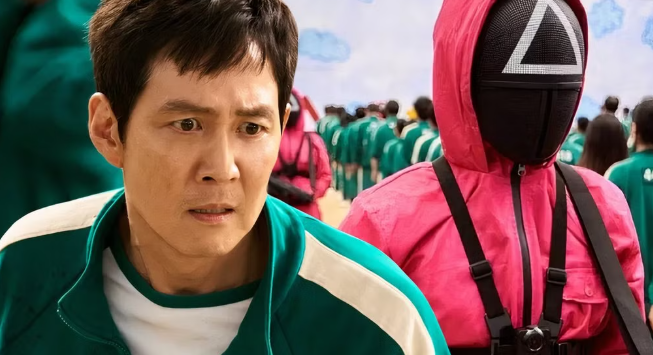
The image is etched into the collective consciousness: hundreds of desperate individuals in emerald-green tracksuits, standing in a sterile, brightly lit arena, facing a giant mechanical doll. The premise is deceptively simple: play a series of childhood games to win a life-changing fortune. The catch is lethal: lose the game, and you lose your life. Squid Game is not just a television series; it is a visceral, bone-chilling exploration of the human condition under the crushing weight of debt and social inequality.
What began as a localized story about South Korean struggle exploded into a global phenomenon, transcending language barriers and cultural divides. It tapped into a universal anxiety regarding modern capitalism and the lengths to which a person will go when pushed to the absolute brink. However, beneath the surface-level violence and the iconic aesthetic lies a treasure trove of hidden meanings, production hurdles, and psychological depth. To truly understand the “Game,” one must look at the intentionality behind every frame. This guide reveals the ten most essential truths about the series that changed the landscape of survival fiction forever.
1. The Decade-Long Struggle of a Visionary Creator
The path to creating one of the most-watched stories in history was anything but easy for writer and director Hwang Dong-hyuk. The concept for the series was first conceived nearly a decade before it ever graced a screen. At the time, Hwang was struggling financially, much like the characters in his story. Legend has it that he was forced to stop writing the script at one point and sell his laptop for several hundred dollars just to make ends meet.
During this long period of rejection, potential studios and actors turned him down, citing that the premise was “too grotesque” and “unrealistic.” However, as the gap between the wealthy and the impoverished widened across the globe, the script transitioned from being a “bizarre fantasy” to a “painfully relatable reality.” This struggle for production is essential to the story’s soul; the desperation felt by the protagonist, Seong Gi-hun, is a direct reflection of the creator’s own period of hardship. When the story finally reached the public, its themes of survival were not just theoretical—they were born from a decade of perseverance and a deep understanding of what it feels like to be at the bottom of the social ladder.
2. The Hierarchy of Shapes: Circles, Triangles, and Squares
One of the most striking visual elements of the series is the masked guards, whose faces are covered by screens featuring a single geometric shape. While they may look like something out of a futuristic video game, the shapes represent a rigid, ant-like social hierarchy. Each shape dictates a specific role and level of authority within the facility, ensuring that the machine of the game runs with absolute, cold efficiency.
The Circles are the workers; they are the lowest rung of the ladder, responsible for clearing bodies, preparing meals, and performing manual labor. They are not permitted to speak unless spoken to by a superior. The Triangles are the soldiers; they are the enforcers who carry weapons and maintain order through the threat of lethal force. Finally, the Squares are the managers; they oversee the other two groups, communicate with the Front Man, and ensure the games proceed according to the rules. This system serves as a haunting analogy for the modern corporate and social structures where individuals are reduced to their “function” rather than their humanity. By stripping the guards of their names and faces and replacing them with geometry, the game emphasizes that in this system, everyone—even the enforcers—is a replaceable part of a larger, indifferent engine.
3. Young-hee: The Heritage Behind the Giant Doll
The “Red Light, Green Light” doll, with her spinning head and motion-tracking eyes, became the immediate symbol of the series’ terror. Named Young-hee, the doll is not a random invention of the horror genre; she is actually based on a classic character from Korean textbooks used in the 1970s and 80s. In those books, Young-hee and her male counterpart, Cheol-su, were the “everyman” children who taught students about friendship and school life.
By taking a figure associated with childhood innocence and education and turning her into a harbinger of death, the series utilizes a psychological trope known as “the uncanny.” The juxtaposition of a friendly, familiar face with the cold, mechanical scanning of human targets creates a jarring sense of dread. Interestingly, the doll used in the production was not a digital effect; it was a physical, ten-foot-tall statue. After filming concluded, the doll was returned to a horse carriage museum in Jincheon County, where it remains a silent, towering reminder of the game’s lethal stakes. For viewers, Young-hee represents the corruption of childhood nostalgia, signifying that the “playground” of the past has been weaponized by the predators of the present.
4. Visual Language: The Meaning Behind the Colors
Color theory plays a massive role in the storytelling of the series. The most prominent colors are the teal-green of the players’ tracksuits and the hot-pink (or “reddish-pink”) of the guards’ jumpsuits. Director Hwang Dong-hyuk chose these colors specifically for their psychological impact and their relationship to one another on the color wheel. The green tracksuits are a reference to the “Saemaul Undong” (New Village Movement) uniforms from the 1970s, which were intended to symbolize progress and hard work in Korea.
Conversely, the pinkish-red of the guards represents a direct threat. In nature, bright reds often serve as “aposematism”—a warning signal to predators that a creature is dangerous or toxic. By placing these two colors against one another, the series creates a visual tension that never lets the viewer rest. Furthermore, the bright, pastel colors of the hallways and staircases were designed to mimic a children’s playground or a dollhouse. This “fairytale” aesthetic makes the dark, bloody reality of the games even more disturbing. It suggests that the elites who watch the games view the players as nothing more than playthings in a brightly colored toy box, further dehumanizing the participants.
5. The Foreshadowing Hidden in Plain Sight
One of the most brilliant aspects of the show’s writing is its use of foreshadowing, much of which is missed on a first viewing. From the very beginning, the dorm room where the players sleep is covered in large, elaborate murals. Initially, these murals are hidden by the massive stacks of beds that house the 456 participants. However, as the number of players dwindles and the beds are removed, the walls are slowly revealed.
These murals actually depict every single game that will be played throughout the competition. If the players had stopped to look at their surroundings rather than focusing on their internal conflicts and survival, they would have known exactly what challenges were coming next. This serves as a metaphor for how people in desperate situations often miss the “big picture” because they are too consumed by immediate survival. Additionally, many of the main characters’ deaths are foreshadowed by their actions in the “real world” during the brief period they were released from the game. For example, a character who threatens to jump off a bridge later meets their end by falling from a high height. This fatalistic approach to storytelling suggests that for these individuals, their fates were sealed by their circumstances long before they ever stepped back into the arena.
6. Practical Sets vs. Digital Effects
In an era where most large-scale productions rely heavily on Green Screen and CGI, the creators of this series made the bold decision to build massive, practical sets. The most famous example is the “Maze Stairs”—the Escher-inspired, multi-colored staircases that the players and guards walk through to reach the arenas. The set was constructed to be fully functional, with multiple levels and intricate paths, forcing the actors to actually navigate the confusing geometry.
The scale of the sets was intended to evoke a sense of “diminishment.” By making the environments physically huge, the actors felt smaller and more vulnerable, which translated into more authentic performances. Even the “Red Light, Green Light” field was a massive open space that could actually hold hundreds of extras. This commitment to physical space adds a layer of “weight” to the series that digital effects often lack. When you see 456 people in a room, you are seeing a real, crowded space, which heightens the claustrophobia and the subsequent emptiness as the crowd thins out. This practical approach ensures that the “Game” feels like a real, tangible location, making the horror feel grounded in physical reality rather than digital fantasy.
7. The Inspiration: Manhwa and Survival Literature
While the series is a unique cultural product of Korea, its roots can be traced to the creator’s love for survival-themed manga and manhwa. During his period of financial hardship, Hwang Dong-hyuk spent significant time in “comic book cafes,” reading titles like Battle Royale, Liar Game, and Kaiji. These stories often revolve around characters trapped in high-stakes games where their lives or massive debts are on the line.
However, Hwang wanted to differentiate his story by making the games “extremely simple.” In many Japanese survival stories, the games involve complex rules, high-level mathematics, or psychological trickery. In this series, the games are those that a child could understand in five seconds. This simplicity is intentional; it allows the audience to focus on the emotions and the relationships of the characters rather than the mechanics of the puzzle. By using children’s games, the story highlights the irony of “fairness.” The organizers claim the games are fair because everyone follows the same simple rules, yet the inherent inequality of the players’ skills and physical conditions proves that “fairness” is a myth designed by those at the top.
8. Character Names and Their Deeper Meanings
Names in Korean culture often carry significant weight, and the characters in the series are no exception. The protagonist, Seong Gi-hun, has a name that can be interpreted as “the foundation of success” or “meritorious,” which is ironic given his status as a “failure” in the eyes of society. His name suggests a hidden potential for greatness that is only unlocked when he is forced into an extreme situation.
The character Kang Sae-byeok, the North Korean defector, has a name that translates to “dawn.” This is deeply symbolic of her character’s journey; she is looking for a new beginning, a light at the end of the dark tunnel of her life. Dawn represents hope, but it is also a fleeting, fragile time of day. Similarly, the elderly Oh Il-nam has a name that literally translates to “First Man.” This is a massive hint toward his true identity as the creator and “first” participant of the games. For Korean-speaking audiences, these names provided subtle layers of characterization and foreshadowing that added to the richness of the viewing experience. It shows that even at the level of individual identity, the series was designed with surgical precision.
9. The Psychological Horror of the “Dalgona” Challenge
The “Dalgona” or Honeycomb challenge—where players must perfectly carve a shape out of a brittle sugar disc—became one of the most replicated real-life challenges. However, for the actors on set, it was a genuine test of nerves. The sugar discs used during filming were real, and the production team had a “professional Dalgona maker” on set every day to ensure the props were consistent and realistic.
The tension in that scene worked so well because the actors were genuinely worried about breaking the fragile candy under the hot studio lights. The “honeycomb” game is a perfect analogy for the series’ view of social pressure. One small slip, one moment of trembling hands, and everything shatters. The “trick” discovered by Gi-hun—licking the back of the candy to melt the sugar—was based on the director’s own childhood memories of trying to beat the local street vendors who sold the treats. It grounds the life-or-death stakes in a tactile, sensory memory that almost everyone can relate to, turning a simple snack into a source of heart-pounding anxiety.
10. The Critique of Modern Capitalist Structures
At its heart, the “Game” is a microcosm of the global capitalist system. The “Front Man” and the “VIPs” represent the elite 1% who watch the struggle of the masses for entertainment. The players are told that the game is a “meritocracy”—that as long as they follow the rules and play hard, they can win. This mirrors the “Pull yourself up by your bootstraps” narrative often sold to those in poverty.
However, the series consistently shows that the game is rigged. Whether it’s the glass bridge where the odds are mathematically impossible for the first players, or the marble game where friendship is weaponized, the “fairness” of the game is a lie. The ultimate horror of the series isn’t the violence; it’s the realization that for many of the players, the world inside the game—where they at least have a slim chance at wealth—is preferable to the world outside the game, where they are doomed to a slow, crushing death by debt. This social commentary is what makes the series evergreen. It isn’t just about a specific time or place; it is about the universal human struggle for dignity in a system that values profit over people.
Further Reading
To further explore the themes of survival, social stratification, and the “death game” genre, these books are essential:
- Battle Royale by Koushun Takami
- The Hunger Games by Suzanne Collins
- The Long Walk by Stephen King (writing as Richard Bachman)
- The Trial by Franz Kafka (for themes of bureaucratic and social nightmare)
- Capital in the Twenty-First Century by Thomas Piketty (for a non-fiction look at the wealth gap themes)




Leave a Reply