
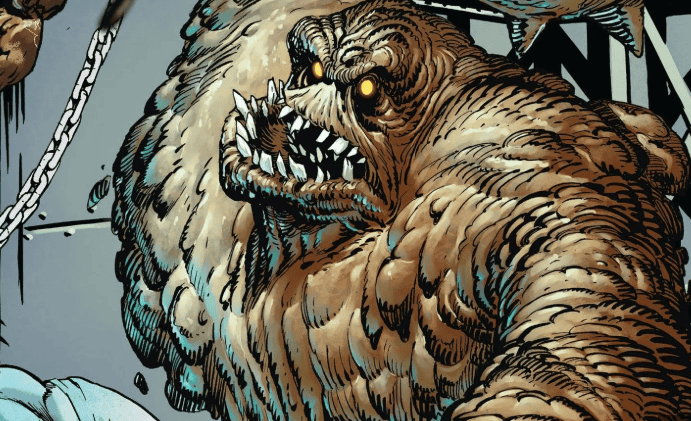
In the dark, rain-slicked alleys of Gotham City, the shadows often hide monsters. Some are mere men with broken minds, while others are literal nightmares birthed from science and tragedy. Among the most formidable of Batman’s rogues gallery is Clayface—a name that has been claimed by several individuals, each bringing a unique brand of horror to the Caped Crusader’s life. Unlike the Joker’s chaotic whimsy or the Penguin’s calculated greed, Clayface represents a profound loss of identity. He is a living, breathing mass of protoplasm, capable of becoming anyone yet fated to be no one.
Whether you know him from the classic animated series or the gritty pages of the comics, Clayface is a masterclass in the “tragic villain” archetype. He is a character defined by the desperate desire to be “normal” again, even as he uses his monstrous abilities to tear Gotham apart. To understand Clayface is to understand the fragile nature of the human ego and the terrifying potential of a body that refuses to stay in one shape. Here are the ten essential things you need to know about the mud-bound menace of DC Comics.
1. The Original Clayface was a Golden Age Horror Star
Long before the character became a literal mud monster, the original Clayface, Basil Karlo, was a purely human threat. Introduced in the 1940s, Karlo was a once-great B-movie horror actor who was driven to madness when he learned that his classic film, The Dreadful, was being remade without him. Adopting the persona of the film’s villain, Clayface, he began a murderous rampage on the set.
In this early iteration, Karlo had no superpowers. He relied on his theatrical training and a gruesome clay mask to terrorize his victims. He was a tribute to the “Phantom of the Opera” style of villainy—a man obsessed with his own lost glory and willing to kill to protect his legacy. It wasn’t until much later in comic history that Karlo would eventually gain the shapeshifting powers that define the character today. This origin is crucial because it establishes the core of the character: he is an actor first, and a monster second. His flair for the dramatic and his ability to inhabit a role remain his most dangerous psychological traits, even when his body is made of mud.
2. The Supernatural Shift of Matt Hagen
The version of Clayface most fans are familiar with—the massive, hulking mud-creature—actually began with the second man to bear the name, Matt Hagen. While exploring a cave, Hagen stumbled upon a mysterious, glowing pool of protoplasm. Upon submerging himself, he discovered he could reshape his body into any form imaginable, from a perfect human double to a sharp-edged weapon or a giant tidal wave of muck.
Unlike Basil Karlo’s psychological horror, Hagen’s era introduced the high-concept science fiction elements that made Clayface a powerhouse. However, this power came with a catch: the effects were temporary. Originally, Hagen had to return to the protoplasm pool every 48 hours to “recharge” his abilities. This created a frantic, desperate rhythm to his crimes, as he was constantly racing against the clock before his body reverted to its human state. This version of the character moved Clayface from the realm of “slasher villain” to a “biological anomaly,” forcing Batman to use his intellect and chemistry kits rather than just his fists to win the day.
3. The Gruesome Genetic Curse of Preston Payne
Perhaps the most tragic figure in the Clayface lineage is Preston Payne, the third individual to take the mantle. An employee at S.T.A.R. Labs suffering from a debilitating pituitary disorder, Payne attempted to cure himself by using a sample of Matt Hagen’s blood. While the experiment worked initially, it quickly spiraled into a Cronenberg-style body horror nightmare. Payne’s flesh began to melt, and he discovered that his touch caused others to dissolve into a puddle of organic “clay” as well.
To prevent himself from melting away entirely and to contain his lethal touch, Payne had to wear a specialized exoskeleton suit. He lived in a state of perpetual agony, both physical and mental. His story is one of isolation; he was a man who literally could not touch another human being without killing them. This iteration of Clayface emphasized the “curse” aspect of the powers. He wasn’t a criminal looking for a payday; he was a dying man looking for a way to stop the pain. His descent into madness was fueled by a desperate need for intimacy that his own biology had rendered impossible.
4. The Creation of the Infamous “Mud Pack”
One of the most fascinating eras in Clayface history occurred when the various individuals who had held the name decided to join forces. Known as the Mud Pack, this group included Basil Karlo, Preston Payne, and Sondra Fuller (also known as Lady Clay). By pooling their resources and unique abilities, they created a collective threat that nearly overwhelmed the Dark Knight.
This storyline was pivotal because it allowed Basil Karlo to reclaim his throne as the “true” Clayface. During the events of the Mud Pack’s formation, Karlo injected himself with samples from the other Clayfaces, gaining their abilities permanently. He transformed from a man in a mask into the ultimate version of the monster—one who possessed the shapeshifting of Hagen, the lethal touch of Payne, and the power-mimicry of Fuller. The Mud Pack demonstrated that while these villains are formidable alone, their shared trauma and obsession with identity make them a terrifyingly cohesive unit when they have a common goal: the destruction of Batman.
5. More Than Just a Disguise: Perfect Mimicry
What makes Clayface a “Tier 1” threat in Gotham isn’t just his physical strength; it’s his ability to commit the ultimate identity theft. Modern iterations of the character, particularly Basil Karlo, can mimic a person’s appearance down to the finest detail. This includes fingerprints, retinal patterns, and even DNA samples. If Clayface decides to replace a high-ranking city official, there is almost no biological test that can prove he is an impostor.
This level of mimicry turns every encounter into a psychological thriller. Batman cannot trust his allies, his technology, or even his own eyes when Clayface is on the loose. The villain has famously impersonated Bruce Wayne, Commissioner Gordon, and even various members of the Justice League. This power forces the stories to focus on “tells”—subtle personality quirks or memories that the monster can’t quite replicate. It elevates Clayface from a mere “brick” character to a master of espionage and sabotage, making him one of the few villains who can dismantle Batman’s life from the inside out.
6. The Fatal Weakness: Water and Temperature
Despite his near-omnipotence as a shapeshifter, Clayface is bound by the laws of chemistry and physics. Because his body is composed of a specialized organic mud, his greatest weaknesses are environmental. Water is his most frequent undoing; if he is doused in enough liquid, his molecular structure begins to lose its cohesion. He becomes too “thin” to maintain a solid shape, often washing away into the sewers or becoming a harmless puddle.
Conversely, extreme cold is equally effective. Freezing Clayface turns him into a brittle, immobile statue of hardened earth. Batman often utilizes “cryo-pellets” or liquid nitrogen to neutralize him without causing permanent harm. There are also specialized chemical “solvents” developed by Bat-tech that can break down the bonding agents in his protoplasm. These weaknesses serve as a constant reminder that for all his power, Clayface is ultimately a biological specimen—a creature of substance that can be manipulated, diluted, or solidified by anyone with a basic understanding of science.
7. The Tragic “Redemption” of Basil Karlo
In some of the most compelling narratives in DC history, Basil Karlo has attempted to turn his life around. Recognizing that he is a victim of his own monstrous nature, he has occasionally sought redemption by working alongside Batman. During one such period, he was recruited into a team of Gotham heroes, where he used his powers to create a training simulator known as “The Mudroom.”
This arc highlights the inherent pathos of the character. Karlo didn’t want to be a monster; he wanted to be the hero he always played on the silver screen. However, the tragedy of Clayface is that his mind is often as unstable as his body. The constant shifting of forms leads to “identity drift,” where he begins to lose the core of who he actually is. His struggle to remain a “good man” while literally having no solid foundation to stand on is one of the most heartbreaking explorations of mental health and self-image in comic book literature. It suggests that for Clayface, the greatest battle isn’t with Batman, but with his own melting sense of self.
8. The Nightmare of Lady Clay and the Next Generation
The Clayface legacy isn’t limited to men. Sondra Fuller, also known as Lady Clay, was a strike force agent who underwent a procedure to gain shapeshifting powers. Unlike some of her predecessors, she could mimic the actual superpowers of the heroes she imitated, making her an incredibly dangerous combatant. Her inclusion in the lore expanded the scope of what a “Clayface” could be—not just a monster of the week, but a tactical weapon.
The horror of the lineage continued with Cassius “Clay” Payne, the son of Preston Payne and Sondra Fuller. Born with the curse in his DNA, Cassius was a “pure” Clayface who didn’t need chemicals or pools to maintain his state. If a piece of him was separated from his main body, it could grow into a sentient, independent organism. This concept of “biological multiplication” turned the Clayface threat into a potential viral outbreak, proving that the more the “clay” spreads through the DC Universe, the more difficult it becomes to ever truly contain the threat.
9. A Brain Made of Mud: The Psychological Toll
One of the most overlooked aspects of Clayface is how he actually thinks. Because his entire body is malleable, his brain is not a static organ. His memories and personality are distributed throughout his protoplasmic mass. This is why he can survive decapitation or being blown to bits—as long as a sufficient amount of his “mud” remains, his consciousness survives.
However, this biological structure has a devastating effect on his sanity. Every time he shifts his shape to become someone else, he has to rearrange his “neurons” to fit the new form. Over decades of shifting, his original personality has become “smeared.” He suffers from severe dissociative identity disorder, often forgetting his own name or his original face. This makes him an unpredictable wild card; he can be a sophisticated actor one moment and a mindless, raging beast the next. He is a man who has quite literally lost his mind in the most physical way possible.
10. The Ultimate Symbol of Failed Ambition
At his core, every version of Clayface is a warning about the dangers of unchecked ambition and the desire for perfection. Basil Karlo wanted to be the greatest actor; Matt Hagen wanted power; Preston Payne wanted health. All of them traded their humanity for a shortcut to their goals, only to find that the “mud” they gained was a prison.
Clayface stands as a dark mirror to Batman. While Bruce Wayne uses masks to protect his identity and serve a higher purpose, Clayface uses masks because he no longer has an identity of his own. He is the ultimate “unfinished man,” forever trying to mold himself into something meaningful but always falling back into a pile of dirt. This existential dread is what keeps the character evergreen. As long as people struggle with their self-image and the fear of being forgotten, Clayface will remain one of the most relevant and terrifying figures in the DC pantheon.
Further Reading
- Batman: Arkham – Clayface by Various Authors
- Batman: Detective Comics Vol. 1: Rise of the Batmen by James Tynion IV
- Mud Pack (Detective Comics #604-607) by Alan Grant
- Batman: The Animated Series – “Feat of Clay” (Screenplay/Episode)
- DC Comics: 10 Essential Things to Know About Shazam
- DC Comics: 10 Essential Things to Know About Sinestro
- DC Comics: 10 Essential Things to Know About The Reverse Flash
- DC Comics: 10 Essential Things to Know About Hal Jordan
- DC Comics: 10 Essential Things to Know About The Green Lanterns
- DC Comics: 10 Essential Things to Know About Mr Freeze
- 10 Defining Chapters in the History of DC Comics Explained
- DC Comics: 10 Essential Things to Know About Poison Ivy
- DC Comics: 10 Essential Things to Know About Bane
- DC Comics: 10 Essential Things to Know About Two-Face



