
For more than half a century, one name has remained synonymous with international intrigue, high-octane action, and peak sophistication: James Bond. What began as a series of novels by a former intelligence officer has blossomed into the most enduring and successful film franchise in cinematic history. To understand Bond is to understand the evolution of the modern blockbuster. The series has survived the Cold War, the rise of the internet, and numerous shifts in cultural sensibilities, always managing to reinvent itself while keeping its core DNA intact.
Whether you are a newcomer to the “007” universe or a seasoned veteran of the Secret Intelligence Service, there is a complex architecture behind these films that goes far beyond fast cars and shaken martinis. From the legal battles that birthed “unofficial” movies to the family-run production house that guards the legacy with ferocity, the story behind the camera is often as dramatic as the one on screen. This guide provides a comprehensive overview of the essential pillars that support the James Bond mythos, exploring why this character remains an evergreen icon of global pop culture.
1. The Literary Architect: Ian Fleming’s Real-World Inspiration
Before he was a cinematic giant, James Bond was the brainchild of Ian Fleming, a man whose real-life exploits in naval intelligence during a major global conflict informed every page of his prose. Fleming wrote the first novel at his Jamaican estate, “GoldenEye,” seeking a “brief, unromantic, Anglo-Saxon and yet very masculine name.” He found it on the cover of a field guide titled Birds of the West Indies, written by an American ornithologist named James Bond. To Fleming, the name was the perfect “dull” mask for a man who performed extraordinary, often brutal, tasks in the shadows.
The literary Bond was a far more melancholic and internal character than his early film counterparts. Fleming described him as resembling the singer Hoagy Carmichael, but with a “cruel” mouth and “cold” eyes. Interestingly, the films and books eventually merged; after seeing the success of the first movie, Fleming was so impressed by the lead actor’s performance that he gave the literary Bond a Scottish heritage in the later novels. This synergy between the author’s vision and the screen’s interpretation created a character with deep roots in reality but a reach that touched the heights of fantasy.
2. Eon Productions: The Family-Run Spy Empire
While most major franchises are managed by revolving doors of corporate executives, the James Bond series is uniquely a “family business.” Eon Productions, founded by Albert R. “Cubby” Broccoli and Harry Saltzman, has been the primary custodian of the character since the early 1960s. After Saltzman sold his shares, the Broccoli family—specifically Cubby, and later his daughter Barbara Broccoli and stepson Michael G. Wilson—became the sole creative force. This familial control is the secret to the franchise’s remarkable consistency and its resistance to the “reboot” trends that plague other series.
The Broccolis are known for their meticulous care in choosing directors, writers, and especially the lead actors. They view themselves as the keepers of a sacred flame, often making decisions based on the long-term health of the character rather than short-term box office gains. This has resulted in a “Bond family” atmosphere behind the scenes, with many crew members, from cinematographers to production designers, returning for decades. This continuity is why a Bond film feels like a “Bond film,” regardless of which actor is wearing the tuxedo or which decade the movie is released in.
3. The Seven Faces of 007: A Masterclass in Reinvention
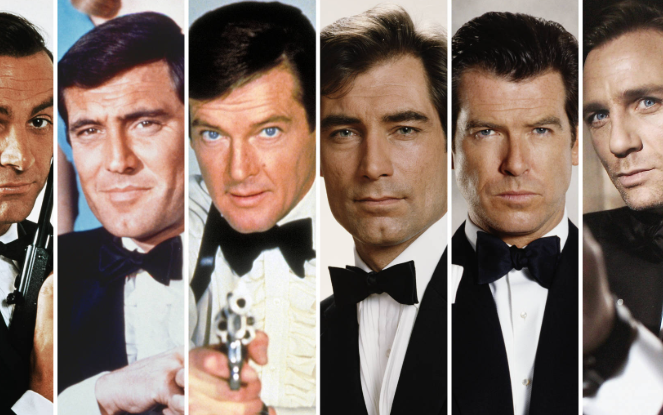
Six actors have officially donned the mantle of 007 for Eon Productions, each bringing a distinct flavor that reflected the era in which they served. The first actor established the archetype—a mix of rugged masculinity and effortless charm. His successor offered a more vulnerable, tragic take in a single, highly-regarded outing. The third actor moved the franchise into a lighter, more “gadget-heavy” and humorous direction, while the fourth returned to the “darker” roots of the novels, playing Bond as a professional assassin burdened by his duty.
The fifth actor bridged the gap between the classic and modern eras, blending high-tech action with a return to the suave persona. Finally, the sixth official Bond introduced a “rebooted” timeline, portraying the agent as a “blunt instrument” whose emotional scars were as prominent as his physical ones. Beyond the official six, a seventh actor played the role in a non-Eon production, adding to the character’s complex cinematic history. This ability to change the face of the protagonist without losing the audience is perhaps the franchise’s greatest achievement, ensuring that James Bond remains relevant to every new generation.
4. From “Eye Candy” to Equals: The Evolution of Bond Women
The role of women in the Bond universe is one of its most discussed and evolving elements. In the early films, female characters often fit the “damsel in distress” or “femme fatale” archetypes, frequently given suggestive names that reflected the era’s sensibilities. However, even in the beginning, characters like the pilot Pussy Galore proved that women could be more than just set dressing. As the series progressed, the “Bond Girl” evolved into the “Bond Woman”—an intellectual and physical equal who often saved the spy as much as he saved her.
Key turning points include the introduction of high-level Soviet agents who shared Bond’s professional skills, and later, computer programmers and nuclear physicists who were essential to the mission’s success. The ultimate evolution came when the character of Vesper Lynd was introduced, serving not just as a romantic interest but as the emotional catalyst for Bond’s entire career. By the modern era, the franchise began to interrogate its own history of chauvinism, placing Bond under the command of female superiors and featuring female agents who were just as lethal as 007 himself, proving the franchise’s capacity for growth.
5. Masterminds and Henchmen: The Architecture of Evil
A hero is only as good as his villain, and the Bond franchise has produced some of the most iconic antagonists in history. The recurring threat often comes from “SPECTRE” (Special Executive for Counter-intelligence, Terrorism, Revenge, and Extortion), a global criminal syndicate led by the calculating Ernst Stavro Blofeld. These villains are typically defined by their grandiosity—possessing private islands, volcano lairs, and schemes that threaten global stability. They represent the “dark mirror” of Bond: men (and occasionally women) of immense resources who use them for chaos rather than order.
Equally important are the henchmen, the physical threats that Bond must overcome before reaching the mastermind. Characters like the metal-toothed giant Jaws or the hat-throwing Oddjob became cultural icons in their own right. The villains are often motivated by more than just money; they are driven by revenge, ideology, or a nihilistic desire to reshape the world. This tradition of the “larger-than-life” villain allows the films to function as modern-day myths, where a singular hero must descend into the underworld to slay a dragon that threatens the entire kingdom.
6. Q Branch: The Art of the Cinematic Gadget
The “gadget” is a staple of the Bond formula, representing the intersection of espionage and cutting-edge technology. Most of these inventions come from the fictional “Q Branch,” the research and development wing of MI6. The most legendary gadget is undoubtedly the modified silver Aston Martin DB5, which first appeared with revolving license plates, a smoke screen, and an ejector seat. This car became the template for every Bond vehicle to follow, from a Lotus Esprit that transformed into a submarine to a BMW that could be driven by a remote-control phone.
The brilliance of the gadgets lies in their “foreshadowing” nature. In almost every film, Q presents Bond with a series of seemingly mundane items—a fountain pen, a watch, or a briefcase—that later become life-saving tools during the climax. This creates a “Chekhov’s Gun” effect that delights the audience. While some gadgets became increasingly far-fetched (such as an “invisible” car), the most successful ones were those that felt like a slightly more advanced version of real-world technology, fueling the public’s fascination with the secret world of spies.
7. The Visual and Sonic Trademark: Gun Barrels and Anthems
You can recognize a James Bond film within seconds, thanks to a highly codified set of visual and auditory motifs. The “Gun Barrel Sequence,” created by Maurice Binder, is perhaps the most famous opening in cinema: Bond walks across a stylized barrel, turns, and fires, as blood (or a red filter) washes down the screen. This is almost always accompanied by the “James Bond Theme,” a surf-rock-inspired piece composed by Monty Norman and orchestrated by John Barry that captures the character’s danger and cool.
Each film also features a bespoke “Title Song,” a tradition that has become a prestigious milestone for any musical artist. From the powerful vocals of Shirley Bassey to the modern anthems of Adele and other contemporary stars, these songs set the mood for the adventure to follow. These elements, combined with the “pre-title sequence” (a high-action mini-movie that precedes the credits), create a sense of ritual. For the audience, these trademarks are more than just branding; they are the familiar signals that we have once again entered the high-stakes world of 007.
8. Global Jet-Setting: The World as a Backdrop
Long before global travel was accessible to the masses, James Bond was the world’s most famous tourist. The films are known for their spectacular locations, taking the audience from the white sands of Jamaica and the underwater caves of the Bahamas to the snowy peaks of the Swiss Alps and the bustling bazaars of Istanbul. These settings are not just window dressing; they are integral to the plot, providing unique terrains for the franchise’s legendary chase sequences.
Filming on location became a hallmark of the series, often requiring the production to build massive sets in remote areas. For example, a secret base might be constructed inside a hollowed-out volcano in Japan, or a high-speed boat chase might weave through the canals of Venice. This “travelogue” quality gave the early films a sense of wonder and exoticism that defined the “Bond style.” Even as the world became more interconnected, the franchise continued to find hidden corners of the globe—from the rugged highlands of Scotland to the ancient cities of Italy—ensuring that every mission felt like a truly international event.
9. M, Q, and Moneypenny: The MI6 Family
Bond may be a “lone wolf,” but he is supported by a recurring cast of characters who provide the emotional and professional framework for his missions. “M,” the head of the Secret Intelligence Service, serves as a stern father (or mother) figure who often views Bond as a “blunt instrument” to be aimed at the nation’s enemies. The long-running portrayal by a specific actor for over a decade cemented the idea of M as the moral anchor of the agency. Similarly, “Q” provides the technical wizardry and much of the franchise’s dry humor, with one actor famously playing the role in 17 films over nearly 40 years.
Then there is Miss Moneypenny, the secretary to M whose flirtatious banter with Bond suggests a mutual affection that is never quite realized. These characters represent the “home” that Bond is constantly protecting. The briefing scenes in M’s office and the technical demonstrations in Q’s lab are the quiet moments before the storm, providing a sense of grounding and workplace camaraderie that makes the character of Bond more human. They remind the audience that behind the hero is a vast, dedicated organization working tirelessly for “Queen and Country.”
10. The Legal Shadow: Thunderball and the “Unofficial” Bonds
One of the most fascinating aspects of Bond history is the legal drama surrounding the novel Thunderball. Due to a dispute over a screenplay that predated the novel, an independent producer named Kevin McClory gained certain rights to the story, the character of Blofeld, and the organization SPECTRE. This led to a unique situation where McClory was allowed to produce his own “unofficial” James Bond movie in the 1980s, which actually featured the return of the very first Bond actor to the role.
This legal battle had a profound impact on the “official” Eon series. For many years, the production was legally barred from using Blofeld or SPECTRE, forcing them to create new villains and organizations to take their place. It wasn’t until the 21st century that these legal issues were fully resolved, allowing the “official” franchise to bring back its most iconic antagonist. This complex history also includes a 1960s spoof film and an early American television adaptation, serving as a reminder that the world of James Bond is even larger and more litigious than it appears on the surface.
Further Reading
- The Man with the Golden Touch: How The Bond Films Conquered the World by Sinclair McKay
- Bond On Bond: Reflections On 50 Years Of James Bond Movies by Roger Moore
- For My Eyes Only – Directing the James Bond Films by John Glen
- The James Bond Bedside Companion by Raymond Benson
- The Battle for Bond by Robert Sellers
- Podcast Episode: Classic Films And Horror Icons
- 10 The Exorcist III (1990) Movie Facts You Didn’t Know
- 10 Scream (1996) Movie Facts That Changed Horror
- 10 The Lion King (1994) Facts That Made It Iconic – Classic Movie
- 10 Forrest Gump (1994) Facts That Make It Timeless – Classic Movie
- 10 Fight Club (1999) Facts That Still Surprise Fans – Classic Movie
- 10 Hostel (2005) Movie Facts That Shocked Viewers
- 10 Avatar (2009) Facts That Changed Cinema – Classic Movie
- 10 Hellraiser (1987) Movie Facts That Built Its Legacy
- 10 Jurassic Park (1993) Facts That Changed Movies Forever – Classic Movie



