
The flicker of a match in a dark cellar, the rhythmic clapping of unseen hands, and the cold chill of a presence that shouldn’t be there—these are the sensations that define The Conjuring movie franchise. Since its inception, this series has done more than just provide jump scares; it has constructed a vast, interconnected mythology that rivals the most complex superhero universes. At the center of this storm are Ed and Lorraine Warren, a real-life couple whose case files have become the foundation for a billion-dollar cinematic empire. The franchise has mastered the art of “prestige horror,” blending high-end cinematography with a deep, emotional focus on family and faith.
Understanding the “Conjuring-verse” requires looking past the surface-level scares to the intricate web of lore, historical inspiration, and technical craftsmanship that keeps audiences returning to the theater. Whether it’s the origins of a possessed doll or the theological implications of a demonic nun, the franchise offers a rich tapestry for fans to unravel. As a cornerstone of modern supernatural cinema, it serves as an introductory resource for the “haunted house” subgenre, showing how old-school tension can be revitalized for a contemporary audience. To truly grasp the scope of this haunting saga, one must venture into the shadows and explore the secrets hidden within the Warrens’ most dangerous case files.
1. The Architectural Blueprint of a Shared Horror Universe
The Conjuring movie franchise is credited with a major milestone in cinematic history: it successfully created the first cohesive, multi-billion-dollar shared universe in the horror genre. While other franchises had sequels and prequels, this series utilized a “hub and spoke” model. The core films serve as the “hub,” focusing on the primary adventures of the Warrens, while spin-off films like Annabelle and The Nun act as the “spokes,” expanding on individual entities introduced in the main entries. This structure allows the universe to grow horizontally, exploring different time periods and sub-genres of horror—from Gothic abbey terrors to suburban domestic hauntings—without losing its central identity.
This architectural approach changed how studios view horror properties. Instead of simply making The Conjuring 2, the creators saw the potential in a background character like the “Lipstick-Face Demon” equivalent in their own world—Valak. By planting seeds in one movie that bloom into full narratives in another, the franchise maintains a consistent “lore” that rewards fans for paying attention to small details. This interconnectedness makes the universe feel lived-in and ancient, suggesting that for every ghost the Warrens exorcise, there are dozens of other tragedies waiting in the wings to be explored in their own dedicated features.
2. Ed and Lorraine Warren: The Emotional Core of the Franchise
At the heart of every film in the core series is the relationship between Ed and Lorraine Warren, portrayed by Patrick Wilson and Vera Farmiga. Unlike many horror protagonists who are disposable “victims,” the Warrens are depicted as a deeply devoted, competent, and compassionate couple. This emotional anchoring is vital to the franchise’s success. The movies aren’t just about the monsters; they are about the bond between a husband and wife who risk their souls to protect others. This focus on “family-centric horror” makes the high stakes feel personal, as audiences aren’t just rooting for the survival of a random family, but for the safety of the Warrens themselves.
The characters are based on real-life paranormal investigators who rose to prominence in the mid-to-late 20th century. By portraying Ed as a “demonologist” and Lorraine as a “clairvoyant,” the films create a “supernatural detective” dynamic. They bring a professional, almost clinical approach to the hauntings, which provides a sense of structure to the chaos. Even when the films venture into the most fantastical territory, the grounded performances of Farmiga and Wilson keep the narrative tethered to a human reality. Their love story provides a “light” that makes the surrounding darkness feel even more oppressive, ensuring the franchise has a soul beneath its terrifying exterior.
3. The Artifact Room: A Vault of Cursed Curiosities
One of the most iconic locations in the entire franchise is the Warrens’ Artifact Room—a locked basement filled with possessed objects collected from their various cases. This room serves as a narrative goldmine, acting as a “museum of evil” where every item has a story. From the haunted samurai armor to a twisted music box and, of course, the infamous Annabelle doll, the room is a physical manifestation of the Warrens’ history. It functions as a recurring setting that reminds the audience of the sheer volume of spiritual threats the couple has faced, effectively acting as a “rogues’ gallery” for the universe.
The Artifact Room is more than just a cool set; it’s a brilliant marketing and storytelling tool. By showcasing various objects in the background of a scene, the filmmakers can gauge audience interest and potentially launch new spin-offs. It also reinforces the rules of the universe: some evil cannot be destroyed, only contained. The room is protected by a series of religious blessings and rituals, emphasizing the precarious balance between the physical and spiritual worlds. When an object “escapes” or is disturbed, it creates an immediate sense of dread because the audience knows that the contents of that room are the “worst of the worst,” concentrated in one domestic space.
4. The Real-Life Roots of the Perron and Enfield Hauntings
The primary Conjuring films are famously “based on the true case files of Ed and Lorraine Warren.” While the movies certainly take cinematic liberties for dramatic effect, they draw heavily from real historical events. The first film focuses on the Perron family in Harrisville, Rhode Island, who claimed to be tormented by the spirit of a witch named Bathsheba Sherman. The second film moves across the Atlantic to investigate the “Enfield Poltergeist” in London, one of the most documented cases of paranormal activity in history. These real-world connections add a layer of “true crime” intrigue to the supernatural proceedings.
By grounding the stories in actual dates and locations, the franchise taps into the power of folklore and urban legend. Even skeptics find themselves intrigued by the grainy “real-life” photos and recordings that are often played during the end credits. This “true story” branding distinguishes the franchise from purely fictional horror series. It suggests that the monsters on screen aren’t just figments of a screenwriter’s imagination, but interpretations of experiences had by real people. This blurred line between history and horror is a key ingredient in the franchise’s “evergreen” appeal, as the curiosity surrounding the original cases continues to draw in new generations of viewers.
5. Annabelle: From Raggedy Ann to a Porcelain Nightmare
Perhaps no character in the franchise is more recognizable than Annabelle, the “conduit” doll. In real life, the Annabelle doll was a simple, innocent-looking Raggedy Ann doll. However, for the films, director James Wan and his team redesigned her into a terrifying, slightly-disfigured porcelain doll with a haunting, frozen grin. This change was a masterstroke of visual design; the movie-version of Annabelle is inherently “uncanny,” sitting in the “valley” between human and object. She doesn’t need to move to be scary; her mere presence in a room suggests a sentient malice that is watching and waiting.
In the lore of the franchise, Annabelle is not “possessed” by a spirit in the traditional sense, but is used as a vessel or a “beacon” by a demonic entity seeking a human host. This distinction is important because it means the doll itself isn’t the threat—it’s the “thing” attached to it. The Annabelle spin-off trilogy explored her origins, showing how a father’s grief led to the creation of the cursed object. This expanded history turned what could have been a one-off gimmick into a tragic, multifaceted antagonist. Annabelle has become a modern horror icon on par with Chucky or Pennywise, representing the primal fear of inanimate objects coming to life.
6. Valak and the Subversion of Sacred Imagery
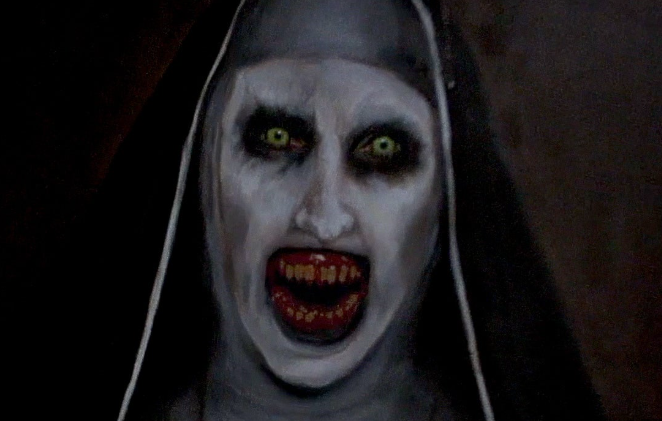
Introduced in the second core film, Valak (popularly known as The Nun) is one of the most visually striking villains in the franchise. Valak is a powerful demon who takes the form of a nun to mock the faith of its victims and to “blend in” within holy environments. This subversion of sacred imagery is a classic horror trope, but the franchise executes it with terrifying precision. The pale, sunken face of the Nun, framed by the traditional black habit, creates a jarring contrast between the “holy” and the “profane.” It plays on the idea that even in the most protected, spiritual places, evil can find a way to manifest.
The character’s popularity led to a dedicated prequel series set in Romania, delving into the demon’s ancient origins and its release during the events of World War II. Valak represents a “higher level” of threat than the typical ghost; it is an intelligent, calculating entity that targets the soul’s vulnerabilities. By making Valak the primary antagonist of Lorraine Warren, the films create a personal rivalry between a woman of faith and a creature that despises it. This theological conflict elevates the scares from simple physical threats to a battle for spiritual salvation, a theme that resonates deeply within the Gothic horror tradition.
7. James Wan’s Signature Style: Tension Over Gore
A defining characteristic of the Conjuring franchise is its reliance on “invisible” horror. While many horror films of the early 21st century focused on “torture porn” and graphic violence, director James Wan took a different path. His style is defined by long, sweeping camera shots, meticulous sound design, and the “slow burn.” He often places the “ghost” in the far background or in a dark corner, never calling direct attention to it, which forces the audience’s eyes to scan the frame in a state of high anxiety. This technique makes the eventual “jump scare” feel earned rather than cheap.
The use of “negative space” is a hallmark of the series. A door slowly creaking open into a pitch-black room is often scarier than a monster jumping out, because it engages the viewer’s imagination. The franchise also excels in “auditory horror”—the sound of a floorboard, a distorted voice on a tape recorder, or the silence that precedes a scream. By focusing on the anticipation of the scare, the films create a psychological tension that lingers long after the credits roll. This commitment to craftsmanship ensures that the movies feel “prestige,” standing out in a genre that is often criticized for being derivative or low-budget.
8. The Non-Linear Timeline: A Narrative Jigsaw Puzzle
One of the most fascinating aspects of the franchise is its timeline. The movies were not released in chronological order, which turned the series into a narrative jigsaw puzzle for fans to assemble. For example, the earliest events in the timeline take place in the 1950s (The Nun), followed by the 1960s (Annabelle: Creation), leading up to the “present-day” cases of the Warrens in the 1970s and 1980s. This non-linear approach allows the writers to “retroactively” explain mysteries from earlier films, creating a sense of “a-ha!” moments for the audience.
This structure keeps the franchise fresh, as it can jump between different decades and aesthetics. One movie might be a 1950s Gothic monastery thriller, while the next is a 1970s suburban haunting. It also allows for clever character crossovers; a minor character mentioned in a 1970s case might turn out to be the protagonist of a 1950s prequel. This “connective tissue” makes the universe feel expansive and meticulously planned. For a new viewer, watching the films in “timeline order” offers a completely different experience than watching them in “release order,” adding a layer of replayability that is rare for horror movies.
9. The Role of Religion and Faith in Combating Evil
Unlike many modern horror films that are cynical or nihilistic, the Conjuring franchise is deeply rooted in a Catholic worldview. Faith is not just a background element; it is the ultimate weapon against the dark. The films treat exorcisms, holy water, and prayer as tangible, effective tools. This gives the movies a “classic” feel, reminiscent of The Exorcist. The Warrens are portrayed as “warriors of God,” and their strength comes directly from their religious convictions. This theological framework provides the “rules” of the universe—evil has names, it has hierarchies, and it can be banished through ritual.
However, the films also explore the “crisis of faith.” Characters often struggle with their beliefs when confronted with overwhelming darkness. This humanizes the religious elements, making them more than just plot devices. The franchise suggests that “belief” is a choice, and that the “will” to believe in something good is what ultimately defeats the “will” of the demonic. This optimistic undercurrent—the idea that good can and will triumph over evil if one has enough courage—is part of why the franchise has such a broad, general-audience appeal. It provides a “safe” way to explore the most terrifying concepts imaginable.
10. The Enduring Cultural Impact of the Highest-Grossing Horror Series
By any metric, the Conjuring franchise is a phenomenon. It currently stands as the highest-grossing horror franchise of all time, outperforming long-running series like Halloween, Friday the 13th, and Saw. Its impact on pop culture is immense, having spawned countless imitators and revitalized the “supernatural investigation” subgenre. It proved that there was a massive global appetite for “classical” horror—stories that rely on atmosphere, character, and lore rather than just blood and guts. The “Conjuring style” has become a shorthand for high-quality, effective filmmaking in the horror community.
Beyond the box office, the franchise has created a “modern mythology.” Characters like Annabelle and The Nun have entered the cultural lexicon, appearing in memes, Halloween costumes, and theme park attractions. The series has also brought renewed interest to the real-life work of the Warrens, sparking debates and documentaries about their legacy. As the universe continues to expand with new chapters and “New Case Files,” its place in cinema history is secure. It is the “gold standard” for how to build a successful, enduring, and genuinely terrifying movie universe in the 21st century, ensuring that the shadows will always have something new to hide.
Further Reading
- The Demonologist: The Extraordinary Career of Ed and Lorraine Warren by Gerald Brittle
- Ghost Hunters: True Stories from the World’s Most Famous Demonologists by Ed Warren and Lorraine Warren
- House of Darkness House of Light: The True Story by Andrea Perron
- The Encyclopedia of Demons and Demonology by Rosemary Ellen Guiley
- 10 The Exorcist III (1990) Movie Facts You Didn’t Know
- 10 Scream (1996) Movie Facts That Changed Horror
- 10 Hostel (2005) Movie Facts That Shocked Viewers
- 10 Hellraiser (1987) Movie Facts That Built Its Legacy
- 10 Candyman (1992) Movie Facts That Still Give Chills
- 10 Essential Facts About The Texas Chainsaw Massacre (1974)
- 10 Essential Facts That Explain the World of The Walking Dead TV Show
- From – Season 1 Full Recap and Spoilers Explained
- 10 Things You Should Know About The Thing (1982) – Movie Facts and Hidden Details
- 10 Fascinating Supernatural Facts You Probably Missed – TV Show Lore



