
From Basements to Blockbusters: 10 Untold Secrets of the Dungeons & Dragons Evolution
Before it was a household name, a blockbuster movie franchise, or the inspiration for hit streaming series, Dungeons & Dragons (D&D) was a collection of loosely organized rules printed in a small, wood-grained box. Born from the minds of two hobbyists in the American Midwest, this game didn’t just create a new genre; it fundamentally altered how humans interact with stories. It moved the narrative from the “top-down” perspective of an author to a “first-person” experience where the players held the pen.
The history of D&D is a saga of creative friction, corporate drama, moral panics, and an eventual cultural renaissance. To understand the game today, one must look back at the tactical wargames that preceded it and the social shifts that allowed it to thrive. Whether you are a seasoned Dungeon Master or a curious observer of pop culture, these ten pillars of D&D history provide a comprehensive overview of how “the world’s greatest roleplaying game” conquered the globe.
1. The Strategic Wargaming DNA of “Chainmail”
The story of D&D begins not with dragons, but with historical miniatures. In the late 1960s and early 1970s, hobbyist gaming was dominated by wargaming—simulations where players moved large armies across terrain maps to recreate famous battles. Gary Gygax, a co-creator of the game, developed a set of rules titled Chainmail. While primarily focused on medieval combat, Chainmail included a small “Fantasy Supplement” that introduced wizards, elves, and a hero-tier unit that could take multiple hits before dying.
This was the “Big Bang” of roleplaying. For the first time, players weren’t just controlling a nameless battalion; they were controlling a single, powerful individual. This shift from the macro to the micro scale allowed for a level of identification with the game pieces that had never been seen before. The “Hero” unit in Chainmail laid the groundwork for what would eventually become the “Player Character.” By injecting Tolkien-esque fantasy into the rigid structures of historical wargaming, Gygax accidentally discovered a formula for immersive storytelling that would soon outgrow the battlefield entirely.
2. The Twin Fathers: Gary Gygax and Dave Arneson
While Gygax provided the tactical framework, it was Dave Arneson who provided the soul of the game. Arneson took the Chainmail rules and applied them to a campaign he called “Blackmoor.” Instead of a flat battlefield, he took his players deep into the dungeons beneath a castle. He introduced the concept of “leveling up”—allowing characters to gain power and experience over time—and the idea of a “referee” (later the Dungeon Master) who described the world rather than just enforcing rules.
The collaboration between Gygax and Arneson was a lightning-in-a-bottle moment, but it was also fraught with tension. Gygax was a master of systems and organization, while Arneson was a master of narrative and improvisational play. When they merged their ideas, Dungeons & Dragons was born. However, their differing philosophies on how much of the game should be “rules” versus “story” would eventually lead to legal battles and a fractured legacy. Despite their later falling out, the synthesis of Gygax’s crunch and Arneson’s fluff remains the bedrock of every RPG played today.
3. The 1974 “Brown Box” and the Birth of an Industry
In 1974, the first version of Dungeons & Dragons was released in a small, hand-assembled wood-grain box (often called the “Original D&D” or OD&D set). It consisted of three booklets: Men & Magic, Monsters & Treasure, and The Underworld & Wilderness Adventures. The initial print run was only 1,000 copies, and the rules were famously opaque, often assuming the reader was already an experienced wargamer who knew how to interpret complex tables.
Despite its DIY aesthetic and confusing instructions, the game was an immediate underground hit. It spread through college campuses and military bases like wildfire. It wasn’t just a game; it was a toolkit for imagination. Early players had to invent their own ways to handle situations the rules didn’t cover, fostering a culture of “homebrewing” that persists to this day. This “Brown Box” era proved that there was a massive, untapped market for collaborative storytelling, leading to the formation of TSR (Tactical Studies Rules), the company that would dominate the hobby for the next two decades.
4. The Great Schism: Basic vs. Advanced D&D
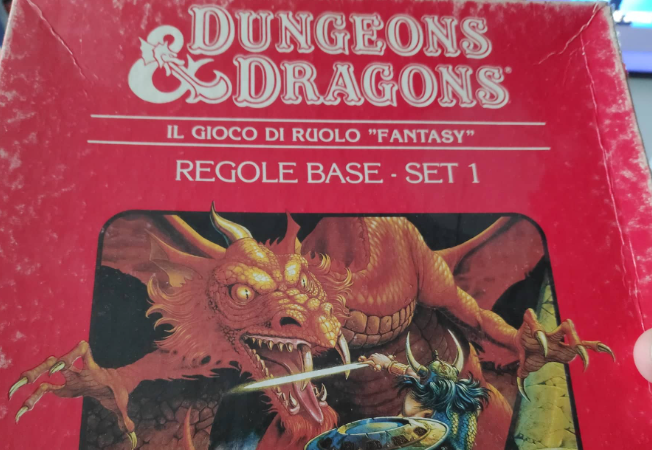
As the game grew, a significant strategic decision was made to split the product into two distinct lines: Dungeons & Dragons (Basic) and Advanced Dungeons & Dragons (AD&D). The “Basic” line, pioneered by J. Eric Holmes and later Tom Moldvay, was designed to be an accessible entry point for newcomers, featuring streamlined rules and a focus on dungeon crawling. AD&D, spearheaded by Gygax, was a massive, three-volume set of hardback books designed for “serious” play with standardized rules for tournament use.
This split was partially a creative choice but also a legal maneuver. By creating a “new” game in AD&D, Gygax sought to distance the product from the original version for which Dave Arneson was still owed significant royalties. For years, these two versions of the game existed side-by-side, often confusing consumers who didn’t know which “version” of the game they were playing. While the “Basic” sets are remembered for their iconic cover art and approachability, AD&D became the definitive version of the game for the 1980s, establishing the “triad” of core books: the Player’s Handbook, the Dungeon Master’s Guide, and the Monster Manual.
5. The Satanic Panic and the Power of Controversy
During the 1980s, D&D became the target of an intense moral panic. Critics, concerned parents, and religious groups claimed the game was a gateway to the occult, witchcraft, and even devil worship. High-profile cases, such as the disappearance of a college student (which was falsely linked to the game) and the publication of sensationalist books and “tracts,” painted D&D as a dangerous influence on the youth.
Paradoxically, this “Satanic Panic” was the best marketing the game could have received. The controversy gave D&D an “edgy” reputation, making it irresistible to teenagers looking for a way to rebel. TSR leaned into the attention, and sales skyrocketed. The game moved from the back of hobby shops to the shelves of mainstream toy stores. While the panic caused genuine stress for many players at the time, it ultimately solidified D&D’s place in the cultural zeitgeist. It proved that the game was powerful enough to scare the establishment, which only added to its mystique and longevity.
6. The Corporate Tragedy and the Fall of TSR
By the late 1980s and early 1990s, the company that started it all, TSR, was in trouble. After Gary Gygax was forced out of the company he co-founded, leadership shifted to Lorraine Williams. While TSR initially saw great success with campaign settings like Dragonlance and Forgotten Realms, the company eventually suffered from over-expansion and poor financial management. They produced too many products for too many niche audiences, diluting their brand and drowning in unsold inventory.
By 1997, TSR was on the verge of bankruptcy. They were unable to pay their printers and were close to disappearing forever. In a dramatic turn of events, Wizards of the Coast—a young company that had become incredibly wealthy through the success of the trading card game Magic: The Gathering—stepped in and purchased TSR. This acquisition saved D&D from extinction. The move moved the headquarters from Wisconsin to Washington state and brought a fresh, “fan-first” perspective to the game’s development, leading to one of the most successful eras in its history.
7. Third Edition and the Open Game License (OGL) Revolution
Under Wizards of the Coast, the game underwent its most radical mechanical overhaul yet: the release of the Third Edition (3e) in 2000. This version introduced the “d20 System,” which unified the game’s mechanics into a single, elegant resolution system: roll a 20-sided die, add your modifiers, and try to beat a target number. Gone were the confusing “THAC0” tables and “negative Armor Class” of previous eras.
Accompanying this was the Open Game License (OGL), a revolutionary legal framework that allowed other companies to use the core D&D rules to create their own products. This led to an explosion of third-party content and ensured that the d20 System became the “industry standard” for roleplaying games. The OGL transformed D&D from a single product into an entire ecosystem. Even if Wizards of the Coast stopped making books, the game could live on through the community. This move effectively ended the competition between different RPG systems by making D&D the foundation upon which almost everyone else built.
8. The “Edition Wars” and the 4th Edition Experiment
The transition from 3.5 Edition to Fourth Edition (4e) is one of the most debated chapters in the game’s history. Released in 2008, 4th Edition was a radical departure from everything that came before. It was designed with a heavy influence from tactical video games and Massively Multiplayer Online (MMO) RPGs. The rules were extremely balanced, focusing on “powers,” “roles” (like tank, healer, or striker), and grid-based tactical combat.
While some players loved the tactical depth and balance, a large portion of the fanbase felt that the “soul” of the game—the roleplaying and the “theatre of the mind”—had been lost in favor of board game mechanics. This led to the “Edition Wars,” a period of intense fragmentation in the community. During this time, a rival game called Pathfinder (built on the 3.5 OGL rules) actually outsold D&D for a period. This era taught the developers a vital lesson: D&D is not just a tactical engine; it is a legacy, and changing it too much can alienate the people who love it most.
9. The Fifth Edition and the Modern Renaissance
Learning from the divisiveness of the 4th Edition, the developers embarked on a massive public playtest called “D&D Next.” The result was Fifth Edition (5e), released in 2014. This version was a “love letter” to every previous era of the game, combining the accessibility of the Basic sets, the flavor of AD&D, and the unified mechanics of the 3rd Edition. It focused on “Bounded Accuracy” to keep the math simple and emphasized storytelling over complex rules-lawyering.
Fifth Edition arrived at the perfect cultural moment. The rise of “geek culture” into the mainstream, combined with the power of social media, allowed the game to reach a wider audience than ever before. It was no longer a game for “nerds in basements”; it was a game for everyone. The rules were light enough for celebrities, actors, and writers to pick up and play, leading to an explosion of “Actual Play” content. This version has become the most popular and commercially successful edition in the history of the franchise, proving that a return to roots was exactly what the hobby needed.
10. The Rise of “Actual Play” and The Critical Role Effect
Perhaps the most significant shift in the modern history of D&D is the move from playing the game to watching it. The “Actual Play” phenomenon—where groups of people stream their gaming sessions for an audience—transformed D&D into a spectator sport. Shows like Critical Role, featuring a cast of professional voice actors, showed the world what high-level, emotionally resonant roleplaying could look like.
This “Critical Role Effect” brought millions of new players into the fold. It humanized the game, showing that it was about friendship, laughter, and shared vulnerability. It also changed the way people play at home; many modern players now prioritize character backstories and “acting” as much as they do combat and loot. D&D has evolved from a private hobby into a global community and a form of performance art. The game has moved beyond the table and into the digital space, ensuring that its history is no longer just written in rulebooks, but in the thousands of hours of stories shared across the internet every day.
Further Reading
- Empire of Imagination: Gary Gygax and the Birth of Dungeons & Dragons by Michael Witwer
- Of Dice and Men: The Story of Dungeons & Dragons and the People Who Play It by David M. Ewalt
- Art & Arcana: A Visual History by Michael Witwer, Kyle Newman, Jon Peterson, and Sam Witwer
- Dungeons & Dreamers: A Story of How Computer Games Created a Global Community by Brad King and John Borland
- 10 Twin Peaks TV SHOW Facts That Still Puzzle Fans
- 10 Poltergeist (1982) Movie Facts That Are Still Creepy
- 10 Hellraiser (1987) Movie Facts That Built Its Legacy
- 10 Essential Facts About Predator (1987) – Movie Facts
- 10 Things You Probably Didn’t Know About The Actor Eddie Murphy
- 10 Things You Should Know About Ferris Bueller’s Day Off (1986) – Movie Facts and Hidden Details
- 10 Things You Should Know About Beverly Hills Cop (1984) – Movie Facts and Hidden Details
- 10 Things You Should Know About Ghostbusters 2 (1989) – Movie Facts and Hidden Details
- 10 Things You Should Know About The Thing (1982) – Movie Facts and Hidden Details
- Stranger Things – Season 5 Full Recap and Spoilers Explained



