Say His Name: 10 Chilling Behind-the-Scenes Secrets of the Original Candyman That Will Haunt Your Dreams
Urban legends are the ghost stories of the modern age—tales whispered in dorm rooms and at sleepovers that transform ordinary spaces into corridors of dread. In the landscape of cinematic horror, few figures loom as large or as elegantly terrifying as the Candyman. Cloaked in a heavy shearling coat with a rusted hook for a hand and a swarm of bees in his wake, he is not a mindless slasher but a tragic, vengeful spirit born of systemic injustice and forbidden love.
The original film adaptation of this legend did more than just provide jump scares; it anchored supernatural horror in the grim reality of socio-economic decay. It explored how the stories we tell about “dangerous” places can manifest a monster far more real than any ghost. However, the true terror of this masterpiece often lies in the production itself. From real-life gang negotiations to the use of live insects and actual hypnosis, the making of this film was a journey into the heart of darkness. To appreciate the craftsmanship of this gothic nightmare, one must look behind the mirror. Here are ten essential facts about the production that prove some legends are better left uncalled.
1. The Honeybee Contract: Tony Todd’s Thousand-Dollar Stings
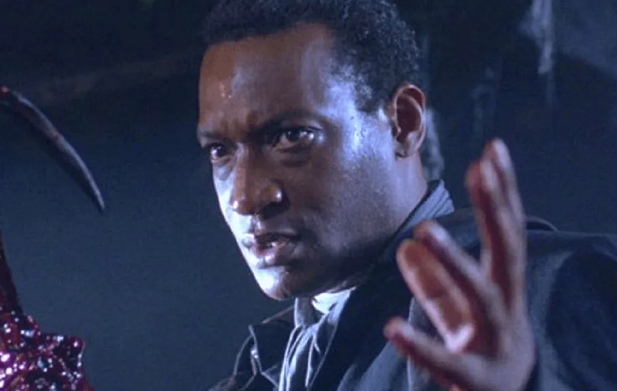
One of the most visceral and unforgettable aspects of the film is the Candyman’s connection to bees. In an era before digital effects could convincingly simulate a swarm, the production relied on the real thing—specifically, over 200,000 live honeybees. The actor portraying the titular spirit, Tony Todd, had to endure scenes where these insects crawled across his face and even inside his mouth. To ensure the safety of the cast, the bees were specifically “newborns,” only a few days old, making them less likely to sting. However, the risk remained significant.
To compensate for the immense physical toll and psychological stress of working with a live swarm, Todd negotiated a brilliant addition to his contract: a $1,000 bonus for every time he was stung during filming. This wasn’t a hypothetical clause. By the time the production wrapped, the actor had been stung 23 times, padding his paycheck with an extra $23,000. Most of the stings occurred during the climax, where the bees were required to cover his chest and face. This commitment to practical effects created a sense of “real” danger that radiates through the screen, as the audience can see the genuine weight and movement of the insects on the actor’s skin.
2. Filming in the Shadows of the Real Cabrini-Green
While many horror films utilize soundstages to recreate dangerous environments, the director insisted on filming at the actual Cabrini-Green public housing projects in Chicago. At the time of production, the area was notorious for its high crime rates and extreme poverty, serving as a stark symbol of urban neglect. This choice lent the film an atmospheric authenticity that no set could replicate. The peeling paint, the narrow hallways, and the looming concrete structures were not props; they were the lived reality of thousands of residents.
The production was so embedded in the local environment that the crew had to enter negotiations with actual gang members for protection and permission to film on the grounds. In exchange for hiring residents as extras and ensuring the production didn’t disrupt the community, the crew was granted safe passage. However, the tension was always present. During one day of filming, a sniper’s bullet actually struck the production’s camera truck, though no one was injured. This proximity to real-world danger heightens the film’s subtext about how society “monstercizes” the marginalized, making the setting as much a character as the Candyman himself.
3. The Hypnosis of Virginia Madsen
To capture the surreal, dreamlike state of the protagonist, Helen Lyle, the director utilized a highly controversial technique: actual hypnosis. Virginia Madsen, the actress playing Helen, was hypnotized on set by a professional before many of her encounters with the Candyman. The goal was to give her eyes a glazed, distant look and to slow her movements, making her appear as if she were in a trance-like state under the legend’s thrall.
Madsen later recalled that the process was exhausting. While under hypnosis, her pupils would dilate, and she became more susceptible to the director’s suggestions, which helped in scenes where she needed to show no fear in the face of a terrifying apparition. However, the actress also noted that the process was “uncomfortable” and left her feeling drained. The result on screen is hauntingly effective; Helen doesn’t react like a typical “scream queen.” Instead, she moves through the film with a somnambulistic grace that makes the audience question what is real and what is a manifestation of her crumbling psyche. This dedication to psychological realism is a key reason why the film feels so distinct from its contemporaries.
4. A Score That Almost Wasn’t: Philip Glass’s Gothic Organ
The atmosphere of the film is inextricably linked to its haunting, operatic score. Composed by the legendary Philip Glass, the music utilizes pipe organs, choral arrangements, and a recurring piano motif that feels both ancient and contemporary. Interestingly, Glass was initially under the impression that he was scoring a “high-art” independent film about social issues and urban legends. When he saw the finished product and realized it was a bloody, visceral horror movie, he was reportedly disappointed, feeling he had been misled about the project’s tone.
Despite the composer’s initial reservations, the score is now considered one of the greatest in horror history. It eschews the typical “stings” and orchestral swells of slasher films in favor of a melancholic, gothic soundscape that emphasizes the Candyman’s origins as a romantic figure. The music elevates the story, transforming it from a simple “slasher” into a modern opera of tragedy and blood. The primary theme, “Music Box,” has since become a staple of the genre, proving that even a composer who was “unhappy” with the genre could create a masterpiece when the visuals and the sound are so perfectly aligned.
5. The Hook and the Ribcage: Practical Effect Mastery
The visual of the Candyman’s hook—a rusted, jagged piece of metal protruding from a bloody stump—is the film’s most iconic image. Creating this effect required a blend of ingenious costume design and prosthetic makeup. The hook was attached to a sleeve that Tony Todd wore, which was then blended into his actual arm using latex and stage blood. Because the character often appears in shadows or through mirrors, the makeup team had to ensure the textures looked realistic under various lighting conditions.
In the film’s most grotesque scene, the Candyman opens his coat to reveal a hollowed-out ribcage filled with a live hive. This was achieved through a prosthetic chest piece worn by Todd. The piece was hollowed out to allow the handlers to place live bees inside the cavity. The actor had to remain perfectly still while the bees swarmed over the prosthetic “ribs.” This commitment to physical prosthetics over early-90s digital technology ensures that the film has not aged. The “weight” of the gore and the tangible nature of the hook make the violence feel permanent and painful in a way that modern computer-generated imagery often fails to capture.
6. From Liverpool to Chicago: The Literary Shift
The film is based on the short story “The Forbidden” by the master of “body horror,” Clive Barker. In Barker’s original text, the story is set in a bleak, working-class housing estate in Liverpool, England. The social themes focused on the British class system and the decay of the “council flats.” However, the director decided to move the setting to Chicago, specifically to explore the American legacy of racial segregation and the “myth of the inner city.”
This change was pivotal. By relocating the story to the United States, the production was able to incorporate the historical trauma of the Jim Crow era and the specific architecture of American poverty. The Candyman’s backstory—which was largely invented for the film—turned him into the son of an enslaved person who became a successful artist before being murdered for a forbidden interracial romance. This added a layer of righteous, historical fury to the character. It transformed a European ghost story into a uniquely American tragedy, grounding the supernatural elements in the very real horrors of racial violence and social exclusion.
7. The Vocal Power of Tony Todd
When casting the role of the Candyman, the director looked for someone with “the presence of a god.” Tony Todd, standing at six-foot-five with a deep, resonant baritone voice, was the perfect fit. Todd’s performance is notable for its stillness and its vocal control. He doesn’t run or scream; he speaks with a seductive, rhythmic cadence that lures his victims in. To enhance the “otherworldly” quality of his voice, the sound designers utilized minimal processing, relying instead on Todd’s natural ability to project a sense of ancient authority.
Todd has stated that he approached the character like a figure from a Shakespearean tragedy rather than a horror villain. He wanted the Candyman to sound lonely and longing, someone who had been “forgotten” and was desperate to be remembered. This vocal performance is what makes the character so terrifying; he isn’t a mindless animal, but a sentient, intelligent being who understands the power of his own legend. His “Say my name” is not a threat, but an invitation to join his myth, delivered with a voice that sounds like it’s vibrating from the bottom of a deep well.
8. The Mirror Ritual: The Creation of a New Myth
The ritual of saying “Candyman” five times into a mirror is so pervasive today that many people believe it is a centuries-old folk tale. However, the specific mechanics of this ritual were largely popularized—and in many ways, defined—by the 1992 film and its source material. While “Bloody Mary” is the older, real-world equivalent, the “Candyman” variation took on a life of its own following the film’s release.
The production team utilized the mirror as a central motif for the entire film. Mirrors represent the threshold between our reality and the “imaginary” space where legends live. To film the scenes where the Candyman appears in the reflection, the crew often used two-way mirrors or “trick” sets where an actor would stand behind a pane of glass. This obsession with the mirror as a portal helped cement the film’s legacy in the real world. For years after the film’s release, audiences reported being unable to look into a mirror in a dark room without thinking of the five-call rule. The film didn’t just depict an urban legend; it successfully created one.
9. Real-Life Inspiration: The Case of Ruthie Mae McCoy
While the Candyman himself is a fictional creation, one of the most terrifying details in the film—the idea that a killer can enter an apartment through the space behind the bathroom mirror—was based on a real-life horror story. In 1987, a woman named Ruthie Mae McCoy was killed in a Chicago public housing project. The attackers entered her apartment by removing the medicine cabinet/mirror in a neighboring, vacant unit and crawling through the shared plumbing chase into her bathroom.
This incident was a well-known “urban legend” within the Chicago housing community that turned out to be tragically true. The director incorporated this “medicine cabinet” entry point into the film to highlight the architectural vulnerability of public housing and the lack of security provided to its residents. For the characters in the movie, the mirror isn’t just a place of superstition; it is a literal physical weakness in their homes. This blending of a real-life murder with a supernatural legend makes the film’s “scares” feel incredibly grounded and deeply disturbing for those familiar with Chicago’s history.
10. The Tragic Artist: The Paintings of Daniel Robitaille
In the film’s lore, the Candyman was once Daniel Robitaille, a gifted painter in the late 19th century who was commissioned to paint the portrait of a wealthy landowner’s daughter. The two fell in love, leading to the brutal lynching that created the Candyman. To emphasize this backstory, the production featured several massive, haunting murals and paintings. Many of these pieces were created specifically for the film to depict the “history” of the legend.
The most famous of these is the mural inside the “forbidden” room in Cabrini-Green, where the Candyman’s mouth is the entrance to a secret lair. These artworks were designed to look like “folk art” that had been added to by generations of residents, showing how the community kept the story alive through visual storytelling. The emphasis on the Candyman as an artist is vital; it suggests that he was a man of beauty and creation before he was turned into a creature of destruction. This aesthetic depth separates the film from typical “slasher” fare, reminding the audience that every monster has a history and that the things we destroy often return to haunt the culture that broke them.
Further Reading
- Clive Barker’s Books of Blood, Vol. 4 (containing “The Forbidden”) by Clive Barker
- The Urban Legend in American Film by Various Authors
- Men, Women, and Chain Saws: Gender in the Modern Horror Film by Carol J. Clover
- Tony Todd: The Man Behind the Hook (Interviews and Biographies) by Various Authors
- 10 Candyman (1992) Movie Facts That Still Give Chills
- 10 Essential Facts About The Texas Chainsaw Massacre (1974)
- 10 Essential Facts That Explain the World of The Walking Dead TV Show
- From – Season 1 Full Recap and Spoilers Explained
- 10 Things You Should Know About The Thing (1982) – Movie Facts and Hidden Details
- 10 Fascinating Supernatural Facts You Probably Missed – TV Show Lore
- 10 Things You Need To Know About History Of Mummy Movies
- 10 Things You Need To Know About The Childs Play Movie Franchise
- 10 Things You Need To Know About The Evil Dead Movie Franchise
- 10 Things You Should Know About The Conjuring Movie Franchise