
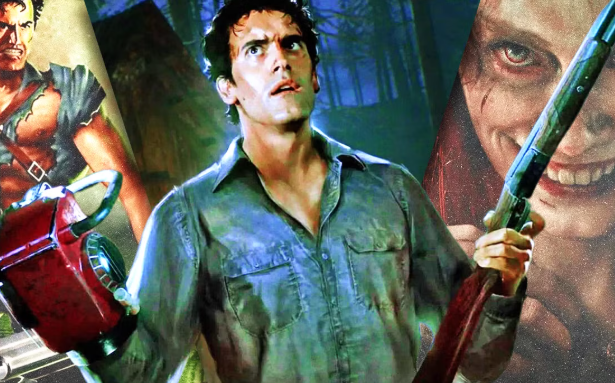
The world of horror is filled with masked slashers and quiet ghosts, but few franchises possess the raw, kinetic energy and unapologetic “splatter” of the Evil Dead series. What started as a low-budget experiment by a group of friends in the woods has transformed into a multi-media empire that redefined the genre. It is a saga of survival, demonic possession, and a chainsaw-wielding hero whose chin is as legendary as his “boomstick.”
Whether you are a newcomer preparing to enter the fruit cellar for the first time or a seasoned Deadite hunter looking to brush up on your lore, understanding the DNA of this franchise is essential. It isn’t just about the scares; it’s about the spirit of independent filmmaking, the evolution of a reluctant hero, and a unique tonal blend of terror and slapstick that has never been successfully duplicated. This article dives deep into the guts of the franchise to provide the ultimate introductory resource for every horror enthusiast.
1. The Legend of the Shoestring Budget DIY Roots
The story of how the first film came to be is almost as harrowing as the movie itself. Before it became a household name, the franchise began with a group of Michigan teenagers led by a young director and his best friend. To secure funding, they filmed a “prototype” short film to show potential investors that they could actually handle the horror genre. The production was a masterclass in grit; the crew filmed in a remote, dilapidated cabin in the Tennessee woods where they faced freezing temperatures and isolation.
Because the budget was so tight, the filmmakers had to invent their own equipment and special effects. They used “fake shemps”—friends and family members who filled in for actors who had left the grueling shoot—to finish the project. This DIY ethos didn’t just save money; it created a raw, claustrophobic atmosphere that modern big-budget productions often struggle to replicate. The success of the original film proved that a creative vision and sheer willpower are more important than a massive studio bankroll, inspiring generations of independent filmmakers to pick up a camera and head into the woods.
2. The Cinematic Metamorphosis of Ash Williams
In the landscape of horror icons, Ashley “Ash” Williams stands alone. While most horror protagonists are “final girls” or one-dimensional victims, Ash undergoes one of the most drastic character arcs in cinematic history. In his first outing, he is a sensitive, soft-spoken young man who is clearly out of his depth. He is terrified, reactive, and barely survives the night. However, as the franchise progresses, the trauma of the Deadites transforms him into a “reluctant hero” who is part action star and part buffoon.
Portrayed with unmatched physical comedy and charisma by a legendary cult actor, Ash eventually becomes the “Chosen One.” He trades his right hand for a modified chainsaw and arms himself with a double-barreled Remington—his famous “boomstick.” This transition from a screaming victim to a quip-ready warrior makes Ash relatable. He isn’t a perfect hero; he is arrogant, occasionally dim-witted, and often responsible for his own problems, yet he always finds a way to stand his ground against the forces of darkness.
3. The Birth of the “Splatstick” Genre
If you’ve ever wondered how a movie can be simultaneously horrifying and hilarious, you’re looking at the birth of “splatstick.” This portmanteau of “splatter” and “slapstick” defines the middle chapters of the franchise. The filmmakers were heavily influenced by the physical comedy of the Three Stooges, and they decided to apply those comedic beats to extreme gore. Imagine a character getting into a wrestling match with his own severed, possessed hand—that is the essence of splatstick.
This tonal shift was revolutionary. It allowed the franchise to lean into the absurdity of its premise. By making the violence over-the-top and cartoonish, the audience is given permission to laugh at the macabre. This doesn’t mean the tension is gone; rather, the laughter acts as a release valve for the intense horror. This unique flavor has influenced countless other horror-comedies, proving that blood and guts don’t always have to be somber—they can be a delivery mechanism for world-class physical comedy.
4. The Lore of the Necronomicon Ex-Mortis
Every great horror franchise needs a “MacGuffin”—an object that drives the plot—and the Necronomicon Ex-Mortis is one of the best. Known as the “Book of the Dead,” this ancient Sumerian text is bound in human skin and inked in blood. It serves as a gateway for the Kandarian Demon to enter our world and possess the living. The book is not merely a prop; it is a character in its own right, often seen “screaming” or biting those who try to handle it.
The lore suggests the book was penned by “The Dark Ones” and contains funerary incantations and demon resurrection passages. Over the course of the franchise, the history of the book has expanded, revealing that there are actually multiple volumes of the text scattered across time and space. This “Three Books” theory explains why different films in the franchise can have slightly different rules or aesthetics while still remaining part of the same connected universe. The book is the ultimate “don’t touch that” warning, a cursed artifact that ensures the evil can never be truly defeated.
5. Kinetic Cinematography and the “Shaky-Cam”
The visual language of the franchise is defined by its “active” camera. The director used a restless, aggressive camera style to simulate the perspective of the “Invisible Force” or the demon hunting the characters. Because they couldn’t afford expensive Steadicams or cranes in the early days, they invented the “Shaky-Cam.” This involved bolting a camera to a long piece of wood and having two people run with it through the forest, creating a frantic, low-to-the-ground POV that felt visceral and terrifying.
This style of cinematography does more than just look cool; it builds a sense of mounting dread. The camera often moves faster than the characters can react, crashing through doors and windows as if the environment itself is trying to consume them. These “Raimi-cams” became a signature of the franchise, emphasizing movement and energy over static shots. Even as the series moved into higher-budget territory, this kinetic energy remained a staple, ensuring that the audience is always kept on the edge of their seat.
6. The “Re-Sequel” and Continuity Confusion
One of the most frequent questions from new fans is why the second film seems to “remake” the first film in its opening minutes. This was born out of a legal necessity rather than a creative choice. Because the filmmakers did not own the distribution rights to the footage of their own first movie, they couldn’t use clips to summarize the story for the sequel. Instead, they decided to re-film a condensed, slightly altered version of the original events to get the audience up to speed.
This created a “loose” continuity that the franchise has embraced ever since. The series values “vibe” and “energy” over rigid chronological accuracy. While the core story of Ash and the cabin remains consistent, the details often shift to suit the needs of the current installment. This flexibility has allowed the franchise to evolve from straight horror into fantasy-adventure and back to urban horror without losing its identity. In the world of the Deadites, the “rules” of reality are as fluid as the blood on the walls.
7. The Secret Star: The “Classic” Oldsmobile Delta 88
While Ash is the human face of the franchise, there is one mechanical star that has appeared in almost every installment: a 1973 Oldsmobile Delta 88, affectionately known as “The Classic.” Originally the real-life car of the director’s father, the vehicle has become a beloved Easter egg for fans. It has been transported back to the Middle Ages, reinforced with steam-powered armor, and even buried in overgrown forests, yet it always finds a way back onto the screen.
The car’s presence is a nod to the franchise’s humble beginnings and a symbol of the creative team’s loyalty to their roots. It has even made cameo appearances in the director’s other non-horror projects, including superhero blockbusters and Westerns. For fans, spotting “The Classic” is a rite of passage, a signal that even as the scale of the movies grows, the heart of the original Michigan filmmaking crew is still behind the wheel.
8. Practical Effects and the Mastery of “Gore as Art”
In an era of digital effects, the franchise remains a bastion of practical “in-camera” wizardry. The series is famous for its use of gallons upon gallons of fake blood, often mixed with various colors—green, black, or even yellow—to bypass censorship or emphasize the inhuman nature of the Deadites. The makeup effects utilize foam latex, stop-motion animation, and intricate puppetry to create monsters that feel physically present and tangibly gross.
This commitment to practical effects creates a different kind of horror. There is a weight and a messiness to the violence that CGI often lacks. Actors frequently discuss the “torture” of being covered in sticky corn syrup for weeks on end, which ironically adds to the frantic, exhausted performances on screen. Whether it’s a decaying hand crawling across the floor or a massive, multi-headed demon, the franchise treats gore as a form of elaborate performance art, pushing the boundaries of what can be achieved with prosthetics and imagination.
9. The Ever-Expanding Universe Beyond the Big Screen
The franchise’s influence extends far beyond the cinema. The story of Ash and the Deadites has been expanded through comic books, where Ash has famously crossed over with other horror icons and even traveled through alternate dimensions. These stories allow the lore to go places a film budget might not permit, exploring the deeper history of “The Dark Ones” and Ash’s destiny as a warrior of light.
Additionally, the franchise has a long history in the world of video games. From early adventure titles on 8-bit systems to modern asymmetrical horror games, the “Evil Dead experience” translates perfectly to gaming. Players can step into Ash’s boots, rev up the chainsaw, and quote iconic one-liners while battling waves of possessed enemies. There was even a successful television series that continued the story of an older, wiser (but no less clumsy) Ash, proving that the appetite for this specific brand of horror-comedy is truly evergreen.
10. The Deadites: A Different Kind of Possession
Unlike the demons in most possession movies, the “Deadites” are remarkably vocal and cruel. They aren’t just mindless monsters; they are psychological tormentors. A Deadite will use the voice of a loved one to lure a victim into a false sense of security before unleashing a barrage of insults and physical violence. They are tricksters who take joy in the “play” of the hunt, often laughing hysterically as they are being dismembered.
This personality makes the Deadites some of the most memorable villains in horror. They represent a chaotic, nihilistic evil that wants to break the spirit as much as the body. The possession is also depicted as a physical infection that can spread through scratches or bites, turning the environment into a minefield where anyone—friend or family—can become a monster in an instant. This unpredictability keeps the tension high, as the “rules” for defeating them often change based on which book of the dead has been opened.
Further Reading
- If Chins Could Kill: Confessions of a B Movie Actor – Bruce Campbell
- The Evil Dead Companion – Bill Warren
- Hail to the Chin: Further Confessions of a B Movie Actor – Bruce Campbell
- The Making of The Evil Dead – Various Contributors
- 10 The Exorcist III (1990) Movie Facts You Didn’t Know
- 10 Scream (1996) Movie Facts That Changed Horror
- 10 Hostel (2005) Movie Facts That Shocked Viewers
- 10 Hellraiser (1987) Movie Facts That Built Its Legacy
- 10 Candyman (1992) Movie Facts That Still Give Chills
- 10 Essential Facts About The Texas Chainsaw Massacre (1974)
- 10 Essential Facts That Explain the World of The Walking Dead TV Show
- From – Season 1 Full Recap and Spoilers Explained
- 10 Things You Should Know About The Thing (1982) – Movie Facts and Hidden Details
- 10 Fascinating Supernatural Facts You Probably Missed – TV Show Lore



