
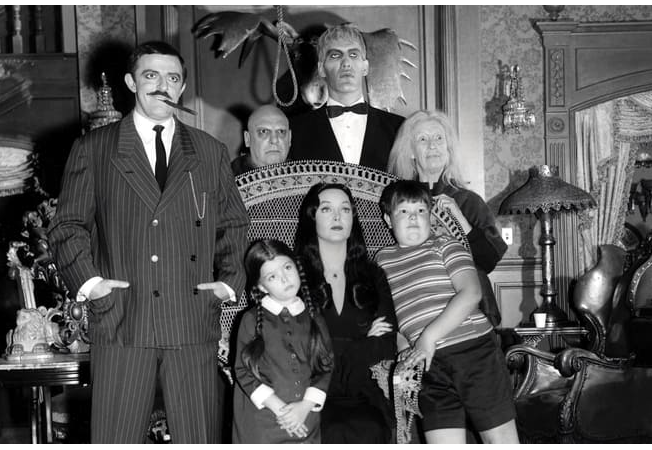
They’re Creepy and They’re Kooky: 10 Surprising Secrets Behind the Original Addams Family TV Show
The Addams Family is more than just a television show; it is a cultural phenomenon that redefined the American sitcom. When the series first flickered onto television screens in the mid-1960s, it introduced audiences to a family that found the macabre magnificent and the terrifying truly tasteful. While most sitcoms of the era were busy portraying the “perfect” suburban life with white picket fences and predictable problems, the Addamses were living in a Victorian mansion filled with carnivorous plants, a disembodied hand, and a butler who looked like Frankenstein’s monster.
To understand the enduring legacy of this show, one must look past the graveyard fog and the gothic aesthetic. At its heart, the series was a brilliant satire of the “American Dream.” The Addams family didn’t realize they were weird; they thought the rest of the world was strange for being so uptight and judgmental. They were wealthy, eccentric, and—most importantly—deeply in love with one another. This foundational irony is what has kept the show evergreen for generations. Whether you are a lifelong fan or a newcomer curious about the origins of Wednesday’s pigtails and Gomez’s fencing skills, these ten essential facts will illuminate the dark corners of 0001 Cemetery Lane.
1. The Morbid Genius of Charles Addams’ Cartoons
Before they were a television dynasty, the Addams Family lived within the ink-splattered pages of The New Yorker. The creator, Charles Addams, was a cartoonist with a penchant for the “happily macabre.” Interestingly, in his original single-panel cartoons, the characters didn’t even have names. They were anonymous archetypes of a wealthy, ghoulish clan. Charles Addams possessed a razor-sharp wit that allowed him to find humor in death, taxes, and the mundane absurdities of life.
When the show was being developed, Addams had to sit down and actually give his creations personalities and monikers. He chose “Gomez” (after considering “Repelli”) and “Morticia” (implying death or a mortician). He envisioned the characters not as villains, but as a family with very different standards of beauty and joy. For example, while a normal person might find a rainy day gloomy, the Addamses would find it perfect for a picnic. This inversion of expectations is the DNA of the entire franchise. Without the specific, dry humor of Charles Addams’ original sketches, the show would have lacked the sophisticated “high-society” edge that separates it from other monster-themed comedies of the time.
2. The Revolutionary Romance of Gomez and Morticia
In the landscape of 1960s television, most married couples were portrayed as polite roommates who occasionally slept in separate twin beds. Gomez and Morticia Addams shattered this trope. Their relationship was—and remains—one of the most passionate and functional marriages in television history. John Astin and Carolyn Jones portrayed a couple that was genuinely, physically, and intellectually obsessed with one another.
Whenever Morticia spoke French (“Cara Mia!”), Gomez would lose all composure, showering her arms with kisses. This display of affection was revolutionary. Unlike their contemporaries who often bickered or lied to one another for the sake of a plot point, the Addamses were a united front. They supported each other’s hobbies, shared a deep mutual respect, and never tried to change one another. For many viewers, they became the ultimate relationship goals: a couple who remained in the “honeymoon phase” for decades, surrounded by the things they loved, completely indifferent to the judgments of their neighbors. This chemistry wasn’t just acting; Astin and Jones worked closely to ensure their bond felt authentic and electric.
3. The “Pink” Reality of the Black-and-White Set
If you were to step onto the set of the 1964 Addams Family show, you might have been shocked by the color palette. Because the show was filmed in black and white, the production designers had to use specific colors that would translate into the right shades of grey on screen. In a bizarre twist that would horrify Morticia, the famous Addams living room was actually filled with shades of bright pink, red, and yellow.
The walls were painted a light pinkish hue because actual dark colors would absorb too much light, making the scene look muddy and indistinguishable. The goal was to create high contrast. By using vibrant, “cheery” colors in the physical space, the cinematographers could achieve that crisp, gothic look that viewers saw on their television sets. This creates a wonderful irony: the most macabre family in history spent their days lounging in a bubblegum-colored mansion. It serves as a reminder of the technical ingenuity required in the early days of television to create an atmosphere that felt lived-in, eerie, and atmospheric.
4. Ted Cassidy’s Surprising Double Duty as Lurch and Thing
The hulking, deep-voiced butler Lurch is one of the most recognizable figures in the show. Played by the 6’9” Ted Cassidy, Lurch was initially intended to be a non-speaking character. However, during the filming of the pilot, Cassidy ad-libbed the line “You rang?” in a booming, resonant bass. The producers loved it so much that Lurch became a speaking character, though his “speech” often consisted of guttural moans that the family understood perfectly.
But Cassidy’s contribution didn’t stop there. He was also the primary “hand” behind Thing. While Thing is often thought of as a separate entity, whenever the disembodied hand appeared in a shot with Lurch, a crew member would take over. However, for most standard shots, it was Cassidy’s own hand reaching out of boxes and vases. This led to some logistical nightmares on set. Cassidy would have to lie on a cart or crouch under tables in awkward positions just to get his arm through the various “Thing-boxes” scattered around the mansion. The fact that the tallest man on set played the smallest character is a testament to the show’s playful, behind-the-scenes spirit.
5. The Mystery of the Addams Family Mansion Address
The Addams house is a character in its own right—a sprawling, museum-like Victorian estate filled with oddities like a stuffed polar bear and a two-headed turtle. Located at 0001 Cemetery Lane, the house was a beacon for the misunderstood. In the show’s universe, the house was tucked away in a fog-shrouded neighborhood, but in reality, the exterior shot used for the show was a real house located on Adams Boulevard in Los Angeles.
The production team added a third floor using a matte painting to make it look more imposing and “haunted.” Interestingly, the actual house used for the exterior was eventually demolished, but its likeness lives on in the hearts of fans. The interior was a masterclass in set design, featuring a mix of genuine antiques and bizarre props. The house wasn’t just a home; it was a sanctuary. The Addamses rarely left their property because everything they could ever want—torture racks, gunpowder, and carnivorous plants—was right there. This reinforced the idea that the family was self-sufficient, a little “island” of weirdness in a sea of conformity.
6. Uncle Fester’s Electric Personality and Confusion
Uncle Fester, played by former child star Jackie Coogan, is perhaps the most visually distinct member of the family with his bald head, sunken eyes, and heavy fur coat. One of Fester’s most famous “party tricks” was his ability to stick a lightbulb in his mouth and turn it on. This wasn’t just a camera trick; the production used a specialized lightbulb with a battery hidden in Coogan’s hand or mouth, though it often required him to bite down on a wire to complete the circuit.
There is often confusion regarding Fester’s place in the family tree. In the original 1964 series, Fester is actually Morticia’s uncle (making him Gomez’s uncle-in-law). In later film adaptations, he was changed to be Gomez’s brother. Regardless of the genealogy, Fester provided the “mad scientist” energy of the household. Coogan brought a manic, joyful vulnerability to the role. Despite his penchant for explosives and electricity, Fester was often the most sensitive member of the family, frequently seeking advice on his love life or feeling “neglected” if no one tried to blow him up that day.
7. The Subversive Style of Carolyn Jones as Morticia
Carolyn Jones didn’t just play Morticia Addams; she embodied her. To achieve Morticia’s signature “willow-of-the-night” silhouette, Jones had to wear a restrictive corset and a skin-tight hobble skirt that made it almost impossible to walk. She developed a rhythmic, gliding gait out of necessity, which only added to the character’s ethereal, ghost-like presence.
Her makeup was also a feat of technical precision. To make her eyes pop on black-and-white film, makeup artists applied a horizontal band of light-colored powder across her eyes, making them appear to glow from within the shadows of her long, raven hair. Morticia was a feminist icon long before the term was mainstream. She was the matriarch who managed the household, cultivated “Cleopatra” (her African Strangler plant), and maintained a rich intellectual life. She was never the “damsel in distress.” If there was a problem, she handled it with a calm, cool elegance that suggested she knew something the rest of the world didn’t.
8. The Catchy Harpsichord Theme and the Iconic Snaps
You cannot think of the Addams Family without hearing the four-note harpsichord riff followed by two sharp finger snaps. The theme song was composed by Vic Mizzy, who also directed the opening sequence. Mizzy wanted something that felt both “stately” and “kooky,” opting for the harpsichord because of its baroque, slightly creepy associations.
The finger snapping was a stroke of genius. It was catchy, interactive, and easy for the audience to mimic. Because the show had a limited budget, Mizzy actually overdubbed his own voice for the “neat,” “sweet,” and “petite” lyrics heard in the song. The opening credits, featuring the cast standing stone-faced while snapping in unison, set the tone perfectly. It told the audience: “This is going to be weird, it’s going to be rhythmic, and you’re invited to join in.” To this day, those two snaps are the universal “secret handshake” for fans of the macabre.
9. The Show’s Clever Use of Exotic “Pets”
The Addamses didn’t have Golden Retrievers or tabby cats. Their menagerie was significantly more dangerous. Their most famous pet was Kitty Kat, a full-grown lion who was apparently terrified of sheep. The family also kept Aristotle the Octopus, Homer the Spider, and Zelda the Vulture.
The use of a real lion on set created some tense moments for the cast and crew, though the animal was well-trained. The presence of these animals served a specific narrative purpose: it showed that the Addamses viewed all of nature—even the predatory parts—with affection and respect. They didn’t see a lion as a threat; they saw it as a “kitty.” This lack of fear is a recurring theme in the show. Whether it was Wednesday playing with her headless doll (Marie Antoinette) or Pugsley playing with blasting caps, the children were raised to be fearless. This was a sharp contrast to the “safety-first” culture of the 1960s, suggesting that perhaps a little danger makes life more interesting.
10. A Legacy of Inclusion and Non-Conformity
While it is categorized as a comedy, the Addams Family was deeply progressive. The family welcomed everyone into their home, from weary travelers to high-strung insurance agents. They never judged others for being “normal,” even though they found normalcy to be quite boring. They were only ever offended when people were rude, dishonest, or unkind.
The show taught a generation of children that it was okay to be different. In the eyes of the Addamses, the “monsters” were the people who tried to force everyone to be the same. By celebrating their own eccentricities, they gave permission to the audience to embrace their own quirks. They were a wealthy family who didn’t care about status, a religious-like family who worshipped the strange, and a loving unit that stood by each other no matter what. The Addams Family proved that you don’t have to fit in to belong, a message that remains as powerful and relevant today as it was when the first snap echoed through the airwaves.
Further Reading
- The Addams Family: An Evilution by H. Kevin Miserocchi
- Chas Addams: A Photographer’s Life by Linda H. Davis
- The World of Chas Addams by Charles Addams
- The Addams Family: The Story of the Show by Stephen Cox
- 10 The Crown TV SHOW Facts That Keep People Watching
- 10 Twin Peaks TV SHOW Facts That Still Puzzle Fans
- 10 Futurama TV SHOW Facts That Still Hold Up
- 10 Poltergeist (1982) Movie Facts That Are Still Creepy
- 10 Things You Should Know About Speedy Gonzales – Looney Tunes
- 10 Things You Should Know About Yosemite Sam – Looney Tunes
- 10 Hellraiser (1987) Movie Facts That Built Its Legacy
- 10 Things You Should Know About Starlight From The Boys TV Show
- 10 Things You Should Know About Road Runner – Looney Tunes
- 10 Things You Should Know About Wile E. Coyote – Looney Tunes



