
The Duality of Doom: 10 Essential Facts About Two-Face Every DC Fan Should Know
In the rain-slicked streets of Gotham City, where the line between hero and villain is often as thin as a razor’s edge, few characters embody the city’s inherent tragedy like Two-Face. While the Joker represents pure chaos and the Penguin represents organized greed, Two-Face—formerly District Attorney Harvey Dent—represents the terrifying fragility of the human soul. He is a cautionary tale of how the “White Knight” of a city can fall into the deepest shadows, transformed not just by a physical scar, but by a psychological schism that splits his very identity in two.
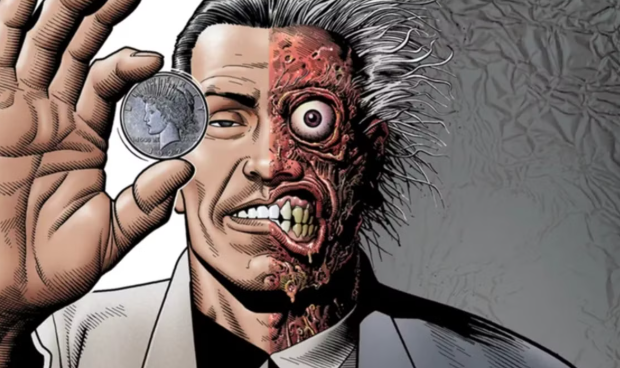
To understand Two-Face is to understand the concept of duality. He is a character defined by the number two: two personalities, a two-headed coin, and a visual design that is literally split down the middle. For decades, he has remained one of Batman’s most personal and heartbreaking adversaries because he wasn’t born a monster; he was forged into one by a single “bad day” and a justice system that failed its most ardent defender. This guide serves as the definitive primer for anyone looking to go beyond the coin flip and delve into the complex, bifurcated world of Harvey Dent.
1. The Tragic Transformation of Gotham’s White Knight
Before he was a scarred criminal mastermind, Harvey Dent was Gotham City’s youngest and most brilliant District Attorney. Known as the “White Knight,” Dent was a beacon of hope in a city drowning in corruption. He was a man of unshakeable integrity who believed that the law could save Gotham. Alongside Batman and Captain James Gordon, Dent formed a triumvirate of justice, working tirelessly to dismantle the organized crime families that held the city in a stranglehold. His charisma and success made him a public icon, providing a legitimate face to the war on crime that Batman fought from the shadows.
However, Dent’s internal world was far more precarious than his public image suggested. Beneath the polished exterior lay a history of repressed trauma and a burgeoning dissociative identity disorder, often attributed to an abusive childhood. The “White Knight” persona was a mask he wore to keep his inner demons at bay. When a courtroom attack by mob boss Sal Maroni left half of his face horribly disfigured with acid, the psychological dam finally broke. The physical trauma served as the catalyst for his repressed rage to manifest as a secondary persona: Two-Face. This transformation remains one of the most poignant falls from grace in comic book history, shifting him from Batman’s greatest ally to one of his most tragic enemies.
2. The Philosophy of the Double-Headed Coin
At the heart of the Two-Face mythos is his iconic silver dollar. This coin, which originally belonged to his abusive father, has two heads, but one side has been violently defaced with deep scratches. To Two-Face, this coin is not just a tool; it is the ultimate arbiter of morality and justice. He believes that the world is inherently unfair and that the only true “pure” justice is found in random chance. He has completely surrendered his free will to the flip of the coin, allowing the 50/50 odds to dictate every major decision he makes, from whether to rob a bank to whether to commit cold-blooded murder.
This reliance on the coin makes Two-Face one of the most unpredictable villains in Batman’s rogues’ gallery. If the coin lands on the clean side, Two-Face might act with the honor and benevolence of Harvey Dent, sometimes even aiding the police or saving a life. If it lands on the scarred side, he is a ruthless engine of destruction. This binary worldview removes the burden of choice from his fractured mind, providing a perverse sense of order to his chaotic existence. For Batman, the coin is a constant source of frustration and opportunity; if he can intercept or switch the coin, he can effectively paralyze Two-Face, who becomes incapable of making even the simplest decision without his mechanical “judge.”
3. The Psychological Depth of Dissociative Identity
Unlike many of Batman’s “themed” villains, Two-Face’s condition is rooted in a complex portrayal of mental illness. He is often depicted as suffering from Dissociative Identity Disorder (DID), with the “Harvey” persona representing his waning morality and the “Two-Face” persona representing his unbridled aggression and nihilism. This internal conflict is a literal tug-of-war for control of his body. In many stories, Harvey is still “in there,” desperately trying to reach out to his former friends, only to be violently suppressed by his darker half. This makes him a sympathetic figure, as he is a prisoner within his own mind.
The duality extends beyond just “good vs. evil.” It reflects the struggle between order and chaos, law and lawlessness. Two-Face’s obsession with pairs—hiring sets of twins as henchmen, planning crimes on the second of the month, or targeting buildings with two addresses—is a manifestation of his psychological need to see the world in binary terms. This rigidity is his greatest strength and his fatal flaw. It allows him to plan with mathematical precision, but it also makes his movements trackable for a detective like Batman. The tragedy of Two-Face is that he can never truly be “whole”; even when his face is surgically repaired, his mind remains split, haunted by the “Big Bad Harv” that lurks in the recesses of his subconscious.
4. The Courtroom Incident: A Catalyst for Chaos
The origin of Two-Face is inextricably linked to the courtroom, symbolizing the moment the law literally blew up in Harvey Dent’s face. During the trial of the notorious mobster Sal “Boss” Maroni, Dent was presenting a key piece of evidence—the very coin he would later use as his trademark. In a desperate act of vengeance, Maroni threw a vial of sulfuric acid (or in some versions, a volatile chemical) at Dent. The resulting burns destroyed the left side of Dent’s face, leaving it a mass of blue or purple scar tissue, often depicted with a bulging eye and exposed teeth.
This incident did more than just scar his skin; it destroyed his faith in the legal system he had spent his life serving. The fact that a criminal could strike him down in the very halls of justice convinced Dent that the law was a sham. He realized that the “rules” didn’t protect the good, and the only “fair” system was one that didn’t care about merit—only luck. This courtroom trauma is why Two-Face often stages his crimes as twisted “trials.” He sees himself as judge, jury, and executioner, using his coin to deliver a verdict that he believes is more honest than anything a human court could provide.
5. The Complicated Friendship with Batman and Bruce Wayne
What sets Two-Face apart from a villain like the Scarecrow or the Riddler is his deep, personal history with Bruce Wayne. Before the scarring, Harvey Dent was one of Bruce Wayne’s few true friends in Gotham. They shared a vision for a cleaner city, and Bruce saw in Harvey the legitimate hero Gotham needed—someone who could do in the sunlight what Batman did in the dark. Bruce’s failure to protect Harvey during the Maroni trial is a source of immense, lingering guilt for the Dark Knight. He doesn’t just see a criminal when he looks at Two-Face; he sees a lost friend and a personal failure.
This relationship adds a layer of emotional stakes to every encounter. Batman often holds back when fighting Two-Face, hoping against hope that he can reach the man Harvey used to be. Conversely, Two-Face’s feelings toward Batman are equally conflicted. Depending on which way the coin lands, he may view Batman as a brother-in-arms or a hypocritical nuisance who refuses to accept the world’s inherent chaos. This “friendship turned to ash” narrative is a recurring theme in Gotham’s history, reinforcing the idea that Batman’s mission is often a battle for the souls of his friends as much as it is a battle for the safety of the city.
6. The Long Halloween and the Modern Origin
While Two-Face has existed since the 1940s, his modern characterization was largely defined by the seminal graphic novel Batman: The Long Halloween. This story reimagined Harvey Dent’s descent into madness as a slow-burn tragedy set against the backdrop of a year-long murder mystery. It emphasized the “trinity” of Batman, Gordon, and Dent, showing how their alliance was slowly eroded by the pressures of the “Holiday” killer and the shifting power dynamics of the Gotham underworld. This version of the story highlighted Dent’s frustration with the slow pace of legal justice, making his eventual turn to vigilantism feel inevitable.
The Long Halloween also introduced the idea that Harvey was already struggling with mental health issues long before the acid hit his face. It portrayed him as a man on the edge, driven to the brink by his obsession with catching the Falcone crime family. By the time he officially becomes Two-Face at the end of the story, it feels less like a sudden change and more like a tragic completion of a transformation that was already underway. This narrative depth has influenced every subsequent iteration of the character, ensuring that Two-Face remains a pillar of the DC Universe’s most acclaimed storytelling.
7. The Binary Wardrobe: A Visual Masterclass
Two-Face possesses one of the most striking visual designs in all of fiction. His wardrobe is a literal representation of his fractured psyche, typically consisting of a “split suit.” One half of the suit is a professional, conservative business attire—the kind of suit a District Attorney would wear. The other half is often loud, garish, or wildly patterned, featuring animal prints, bright colors, or scorched fabric. This visual contrast serves as a constant reminder of his dual nature, making him an instantly recognizable figure in any crowd.
The color of his scarred skin also plays into this visual storytelling. In various eras, his scarred side has been depicted as green, purple, or deep blue, often with a different hair color (usually shock-white) on that side of his head. This isn’t just for shock value; it emphasizes that Two-Face has moved beyond the realm of “normal” humanity. He is a walking contradiction, a man who is half-civilized and half-feral. Even his hideouts reflect this aesthetic, often being divided into two distinct zones—one perfectly ordered and the other completely ransacked or dilapidated. This commitment to the “two” theme makes every frame he appears in a study in artistic balance and contrast.
8. The Impossible Search for a Cure
One of the most recurring themes in Two-Face’s history is the attempt to “fix” him. Because his villainy is so clearly tied to a specific trauma and a physical injury, many stories revolve around Bruce Wayne funding plastic surgery and psychiatric care for Harvey Dent. On several occasions, Harvey’s face has been fully restored to its former handsomeness, and his “Two-Face” persona has been suppressed through intense therapy. For a time, Harvey often returns to the side of the law, even acting as a vigilante protector of Gotham when Batman is absent.
However, these “cures” almost never stick. The tragedy of the character is that the mental scars are far deeper than the physical ones. Even with a perfect face, the “Two-Face” personality remains a lurking shadow, waiting for the right moment of stress or betrayal to resurface. Usually, the return to villainy involves Harvey self-mutilating his face once again, unable to live with the “lie” of a unified identity. This cycle of hope and despair makes Two-Face a unique figure in the rogue’s gallery; he is the villain everyone wants to save, but who seems fundamentally incapable of saving himself.
9. The Number Two: An Obsessive-Compulsive Criminality
Two-Face’s criminal operations are defined by a rigid adherence to the number two. This isn’t just a gimmick; it’s a compulsive necessity for his brain to function. He often plans his heists to involve two distinct locations, two separate getaway vehicles, or a goal that involves the number two (such as stealing two million dollars or targeting the Second National Bank). He surrounds himself with henchmen who are pairs—often literal twins or people with contrasting appearances. This obsession makes his crimes highly stylized and theatrical, fitting perfectly into the “super-criminal” atmosphere of Gotham.
This obsession also extends to his targets. He often seeks out “doubles” in the city—twin landmarks, double agents, or people leading double lives. In some interpretations, his obsession with the number two is a form of coping mechanism; by forcing the world into pairs, he feels he can better navigate his own internal split. However, this predictability is often his undoing. Batman, the world’s greatest detective, can often anticipate Two-Face’s next move by simply looking for the next “two” in the pattern. It creates a fascinating game of cat-and-mouse where the villain’s own psychology provides the clues for his capture.
10. A Power Player in the Gotham Underworld
Despite his mental instability, Two-Face is a formidable and highly effective crime lord. He doesn’t just flip a coin and act randomly; he runs a sophisticated criminal empire. His background as a District Attorney gives him an intimate knowledge of how the police and the courts work, allowing him to stay three steps ahead of the law. He is a brilliant strategist who can organize complex heists and maintain a loyal following of underworld soldiers. Unlike the Joker, who often works alone or kills his own men for a laugh, Two-Face is a respected (and feared) leader who understands the mechanics of power.
Within the hierarchy of Gotham villains, Two-Face is often positioned as a rival to figures like the Penguin or Black Mask. He is a “traditional” mob boss with a super-villain twist. His territory is hard-won and fiercely defended. Even other villains tend to treat Two-Face with a degree of caution; they know that while he might be reasonable one moment, a single flip of a coin can turn him into a relentless, unhinged killer. This duality makes him a permanent fixture in the battle for Gotham’s soul—a man who understands both the majesty of the law and the brutality of the gutter.
Further Reading
- Batman: The Long Halloween by Jeph Loeb and Tim Sale
- The essential modern origin story that explores the “trinity” of Batman, Gordon, and Dent and the fall of the White Knight.
- Batman: Dark Victory by Jeph Loeb and Tim Sale
- The direct sequel to The Long Halloween, focusing on Two-Face’s transition into a full-time crime lord and his rivalry with the old mob.
- Batman: Jekyll & Hyde by Paul Jenkins and Jae Lee
- A deep dive into the psychological warfare between the Harvey Dent and Two-Face personalities.
- Batman: Face the Face by James Robinson
- A fascinating look at Harvey Dent after his face has been repaired and he tries to redeem himself as Gotham’s protector.
- DC Comics: 10 Essential Things to Know About Shazam
- DC Comics: 10 Essential Things to Know About Sinestro
- DC Comics: 10 Essential Things to Know About The Reverse Flash
- DC Comics: 10 Essential Things to Know About Hal Jordan
- DC Comics: 10 Essential Things to Know About The Green Lanterns
- DC Comics: 10 Essential Things to Know About Mr Freeze
- 10 Defining Chapters in the History of DC Comics Explained
- DC Comics: 10 Essential Things to Know About Poison Ivy
- DC Comics: 10 Essential Things to Know About Bane
- DC Comics: 10 Essential Things to Know About Two-Face



