
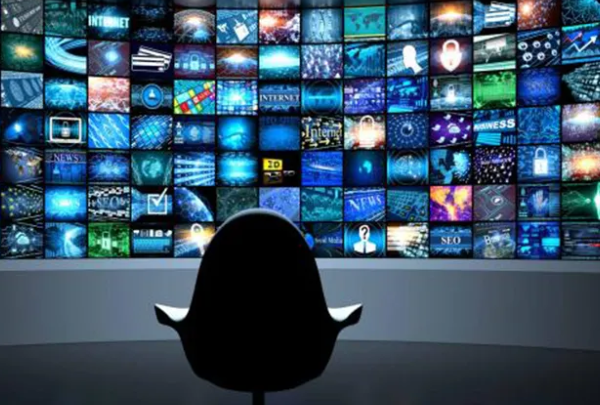
Imagine, for a moment, a world where you had to wait until 6:00 PM to know what happened in your own city, or where missing an episode of your favorite show meant waiting months for a summer rerun. Not long ago, media consumption was a passive, scheduled, and often solitary experience. You were a passenger on a ship steered by massive broadcasting corporations.
Then came the internet.
The digital age didn’t just add a new channel to our televisions; it completely dismantled the old architecture of information. It turned the “one-to-many” broadcast model into a “many-to-many” global conversation. We have moved from a “lean-back” culture—where we sat and accepted what was given—to a “lean-forward” culture, where we hunt, curate, and create. This transformation has touched every corner of human life, from how we discover music to how we participate in democracy.
1. The Death of the Appointment: The Rise of On-Demand Content
The most immediate change the internet brought to media is the total destruction of the “time slot.” In the traditional era, networks dictated your schedule. If a show aired at 8:00 PM on a Thursday, you had to be in front of a screen at 8:00 PM on a Thursday. This created a cultural phenomenon known as “appointment viewing.”
The internet replaced the schedule with the “digital tap.” Like water from a faucet, media now flows whenever we choose to turn it on. Streaming platforms and digital archives allow for binge-watching—a concept that would have been impossible when viewers were forced to wait a week between chapters of a story. This shift has changed storytelling itself; writers no longer need to recap the plot every ten minutes for latecomers, leading to more complex, serialized narratives that reward deep, continuous attention. We are no longer slaves to the clock; we are the masters of our own programming.
2. The Democratization of Creation: Everyone Is a Broadcaster
Before the digital revolution, the “gatekeepers”—studio executives, editors-in-chief, and record label scouts—decided whose voice was worth hearing. The cost of entry was astronomical; you needed a printing press, a radio tower, or a multimillion-dollar film set to reach a mass audience.
The internet lowered those barriers to near zero. Today, a teenager in a bedroom with a smartphone has access to the same distribution networks as a major news organization. This democratization has birthed the “Creator Economy,” where niche experts and charismatic personalities build global followings without ever seeking permission from a corporate entity. While this has led to an explosion of “noise,” it has also allowed for a breathtaking diversity of perspectives. We no longer see the world through a handful of corporate lenses; we see it through millions of individual eyes.
3. From Physical Ownership to Digital Access
There was a time when a person’s status could be measured by the size of their bookshelf or their collection of vinyl records and CDs. Media was a physical artifact—something you bought, stored, and displayed. The internet shifted the entire economic model of media from “ownership” to “access.”
Cloud computing and high-speed data transmission mean we no longer need to own a copy of a movie or a song to enjoy it. Subscription models allow us to rent access to virtually every piece of recorded music or film ever created for a flat monthly fee. This “celestial jukebox” has made media more portable than ever, but it has also changed our relationship with art. When you don’t own the physical disc, you are a temporary tenant of the culture. While we have gained infinite variety and convenience, we have traded away the permanence of the personal library.
4. The Algorithm as the New Cultural Curator
In the past, you discovered new things through “word of mouth,” radio DJs, or physical browsing in a store. You might stumble upon a new band because you liked the album art in a record shop. Today, our discovery is largely mediated by complex algorithms—mathematical formulas designed to predict what we will like based on our past behavior.
These recommendation engines act as personalized curators, filtering the billions of hours of available content into a manageable feed. While this makes finding relevant content incredibly efficient, it creates “filter bubbles.” If an algorithm only shows you what it knows you already like, you are less likely to encounter the challenging, the unexpected, or the contradictory. The internet has made discovery effortless, but it has also made it more insulated, often reinforcing our existing tastes rather than expanding them.
5. The Two-Way Street: Interactive and Social Consumption
Traditional media was a monologue. You watched the movie, read the paper, or listened to the song, and your participation ended there. The internet turned that monologue into a global dialogue. Media consumption is now fundamentally social and interactive.
We don’t just watch a show; we live-tweet it, participate in subreddit theories, and create “reaction videos.” News articles are no longer final statements; they are starting points for heated debates in comment sections. This interactivity has blurred the line between the producer and the consumer—a hybrid role often called the “prosumer.” This change has made media more engaging and communal, but it has also increased the speed at which misinformation can spread, as every consumer is also a potential distributor of unverified claims.
6. The Era of Infinite Choice and the “Long Tail”
In the physical world, shelf space is limited. A bookstore can only hold so many titles; a cinema can only show so many films. This forced media companies to focus on “hits”—content that appealed to the broadest possible audience. This is the “blockbuster” model.
The internet, however, has infinite shelf space. This gave rise to what economists call “The Long Tail.” In a digital marketplace, you can find a community and content for even the most obscure interests—whether it’s 18th-century weaving techniques or competitive underwater basket weaving. The internet has allowed niche cultures to thrive, proving that while any single obscure interest might have a small local following, it has a massive global audience when aggregated online. We have moved from a “one size fits all” culture to a “size for everyone” culture.
7. Hyper-Portability and the “Screen in Your Pocket”
Media used to be tied to a location. You went to the theater for movies, sat in the living room for TV, and stayed at your desk for the computer. The advent of mobile internet and high-performance smartphones has untethered media from geography.
We now consume media in the “interstitial spaces” of life—waiting for a bus, standing in line at the grocery store, or during a lunch break. This hyper-portability has turned every moment of downtime into a potential media consumption window. Consequently, content has become shorter and more “snackable” to fit these brief windows of attention. The “mobile-first” mindset has changed everything from cinematography (using more close-ups for small screens) to journalism (writing headlines that are easily readable on a notification bar).
8. Real-Time Information and the End of the News Cycle
The “news cycle” used to be a predictable 24-hour rhythm. There was the morning paper and the evening news. Events that happened at night were processed and delivered the next day. The internet has compressed this cycle into a state of “permanent now.”
Information now travels at the speed of light. When a major event occurs, the first reports often come from witnesses with smartphones, not professional journalists. While this provides unprecedented transparency and speed, it creates a “rush to be first” that often sacrifices accuracy. The pressure to provide constant updates means that news organizations often report on the reaction to an event before the event itself is even fully understood. We are living in a world of raw, unfiltered data that requires a higher level of media literacy from the consumer than ever before.
9. The Fragmentation of Attention and “Second Screening”
Because the internet provides an infinite stream of stimulation, our attention has become the most valuable commodity on earth. We have moved into the “Attention Economy,” where media platforms compete not just for our money, but for every spare second of our focus.
This has led to the phenomenon of “second screening,” where we browse social media on a phone while simultaneously watching a movie on a television. Our consumption is no longer singular or focused; it is fragmented. This has forced media creators to become more aggressive in their tactics, using “clickbait” headlines, rapid-fire editing, and psychological “hooks” to prevent us from clicking away. The challenge for the modern consumer is no longer finding information, but protecting their ability to focus on it.
10. Global Synchronization and the “Global Village”
Finally, the internet has effectively shrunk the planet. In the past, media was largely regional. You grew up watching the shows and hearing the news of your own country. Cultural trends took months or years to travel across oceans.
Today, a meme created in Tokyo can be viral in New York within hours. A show produced in Seoul can become the most-watched program in London overnight. The internet has created a “Global Village,” where we participate in a synchronized cultural experience. This global connectivity fosters empathy and understanding by exposing us to different cultures, but it also risks a form of “cultural homogenization,” where local traditions and unique regional media are sometimes overshadowed by global digital trends. We are more connected to the rest of the world than at any point in human history.
Further Reading
- The Shallows: What the Internet Is Doing to Our Brains by Nicholas Carr
- The Attention Merchants: The Epic Scramble to Get Inside Our Heads by Tim Wu
- Trust Me, I’m Lying: Confessions of a Media Manipulator by Ryan Holiday
- Everything Bad Is Good for You: How Today’s Popular Culture Is Actually Making Us Smarter by Steven Johnson
- 10 The Crown TV SHOW Facts That Keep People Watching
- 10 Futurama TV SHOW Facts That Still Hold Up
- 10 Things You Should Know About Speedy Gonzales – Looney Tunes
- 10 Things You Should Know About Yosemite Sam – Looney Tunes
- 10 Things You Should Know About Starlight From The Boys TV Show
- 10 Things You Should Know About Road Runner – Looney Tunes
- 10 Things You Should Know About Wile E. Coyote – Looney Tunes
- 10 Things You Should Know About Tweety Pie – Looney Tunes
- 10 Things You Should Know About Sylvester The Cat – Looney Tunes
- 10 Things You Should Know About Porky Pig – Looney Tunes



